
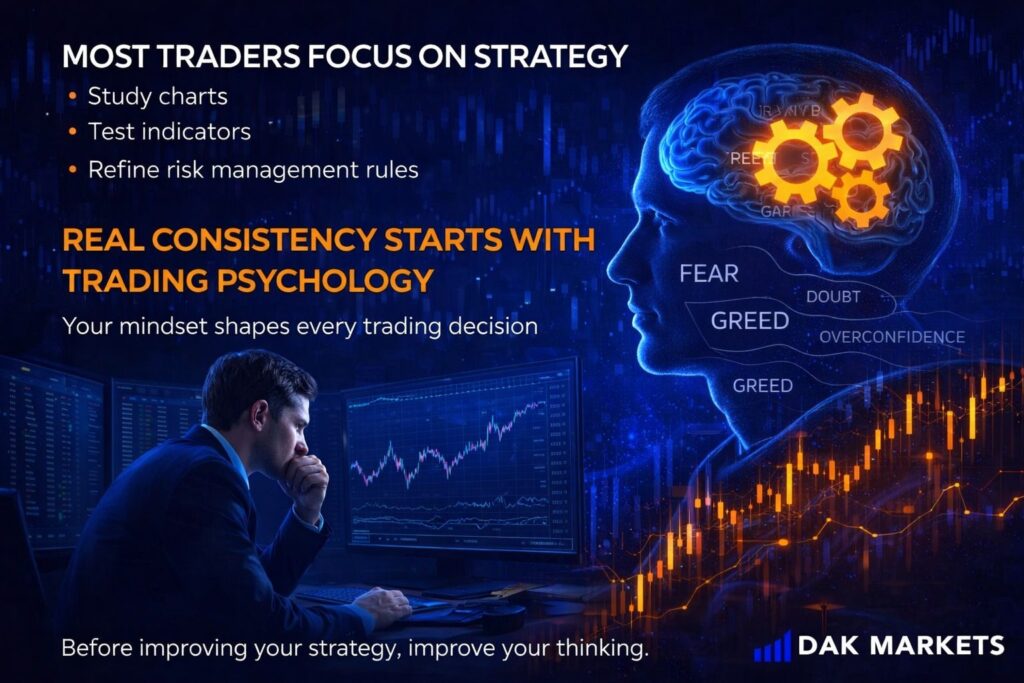
Most traders focus on strategy.
They study charts.
They test indicators.
They refine risk management rules.
Yet many still struggle with consistency.
At DAK Markets, the difference between profitable traders and frustrated ones is rarely technical knowledge. The real edge lies in trading psychology — specifically, the subconscious beliefs driving your decisions.
Your mindset influences every entry, exit, stop-loss adjustment, and emotional reaction. If your internal beliefs conflict with your trading goals, your results will reflect that conflict.
Before improving your strategy, it’s critical to improve your thinking.
What Is Trading Mindset — And Why It Matters?
Many traders focus only on strategies and indicators.
However, trading psychology often determines long-term success.
Without emotional discipline, even the best trading system will fail.
Therefore, developing the right mindset is just as important as technical analysis.
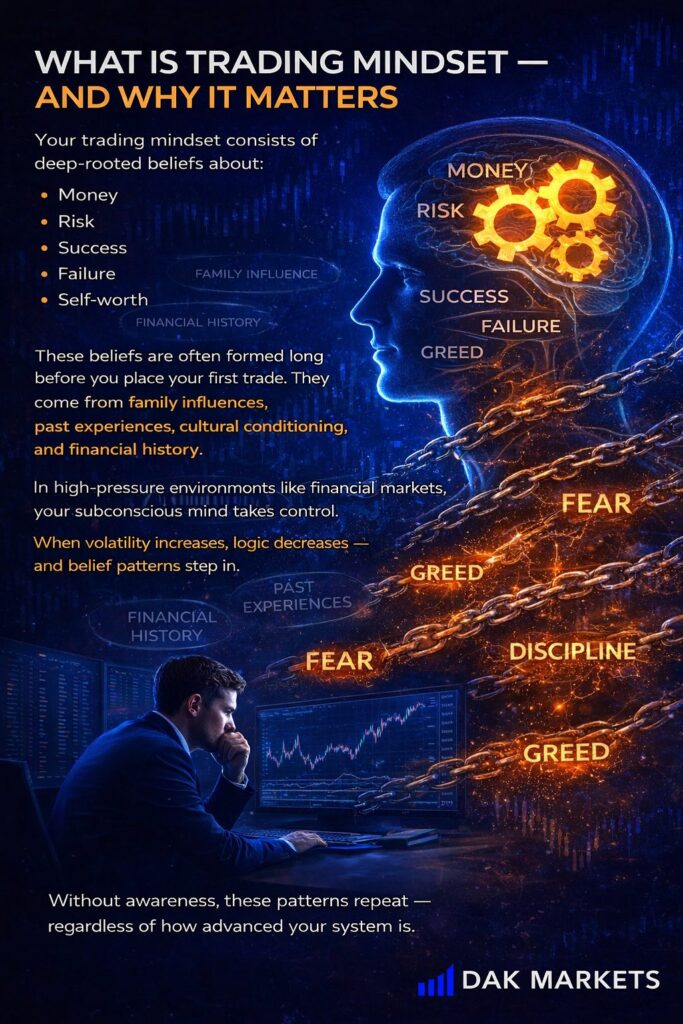
Your trading mindset consists of deep-rooted beliefs about:
- Money
- Risk
- Success
- Failure
- Self-worth
These beliefs are often formed long before you place your first trade. They come from family influences, past experiences, cultural conditioning, and financial history.
In high-pressure environments like financial markets, your subconscious mind takes control. When volatility increases, logic decreases — and belief patterns step in.
For traders at DAK Markets, this means:
- Fear can override risk management
- Greed can override discipline
- Self-doubt can override strategy
Without awareness, these patterns repeat — regardless of how advanced your system is.
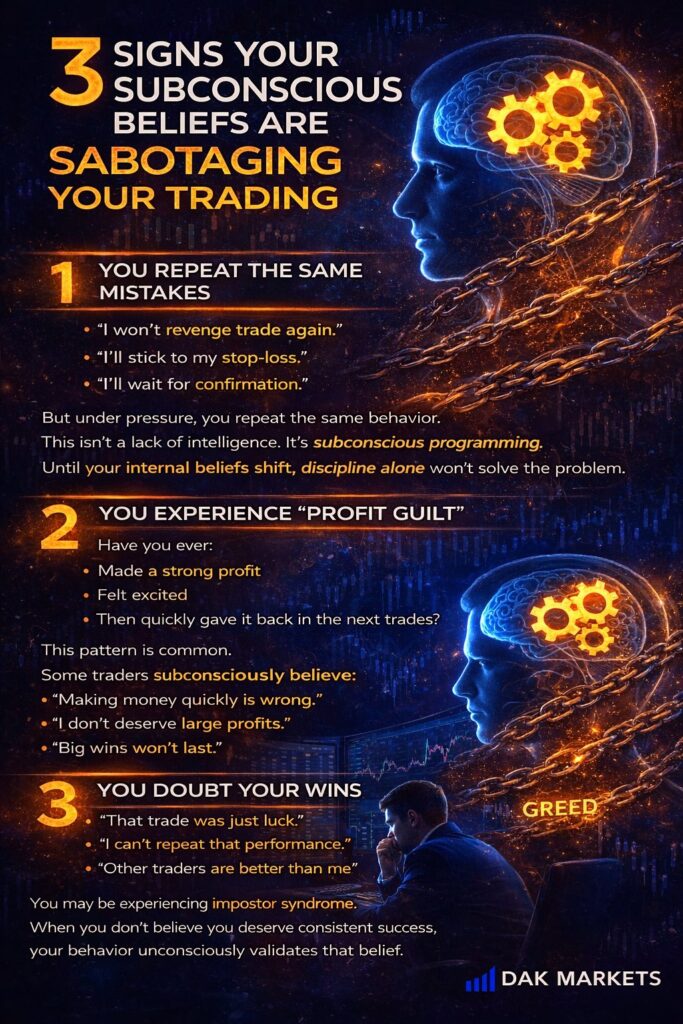
3 Signs Your Subconscious Beliefs Are Sabotaging Your Trading
1. You Repeat the Same Mistakes
You promise yourself:
- “I won’t revenge trade again.”
- “I’ll stick to my stop-loss.”
- “I’ll wait for confirmation.”
But under pressure, you repeat the same behavior.
This isn’t a lack of intelligence. It’s subconscious programming. Until your internal beliefs shift, discipline alone won’t solve the problem.
2. You Experience “Profit Guilt”
Have you ever:
- Made a strong profit
- Felt excited
- Then quickly gave it back in the next trades?
This pattern is common.
Some traders subconsciously believe:
- “Making money quickly is wrong.”
- “I don’t deserve large profits.”
- “Big wins won’t last.”
Your subconscious seeks comfort — even if that comfort means returning to lower performance levels.
At DAK Markets, breaking through your “profit ceiling” often requires internal belief work, not new indicators.
3. You Doubt Your Wins
If you think:
- “That trade was just luck.”
- “I can’t repeat that performance.”
- “Other traders are better than me.”
You may be experiencing impostor syndrome.
When you don’t believe you deserve consistent success, your behavior unconsciously validates that belief.
Confidence is not arrogance. It is alignment between skill and belief.
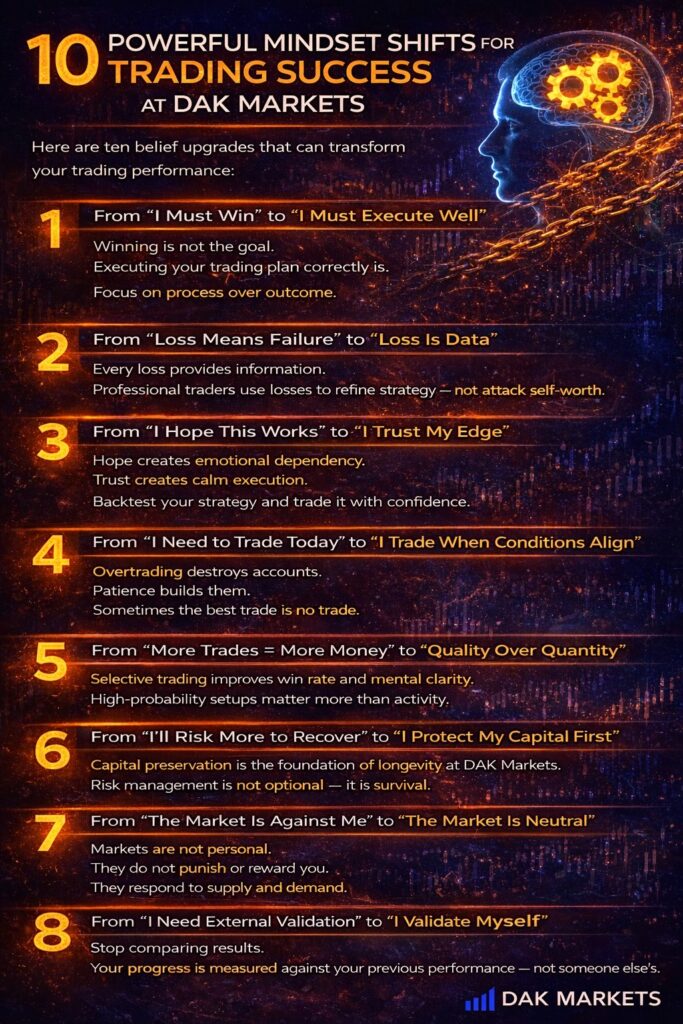
10 Powerful Mindset Shifts for Trading Success at DAK Markets
Here are ten belief upgrades that can transform your trading performance:
1. From “I Must Win” to “I Must Execute Well”
Winning is not the true goal of trading.
Instead, the goal is executing your trading plan correctly and consistently.
Professional traders focus on the process rather than the outcome.
Over time, disciplined execution naturally leads to profitability.
2. From “Loss Means Failure” to “Loss Is Data”
Every loss provides information.
Professional traders use losses to refine strategy — not attack self-worth.
3. From “I Hope This Works” to “I Trust My Edge”
Hope creates emotional dependency.
Trust creates calm execution.
Backtest your strategy and trade it with confidence.
4. From “I Need to Trade Today” to “I Trade When Conditions Align”
Overtrading destroys accounts.
Patience builds them.
Sometimes the best trade is no trade.
5. From “More Trades = More Money” to “Quality Over Quantity”
Selective trading improves win rate and mental clarity.
High-probability setups matter more than activity.
6. From “I’ll Risk More to Recover” to “I Protect My Capital First”
Capital preservation is the foundation of longevity at DAK Markets.
Risk management is not optional — it is survival.
7. From “The Market Is Against Me” to “The Market Is Neutral”
Markets are not personal.
They do not punish or reward you.
They respond to supply and demand.
8. From “I Need External Validation” to “I Validate Myself”
Stop comparing results.
Your progress is measured against your previous performance — not someone else’s.
9. From “Emotion Controls Me” to “I Observe Emotion”
Fear and greed will appear.
The key is awareness, not suppression.
Observe your emotions without reacting impulsively.
10. From “Success Is Uncertain” to “Consistency Is Trainable”
Profitable trading is not random luck.
It is a skill built through discipline, repetition, and mindset conditioning.
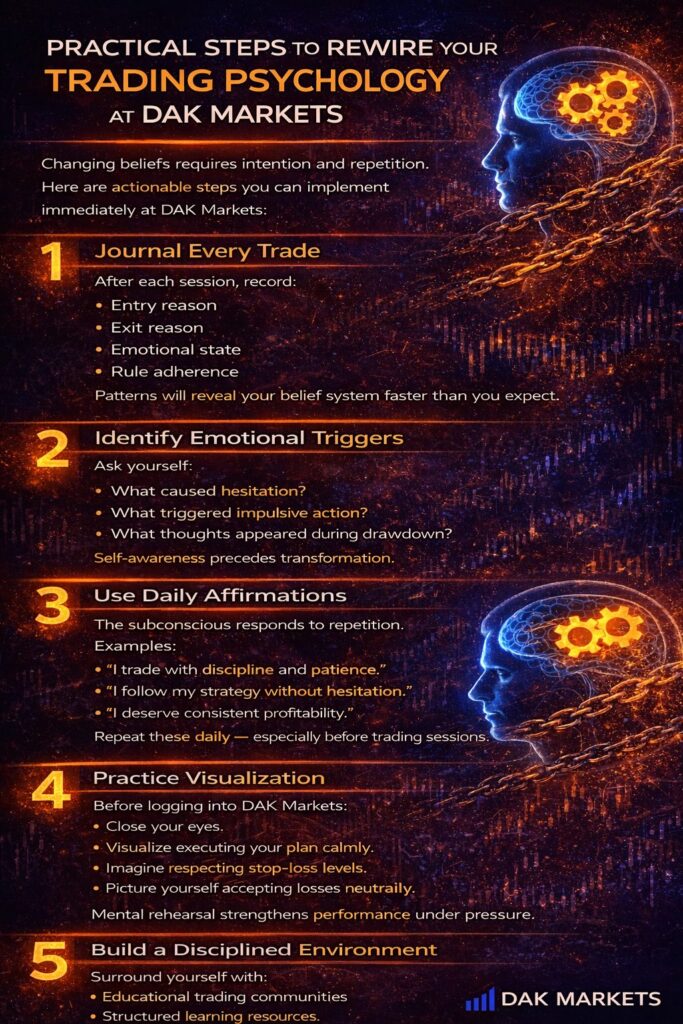
Practical Steps to Rewire Your Trading Psychology
Changing beliefs requires intention and repetition.
Here are actionable steps you can implement immediately at DAK Markets:
1. Journal Every Trade
After each session, record:
- Entry reason
- Exit reason
- Emotional state
- Rule adherence
Patterns will reveal your belief system faster than you expect.
2. Identify Emotional Triggers
Ask yourself:
- What caused hesitation?
- What triggered impulsive action?
- What thoughts appeared during drawdown?
Self-awareness precedes transformation.
3. Use Daily Affirmations
The subconscious responds to repetition.
Examples:
- “I trade with discipline and patience.”
- “I follow my strategy without hesitation.”
- “I deserve consistent profitability.”
Repeat these daily — especially before trading sessions.
4. Practice Visualization
Before logging into DAK Markets:
- Close your eyes.
- Visualize executing your plan calmly.
- Imagine respecting stop-loss levels.
- Picture yourself accepting losses neutrally.
Mental rehearsal strengthens performance under pressure.
5. Build a Disciplined Environment
Surround yourself with:
- Educational trading communities
- Structured learning resources
- Mentors focused on discipline
Avoid hype-driven trading culture.
Your environment shapes your beliefs.
Why Mindset Matters More Than Strategy
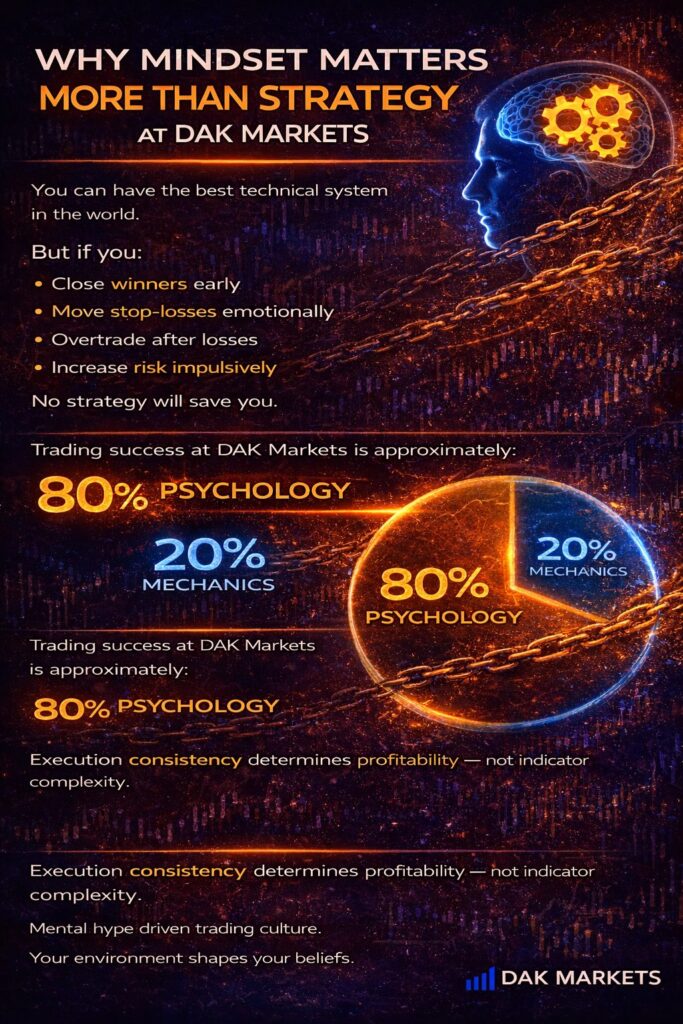
You can have the best technical system in the world.
But if you:
- Close winners early
- Move stop-losses emotionally
- Overtrade after losses
- Increase risk impulsively
No strategy will save you.
Trading success at DAK Markets is approximately:
80% psychology and 20% mechanics.
Execution consistency determines profitability — not indicator complexity.
Frequently Asked Questions About Trading Psychology
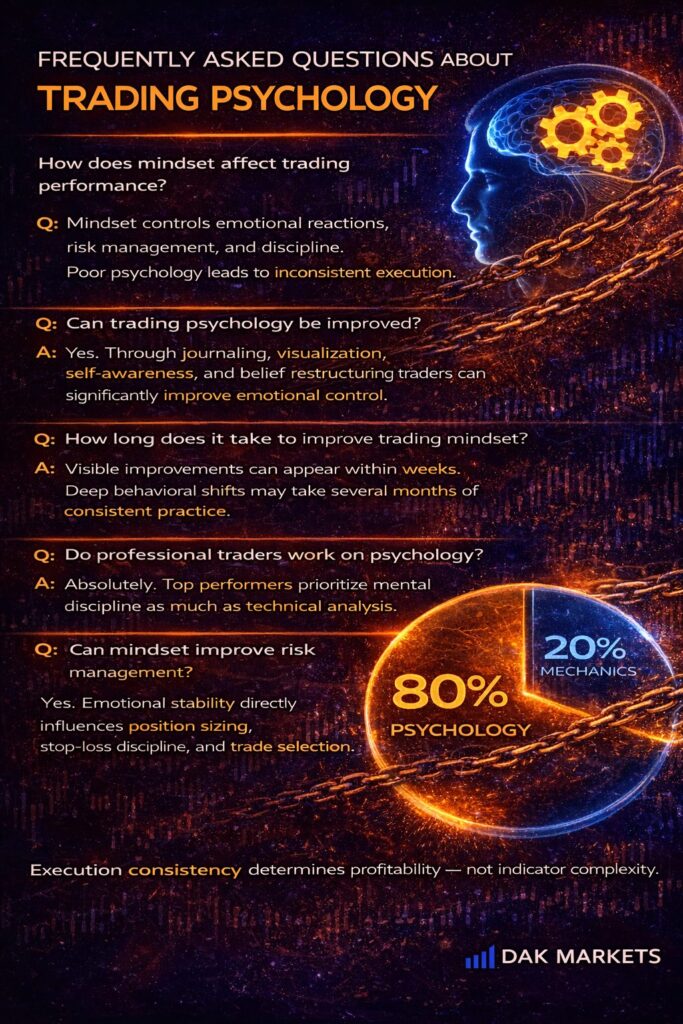
How does mindset affect trading performance?
Mindset controls emotional reactions, risk management, and discipline. Poor psychology leads to inconsistent execution.
Can trading psychology be improved?
Yes. Through journaling, visualization, self-awareness, and belief restructuring, traders can significantly improve emotional control.
How long does it take to improve trading mindset?
Visible improvements can appear within weeks. Deep behavioral shifts may take several months of consistent practice.
Do professional traders work on psychology?
Absolutely. Top performers prioritize mental discipline as much as technical analysis.
Can mindset improve risk management?
Yes. Emotional stability directly influences position sizing, stop-loss discipline, and trade selection.
Final Thoughts: Master Your Mind, Master the Markets
Success at DAK Markets is not just about charts and indicators.
It is about:
- Emotional discipline
- Belief alignment
- Consistent execution
- Capital preservation
Your subconscious beliefs can either sabotage your growth or strengthen your performance.
The choice begins with awareness.
Upgrade your mindset.
Refine your discipline.
Trust your process.
Because in trading, the greatest edge is not your strategy —
It is you.