
There is no single approach to trading that works for everyone. Some traders prefer making several fast decisions during one market session, while others are comfortable holding positions for days, weeks or even months.
Understanding the different types of forex traders can help you select a trading style that matches your personality, schedule, experience and tolerance for risk.
The four most common trading styles are:
- Day trading
- Swing trading
- Position trading
- Scalping
Each style has its own timeframe, decision-making process, trading frequency and risk-management requirements. The best trading style is not necessarily the one that produces the most trades or the largest individual gains. It is the approach that you can follow consistently and responsibly.
Why Your Trading Style Matters
Your trading style determines how often you enter the market, how long you hold positions and how much time you spend analyzing charts.
A trader with a full-time job may struggle to monitor one-minute charts throughout the day. At the same time, someone who enjoys fast-paced decision-making may find long-term position trading too slow.
Choosing the wrong style can lead to frustration, emotional decisions and inconsistent execution. Traders may begin forcing trades, closing positions too early or abandoning their strategy because it does not match their natural routine.
Before choosing a trading approach, consider:
- How much time you can dedicate to trading
- How quickly you are comfortable making decisions
- Whether you prefer technical or fundamental analysis
- How much market volatility you can tolerate
- How long you are comfortable holding a position
Your trading style should fit your life rather than forcing your life to revolve around the market.

1. Day Trader
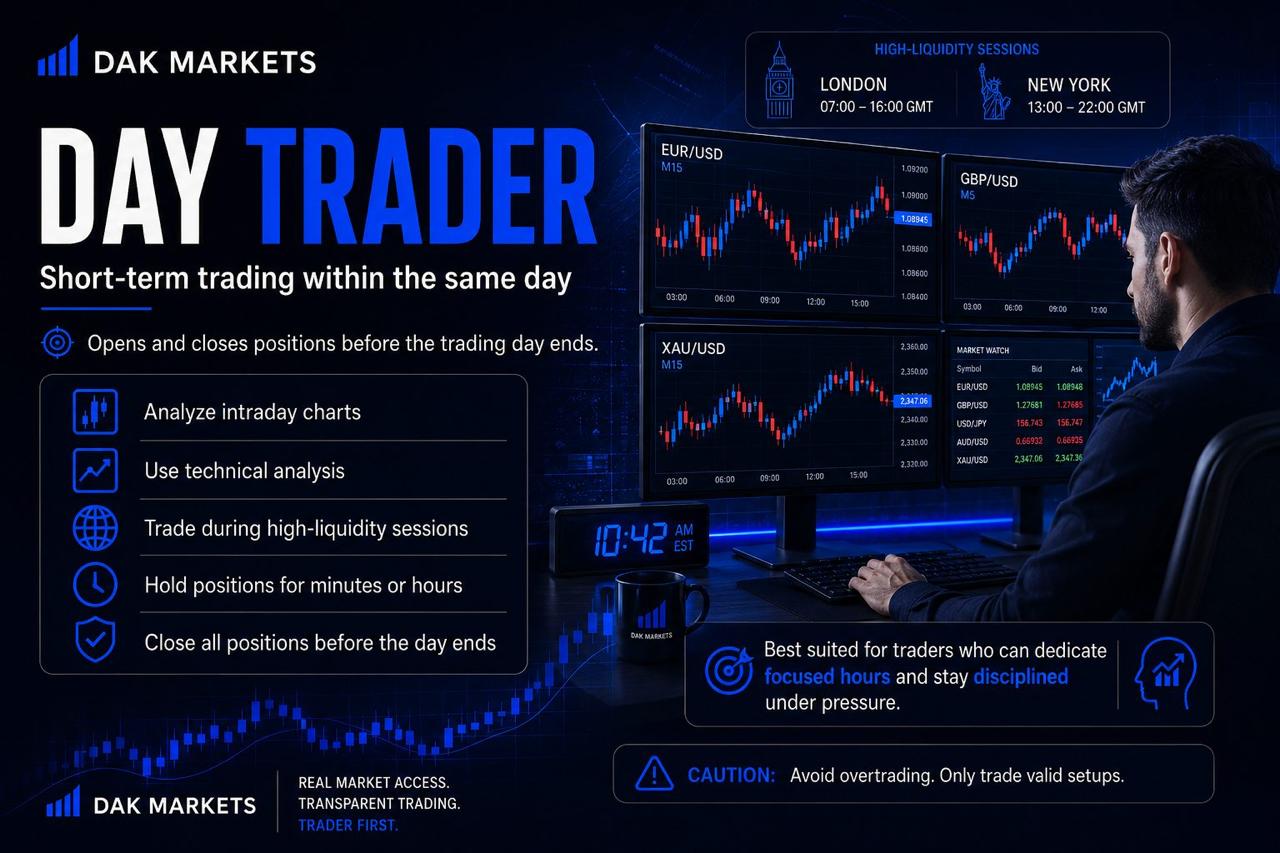
A day trader opens and closes positions within the same trading day. The objective is to capture short-term price movements without keeping trades open overnight.
Day traders often focus on active market periods, such as the London session, New York session or the overlap between the two. These periods may provide increased liquidity and stronger price movement.
How Day Traders Operate
Day traders commonly:
- Analyze intraday charts
- Monitor support and resistance levels
- Use technical analysis
- Trade during high-liquidity sessions
- Hold positions for several minutes or hours
- Close all positions before the trading day ends
Because day traders make decisions within a limited timeframe, preparation is essential. They should understand the market structure, check the economic calendar and identify potential entry and exit levels before placing a trade.
Day trading may suit traders who can dedicate several focused hours to the market and remain disciplined under pressure.
However, opening more trades does not automatically create better results. Day traders must avoid overtrading and should only enter when their strategy provides a valid setup.
2. Swing Trader
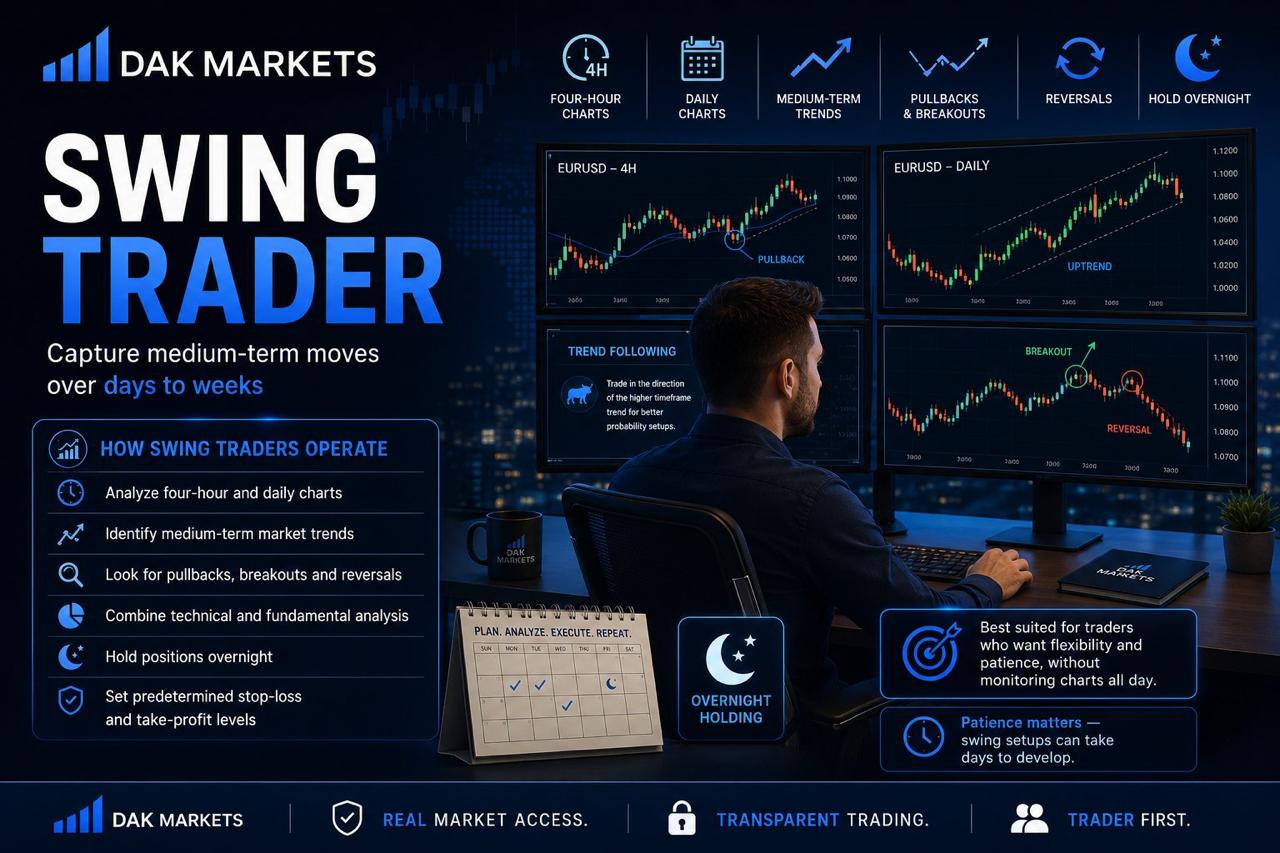
A swing trader holds positions for several days or, in some cases, a few weeks. Instead of targeting small intraday movements, swing traders aim to capture a larger section of a developing market move.
This trading style offers a balance between short-term and long-term trading. Swing traders do not usually need to monitor charts throughout the entire day, but they must remain aware of overnight risk, weekend exposure and important economic events.
How Swing Traders Operate
Swing traders commonly:
- Analyze four-hour and daily charts
- Identify medium-term market trends
- Look for pullbacks, breakouts and reversals
- Combine technical and fundamental analysis
- Hold positions overnight
- Set predetermined stop-loss and take-profit levels
A swing trader may identify an established upward trend, wait for the price to retrace toward a key level and then enter in the direction of the broader trend.
Patience is particularly important. A swing setup may take several days to develop, and the trade itself may require additional time to reach its intended target.
Swing trading may suit individuals who cannot monitor the market constantly but still want to participate in medium-term price movements.
3. Position Trader
A position trader takes a long-term approach, holding trades for weeks, months or potentially longer. The goal is to capture major market trends rather than react to short-term price fluctuations.
Position traders generally spend less time watching lower-timeframe charts. Instead, they study the wider economic environment and focus on factors that may influence a currency over an extended period.
How Position Traders Operate
Position traders commonly:
- Analyze daily, weekly and monthly charts
- Study long-term market direction
- Use fundamental and technical analysis
- Monitor interest rates and economic conditions
- Hold trades through short-term volatility
- Use wider stop-loss and target levels
For example, a position trader may develop a long-term view based on monetary policy, inflation expectations or economic growth. Technical analysis can then be used to identify a suitable entry area within the broader trend.
This style requires considerable patience. Position traders must avoid reacting emotionally to every short-term market movement. A temporary retracement does not always invalidate the original trading idea.
Position trading may be suitable for traders who prefer fewer decisions, longer-term planning and reduced daily screen time.

4. Scalper
A scalper operates on extremely short timeframes, often holding positions for only seconds or minutes. Scalpers aim to capture very small price movements through multiple trades during a trading session.
Scalping is one of the fastest trading styles and demands intense concentration, quick execution and strict risk control.
How Scalpers Operate
Scalpers commonly:
- Use one-minute or five-minute charts
- Focus on very small price movements
- Open multiple trades during a session
- Depend on fast execution
- Use tight stop-loss and take-profit levels
- Trade during periods of strong liquidity
Because the target on each trade is often small, trading costs can have a significant effect on performance. Spreads, commissions, slippage and execution speed are particularly important for scalpers.
Scalping is not simply about clicking quickly. Every trade still requires a defined setup, risk limit and exit plan. Without discipline, rapid trading can quickly turn into emotional overtrading.
This style may suit experienced traders who remain calm under pressure and can make fast decisions without abandoning their rules.

Which Type of Forex Trader Are You?
Selecting a trading style should be based on more than potential profit. Consider your personality, available time and ability to follow a structured plan.
A day trader may prefer active sessions and daily opportunities.
A swing trader may want a balance between regular market participation and reduced screen time.
A position trader may prefer long-term analysis and fewer trading decisions.
A scalper may enjoy a fast-paced environment with short holding periods.
You do not need to copy another trader’s style. A strategy that works with someone else’s schedule and personality may not be suitable for you.
It is also important to avoid switching styles after every losing trade. Consistency requires enough time and data to evaluate whether an approach is working as intended.
![Saturday 1:07 PMWorked for 1m 31sGenerated image: Day trader infographic with mascot and chartsEditmake it based on this Worked for 1m 38sGenerated image: Types of traders: Day trader breakdownEditGenerated image: Swing trading strategies with DAK MarketsEditGenerated image: Types of traders and their strategiesEditGenerated image: Different trading styles, one goalEditGenerated image: Position trader: Long-term analysis and strategyEditgenerate the scalper Generated image: Scalper trading strategies and tipsEditgenerate a blog about this making it 1000 words and fully SEO optimizedToday 2:21 PMIMAGE 2026-07-14 14:21:00.jpggenerate an alt text for this image ]IMAGE 2026-07-14 14:30:25.jpgIMAGE 2026-07-14 14:51:59.jpgIMAGE 2026-07-14 14:53:35.jpgDAK Markets position trader infographic showing a trader analyzing daily, weekly, and monthly charts, with long-term trend analysis, economic factors, wider stop-loss levels, and positions held for weeks to months.IMAGE 2026-07-14 15:00:30.jpgDAK Markets scalper infographic showing a trader using one-minute and five-minute charts, fast execution, tight risk controls, high-liquidity markets, and multiple ultra-short-term trades.IMAGE 2026-07-14 15:01:38.jpgDAK Markets infographic comparing day traders, swing traders, position traders, and scalpers to help traders choose a forex trading style based on personality, available time, and consistency.](https://dakmarkets.com/wp-content/uploads/2026/07/IMAGE-2026-07-14-150206.jpg)
What All Successful Trading Styles Have in Common
Although the different types of forex traders operate differently, the foundations of responsible trading remain the same.
Every trader should have:
- A clear trading plan
- Defined entry and exit conditions
- Appropriate position sizing
- A maximum risk per trade
- A process for reviewing performance
- The discipline to avoid emotional decisions
The timeframe may change, but risk management remains essential. No trading style removes the possibility of losses.
A trader should understand the potential loss before entering a position and should never risk more than they can afford to lose.

Final Thoughts
Understanding the main types of forex traders is an important step toward building a structured trading approach.
Day traders focus on intraday movements. Swing traders hold positions for days or weeks. Position traders aim to capture long-term trends, while scalpers target small movements within seconds or minutes.
There is no universally superior trading style. The right approach is the one that fits your schedule, risk tolerance, personality and long-term objectives.
At DAK Markets, traders can access the market and apply the approach that best aligns with their individual strategy. Regardless of the style you choose, focus on preparation, discipline and responsible risk management.
Trade your plan, not your emotions.
Trading leveraged products involves significant risk and may not be suitable for every investor. This content is provided for educational purposes only and does not constitute financial advice.