
Many traders spend a lot of time trying to improve their entries. They study chart patterns, indicators, market structure, liquidity areas, economic news, and price action in order to find better trade setups. While strong entries are important, they are only one part of trading performance.
A trade does not end when the entry is made. In many cases, the real challenge begins after the position is open.
One of the most common problems traders face is closing profitable trades too early. A trader may enter well, price may move in the right direction, and the setup may work as expected. But instead of allowing the trade to develop, the trader exits too soon because of fear, impatience, uncertainty, or lack of clear exit rules.
This is where Maximum Favorable Excursion, commonly known as MFE, can become extremely useful.
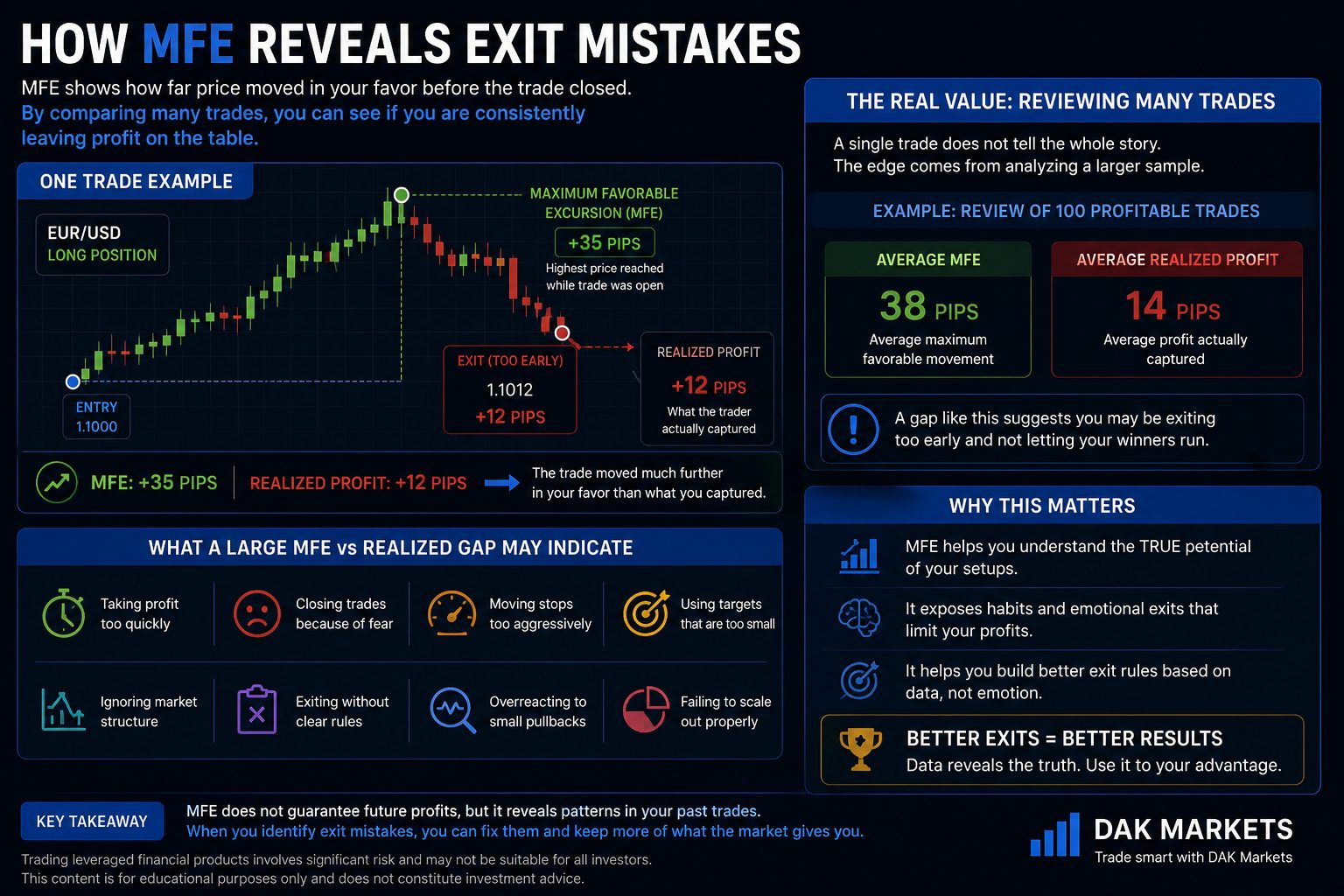
MFE helps traders analyze how far a trade moved in their favor before it closed. By comparing the maximum unrealized profit with the final realized result, traders can identify whether they are consistently leaving profit on the table.
What Does It Mean to Close Profitable Trades Too Early?
Closing a profitable trade too early means exiting a position before the trade has had enough time or space to reach its reasonable potential.
This does not mean every trade should be held until the absolute top or bottom. No trader can know the exact best exit point in advance. Markets are uncertain, and protecting profit is sometimes the correct decision.
However, if a trader repeatedly closes trades with small gains while the same trades regularly move much further in profit afterward, this may reveal a problem.
For example, imagine a trader buys EUR/USD and closes the trade with a 10-pip profit. Later, after reviewing the chart, the trader sees that the trade moved 40 pips in their favor before reversing.
If this happens once, it may not mean much. But if it happens repeatedly across many trades, it may suggest that the trader’s exit strategy is not aligned with the market behavior of their setups.
What Is Maximum Favorable Excursion?
Maximum Favorable Excursion measures the greatest amount of unrealized profit a trade reaches while it is still open.
For a long position, MFE is the highest price reached after entry before the trade closes. For a short position, MFE is the lowest price reached after entry before the trade closes.
For example:
A trader enters a buy position on EUR/USD.
The trade moves 35 pips into profit.
The trader later closes the trade with only 12 pips profit.
In this case:
Maximum Favorable Excursion: +35 pips
Final realized profit: +12 pips
The trade had a much larger favorable movement than what the trader actually captured.
This difference between MFE and realized profit is important because it can reveal whether the trader’s exit decisions are helping or hurting overall performance.
How MFE Reveals Exit Mistakes
MFE becomes especially useful when traders compare many trades instead of focusing on one example.
A single trade does not provide enough information. Sometimes a trader exits early and the market continues. Other times, exiting early protects profit before a reversal. That is normal.
The real value comes from reviewing a larger sample of trades.
For example, a trader reviews 100 profitable trades and finds the following:
Average MFE: 38 pips
Average realized profit: 14 pips
This does not automatically mean the trader should target 38 pips on every trade. However, the gap between the average maximum favorable movement and the average realized result deserves attention.
It may indicate that the trader is consistently exiting too early, cutting winners short, or failing to let profitable trades develop.
MFE can reveal exit mistakes such as:
Taking profit too quickly
Closing trades because of fear
Moving stops too aggressively
Using targets that are too small
Ignoring market structure
Exiting without clear rules
Overreacting to small pullbacks
Failing to scale out properly
By identifying these habits, traders can begin to improve their exit strategy with data instead of emotion.
Emotional Exits and Fear of Giving Back Profit
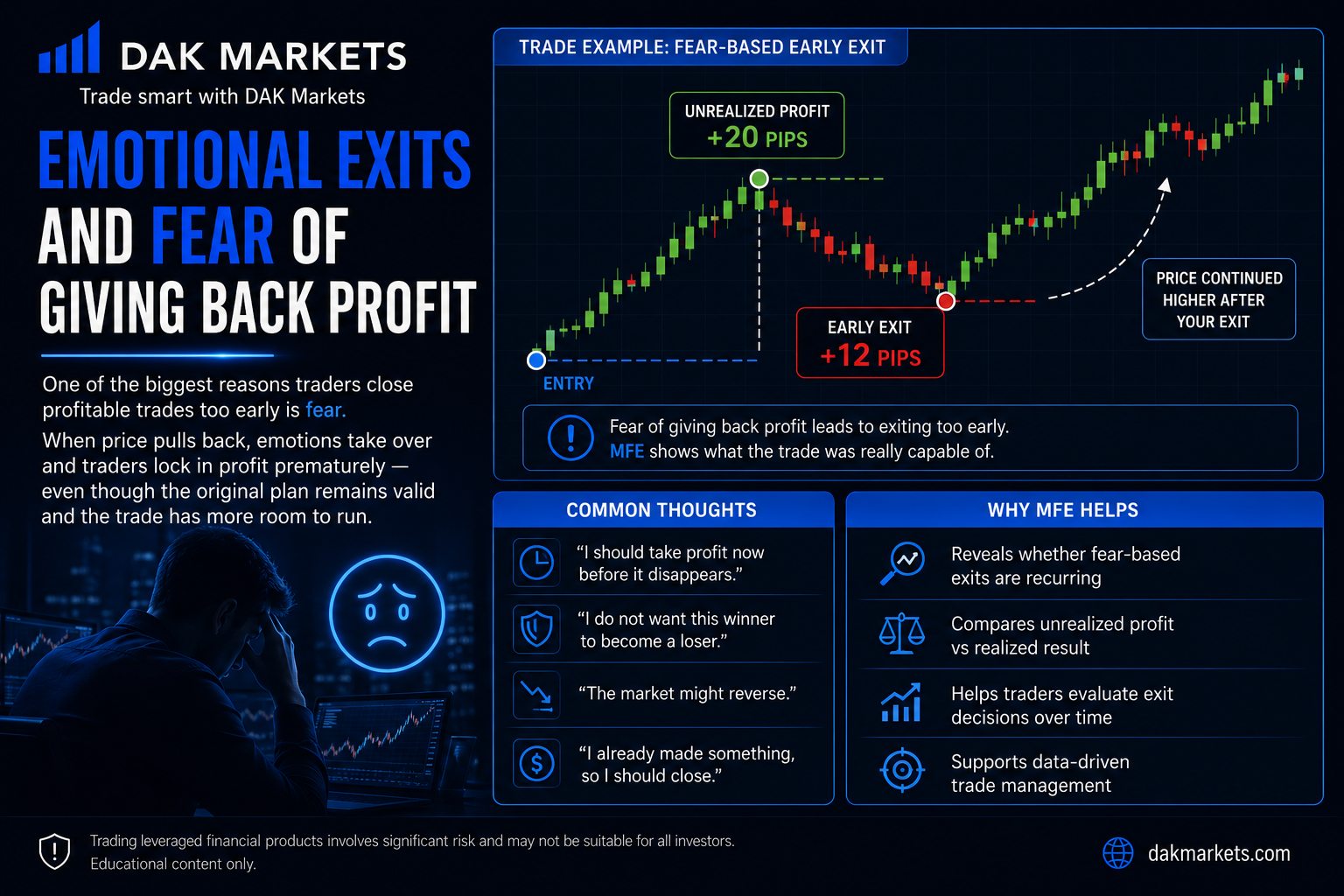
One of the biggest reasons traders close profitable trades too early is fear.
After seeing a trade move into profit, traders may become afraid of losing what they have gained. This can lead them to close the position too soon, even if the original trading plan has not been invalidated.
This behavior is understandable. Watching unrealized profit fluctuate can be psychologically difficult. A trade that is up 20 pips may pull back to 12 pips, then move higher again. Without a clear plan, that temporary pullback can create emotional pressure.
The trader may think:
“I should take profit now before it disappears.”
“I do not want this winner to become a loser.”
“The market might reverse.”
“I already made something, so I should close.”
These thoughts can lead to inconsistent exits.
MFE helps traders review whether these decisions were reasonable over time. If trades regularly continued much further after early exits, it may show that fear-based profit-taking is limiting performance.
Why Small Profits Can Still Be a Problem
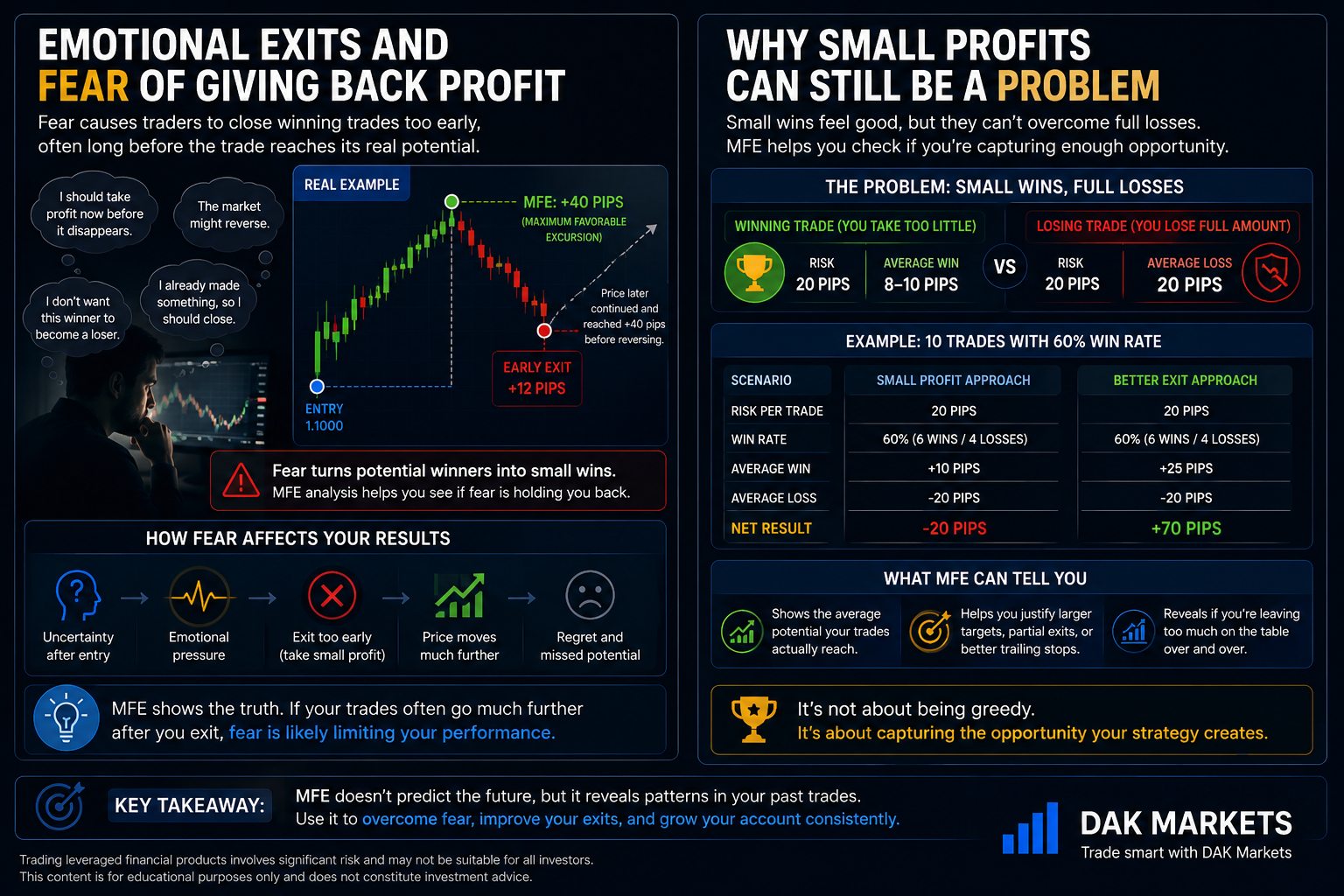
Many traders feel good when they close a trade in profit. A winning trade is better than a losing trade, but not all winning trades are managed well.
If a trader consistently takes small profits while allowing losing trades to reach full stop loss, the strategy may struggle even with a decent win rate.
For example, suppose a trader risks 20 pips per trade but often closes winners at only 8 to 10 pips. Unless the win rate is very high, the trader may find it difficult to grow consistently.
MFE can show whether the strategy regularly provides enough favorable movement to justify larger targets, partial exits, or better trailing-stop rules.
This is not about being greedy. It is about understanding whether the trader is capturing enough of the opportunity created by their own strategy.
MFE and Profit Target Review
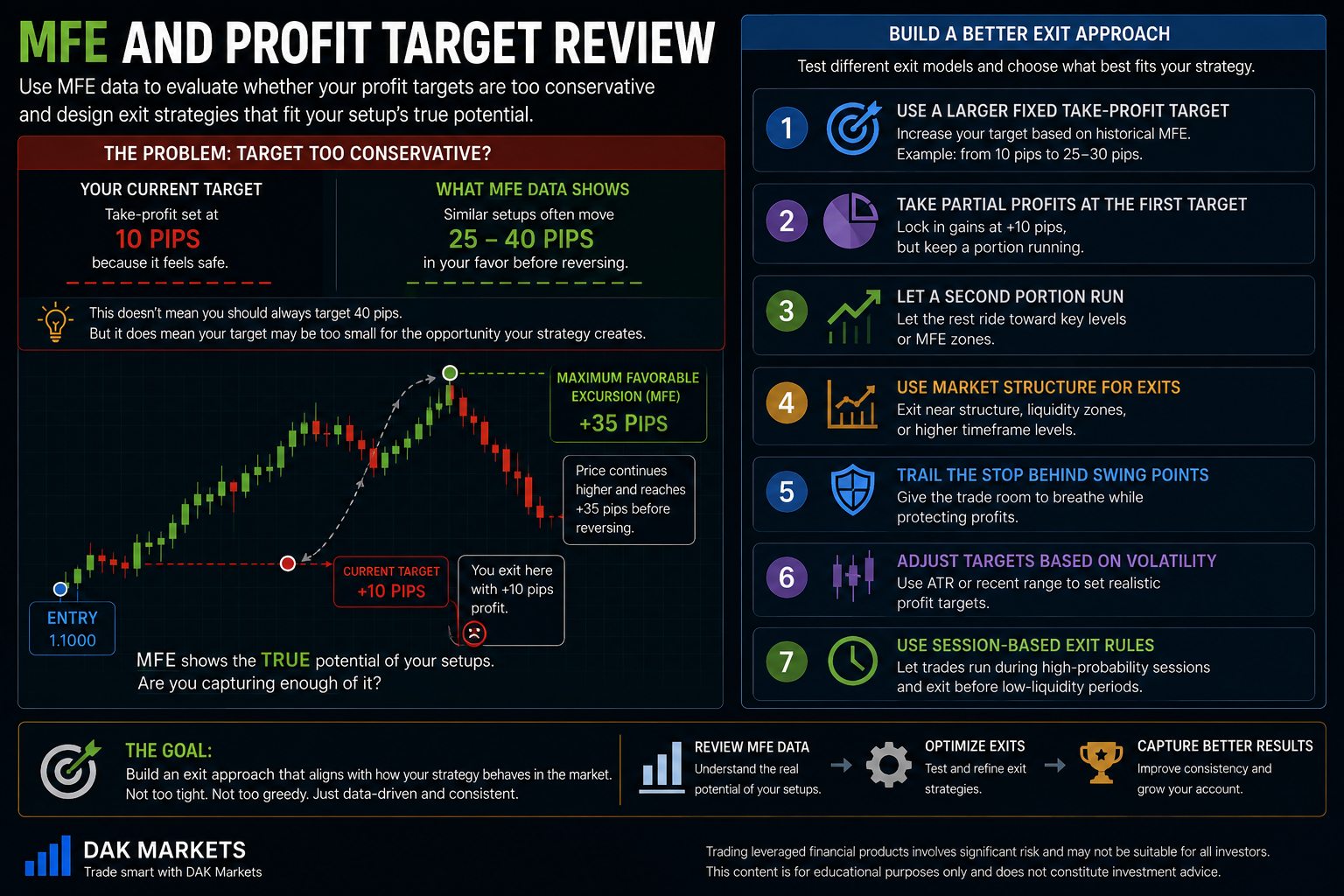
MFE can help traders evaluate whether their profit targets are too conservative.
A trader may set a take-profit target of 10 pips because it feels safe. However, after reviewing historical trades, they may discover that similar setups often move 25 to 40 pips in their favor before reversing.
This does not mean every target should immediately be increased. Instead, the trader can test different exit models.
Possible adjustments may include:
Using a larger fixed take-profit target
Taking partial profits at the first target
Letting a second portion run
Using market structure for exits
Trailing the stop behind swing points
Adjusting targets based on volatility
Using session-based exit rules
The goal is to build an exit approach that fits the behavior of the strategy.
MFE and Trailing Stop Mistakes
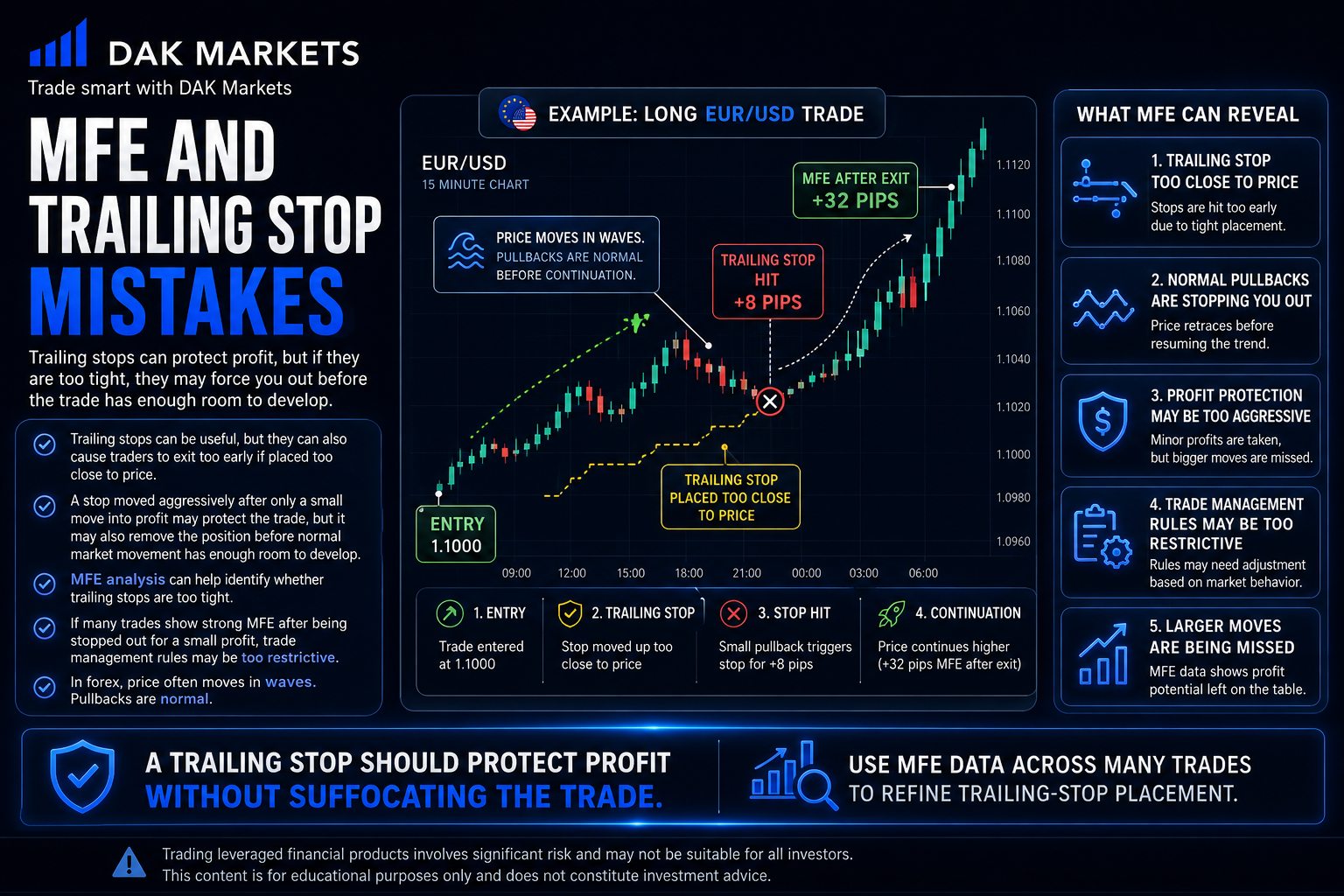
Trailing stops can be useful, but they can also cause traders to exit too early if they are placed too close to price.
A trader may enter a strong setup and move the stop loss aggressively as soon as the trade moves slightly into profit. While this protects the trade, it may also remove the position before normal market movement has enough room to develop.
MFE analysis can help identify whether trailing stops are too tight.
If many trades show strong MFE after the trader was stopped out for a small profit, it may suggest that the trade management rules are too restrictive.
This is especially important in forex, where price often moves in waves. Pullbacks are normal. A stop that is too close may protect profit, but it may also prevent the trader from capturing larger moves.
MFE Does Not Mean You Should Capture Every Pip
It is important to understand what MFE is not.
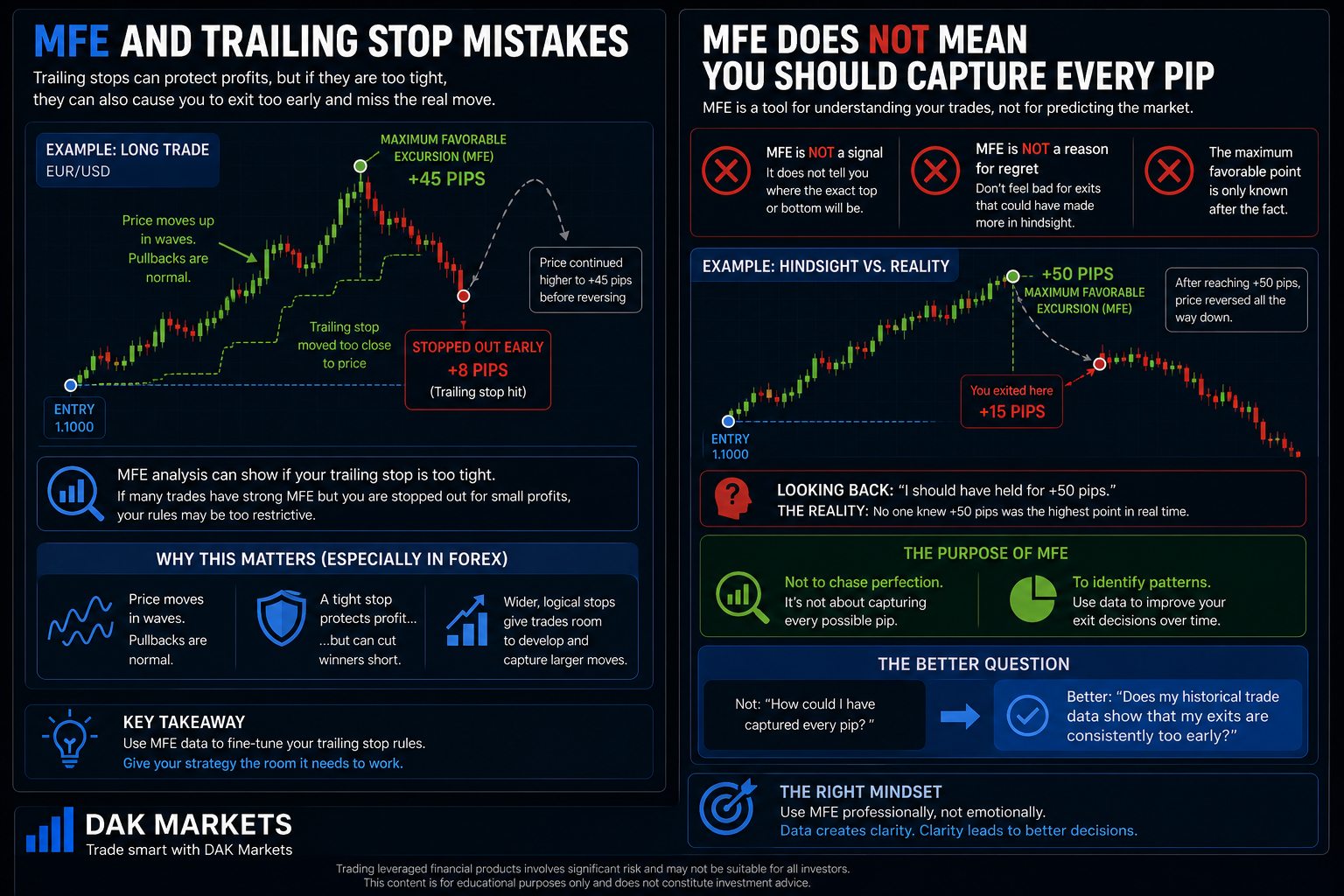
MFE is not a signal that tells traders where the exact top or bottom will be. It is also not a reason to feel regret after every trade that moved further after exit.
The maximum favorable point is only obvious after the fact.
If a trade reaches +50 pips and later reverses, it is easy to look back and think the trade should have been closed at exactly +50 pips. But in real time, there was no guarantee that +50 pips would be the highest point.
The purpose of MFE is not to chase perfection. The purpose is to identify patterns.
A better question is not:
“How could I have captured every pip?”
A better question is:
“Does my historical trade data show that my exits are consistently too early?”
This mindset helps traders use MFE professionally rather than emotionally.
How to Track MFE in a Trading Journal
To use MFE effectively, traders should record it consistently.
For each trade, consider tracking:
Entry price
Stop-loss level
Take-profit level
Maximum favorable price
Maximum favorable excursion
Exit price
Final result
Reason for exit
Market condition
Emotional state during the trade
Over time, this data can reveal whether early exits are random or part of a repeated pattern.
For example, a trader may discover that early exits happen most often during high-volatility sessions, after a losing streak, near news events, or after price pulls back slightly from unrealized profit.
This information can help the trader improve both strategy rules and trading psychology.
Turning MFE Data Into Better Exit Rules
Once enough data has been collected, traders can use MFE to test better exit rules.
For example, if most winning trades reach at least 25 pips of MFE, but the trader usually exits at 8 pips, they may test a new rule that takes partial profit at 10 pips and allows the rest to continue toward 25 pips or a market-structure target.
If trades often reach a certain favorable range before reversing, the trader may use that range to design more realistic profit targets.
If trades often continue after early exits, the trader may work on delaying manual exits unless a clear invalidation condition appears.
The key is to test changes carefully. MFE should guide analysis, not encourage random adjustments.
Final Thoughts
Closing profitable trades too early is one of the most frustrating problems in trading. It can make a trader feel like they had the right idea but failed to benefit fully from it.
Maximum Favorable Excursion helps traders study this issue with more clarity. By comparing how far trades moved in profit with how much profit was actually realized, traders can identify exit mistakes, emotional profit-taking, unrealistic targets, and weak trade-management rules.
MFE does not guarantee better results, and it does not predict the next trade. But when used across a meaningful sample of trades, it can provide valuable insight into how a strategy behaves after entry.
Good trading is not only about finding the right setup. It is also about managing the trade properly once the setup is active.
If traders want to improve consistency, they should not only ask whether a trade won or lost. They should ask how the trade moved, how it was managed, and whether the exit decision matched the strategy.
Data creates awareness.
Awareness improves decisions.
Better decisions support long-term consistency.
Trade smart with DAK Markets
Trading leveraged financial products involves significant risk and may not be suitable for all investors. This content is provided for educational purposes only and does not constitute investment advice.