Leverage and Margin in Forex Trading Explained | DAK Markets
September 29, 2026
Leverage and margin are two of the most important concepts for anyone participating in leveraged financial markets.
Terms such as 1:100 leverage, 1:500 leverage, used margin, and free margin frequently appear on trading platforms. However, understanding what these figures actually mean is essential before opening leveraged positions.
Leverage allows traders to control a market position that is larger than the amount of capital reserved to support that position.
Margin, meanwhile, represents the portion of available funds that is temporarily reserved when a leveraged trade is opened.
Together, leverage and margin determine how much market exposure a trader can take and how much capital must remain available to support that exposure.
Understanding leverage and margin in forex trading is therefore an important part of managing trading risk responsibly.
What Is Leverage in Forex Trading?
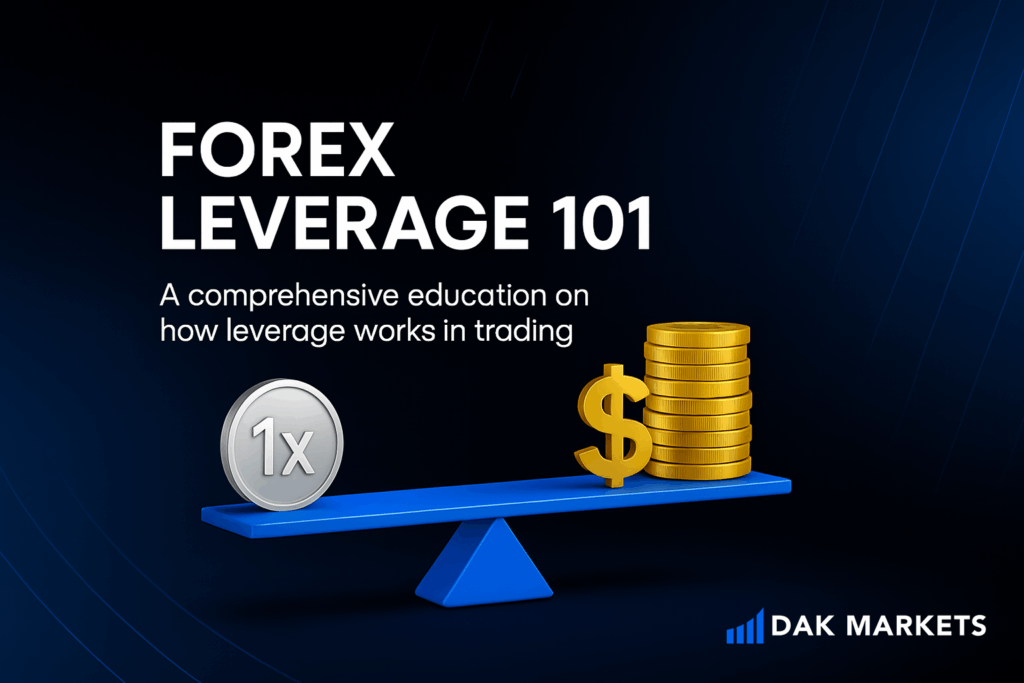
Leverage allows a trader to control a larger market position using a comparatively smaller amount of capital.
For example, imagine a trading account contains:
Account Balance: $1,000
With leverage available, the trader may be able to control a position considerably larger than the account balance itself.
At 1:100 leverage, every $1 of required margin can theoretically support $100 of market exposure, subject to the broker’s margin requirements and the instrument being traded.
This is why leverage is often described as increasing a trader’s buying power.
However, there is an important distinction:
Leverage increases market exposure. It does not increase the actual amount of money in the trading account.
A $1,000 account remains a $1,000 account simply because leverage is available.
The trader is instead receiving the ability to control a larger market position.
How Leverage Expands Market Exposure
Consider a simplified example.
Account Metric
Example
Account Balance
$1,000
Leverage
1:100
Position Size
$10,000
The trader does not necessarily need to provide the full $10,000 position value from the account.
Instead, only a portion of the position may need to be reserved as margin.
This makes leveraged trading more capital-efficient, but it also introduces additional risk because movements in the larger position affect the account’s equity.
The key principle:
The larger the position relative to the account, the greater the potential impact of market movements.
Leverage therefore changes the amount of market exposure a trader can control—not the amount of actual capital deposited into the account.
What Is Margin in Forex Trading?
Margin is the amount of capital reserved to support an open leveraged position.
It should not automatically be interpreted as a trading fee.
Instead, margin acts as collateral while the leveraged position remains open.
A simple representation of margin is:
Position Size ÷ Leverage = Required Margin
Consider a $10,000 position using 1:100 leverage.
The approximate margin requirement would be:
$10,000 ÷ 100 = $100
This means approximately $100 would be reserved as margin to support the $10,000 position.
The remaining funds are not necessarily being used as margin for that particular position.
Actual margin requirements can vary depending on the financial instrument, account conditions, leverage settings, and other factors.
Understanding Balance, Equity, Used Margin and Free Margin
Understanding leverage also requires understanding several important figures displayed within a trading account.
Balance
Your balance represents the account value before unrealized profits or losses from currently open positions are included.
For example:
Balance: $1,000
If there are open trades, the balance may remain unchanged until those positions are closed.
Equity
Equity reflects the current value of the account after unrealized profit or loss is included.
Suppose the account has:
Balance: $1,000 Unrealized Loss: −$40
The account equity would therefore be:
$1,000 − $40 = $960 Equity
Unlike the balance, equity can continuously change as open positions move in profit or loss.
Used Margin
Used margin represents the amount currently reserved to support open leveraged positions.
For example:
Used Margin: $100
That $100 is supporting the account’s existing market exposure.
Free Margin
Free margin represents the remaining equity available to absorb market movements or support additional positions.
Using the same simplified example:
Equity: $960 Used Margin: $100
The free margin would therefore be:
$960 − $100 = $860 Free Margin
A simple way to express this is:
Free Margin = Equity − Used Margin
Free margin is an important figure when evaluating how much unused capacity remains within a trading account.
Why Free Margin Matters
Available leverage does not mean traders should automatically use as much market exposure as possible.
As positions move against a trader, equity can decline.
When equity declines, free margin may also decrease.
If a trader has opened several large positions and has very little free margin remaining, relatively small adverse market movements may place significant pressure on the account.
Maintaining sufficient free margin can provide additional capacity to absorb normal market fluctuations.
This is one reason responsible traders consider position size and overall exposure before entering the market rather than simply using the maximum leverage available.
More available leverage does not automatically mean more leverage should be used.
What Happens When Margin Becomes Too Low?
Trading platforms and brokers generally have margin-management mechanisms designed to prevent account equity from falling indefinitely.
When account equity becomes too low compared with the required margin, the account may reach a:
Margin warning
Margin call
Stop-out level
The exact terminology and thresholds can vary depending on the broker and trading conditions.
At a stop-out level, one or more positions may be closed automatically.
The purpose is generally to prevent losses from continuing beyond the account’s available capacity.
Traders should therefore understand the specific margin requirements, margin levels, and stop-out conditionsassociated with their trading account before opening leveraged positions.
Leverage Magnifies Both Directions
One of the biggest misconceptions about leverage is focusing only on its potential to increase profits.
Leverage magnifies market exposure, not just profitable outcomes.
If the market moves in the trader’s favor, greater exposure can result in a larger potential gain.
However, if the market moves against the position, the same increased exposure can create a larger potential loss.
In simple terms:
Greater Market Exposure = Greater Sensitivity to Market Movements
That principle works in both directions.
Leverage should therefore be viewed primarily as a tool for controlling market exposure, rather than as a method for automatically increasing returns.
Higher Leverage Does Not Require Larger Positions
A trading account may provide relatively high maximum leverage, but that does not mean the trader must use all of it.
There is an important difference between available leverage and effective leverage.
For example, a trader with access to:
1:500 Maximum Leverage
could still choose to maintain relatively small positions.
In this situation, higher available leverage primarily reduces the amount of margin required to support those positions.
The trader remains responsible for determining an appropriate level of market exposure.
Available leverage defines what may be possible. Position sizing determines how much exposure is actually taken.
How to Use Leverage Responsibly
Responsible leverage management starts with understanding risk before entering a trade.
Rather than asking:
“How large a position can I open?”
A more useful question may be:
“How much exposure can my trading plan reasonably support?”
Important considerations include position sizing, stop-loss placement, available free margin, account equity, market volatility, and the amount of capital a trader is prepared to risk.
Traders should also remember that multiple positions can create combined exposure.
Several individually small trades may collectively represent substantial account risk—particularly when those positions are highly correlated and may move in the same direction during changing market conditions.
Responsible leverage management therefore requires looking at the entire account, rather than evaluating each position in isolation.
Final Thoughts: Understand Leverage Before Using It
Leverage and margin are fundamental components of leveraged forex trading.
Leverage determines how much market exposure can be controlled relative to the capital required.
Margin represents the funds reserved to support those leveraged positions.
Understanding concepts such as balance, equity, used margin, free margin, margin levels, and stop-out risk gives traders a clearer picture of what is happening inside their trading account.
Most importantly, leverage should not be viewed simply as an opportunity to trade larger positions.
It should be treated as a risk-management consideration.
More Buying Power Requires More Responsibility
Plan your exposure.
Control your risk.
Maintain sufficient free margin.
Understand how market movements can affect your account before entering a position.
The Forex spot market offers real-time trading at live prices, giving traders direct access to the largest financial market in the world. At DAK Markets,…