The Problem You Can’t See
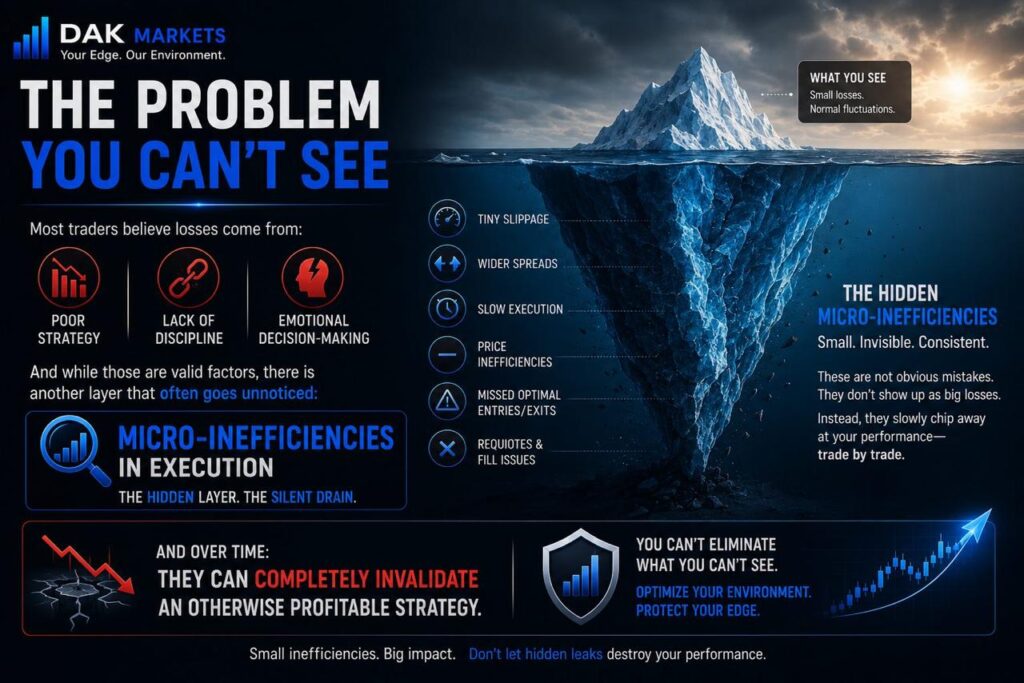
Most traders believe losses come from:
- Poor strategy
- Lack of discipline
- Emotional decision-making
And while those are valid factors, there is another layer that often goes unnoticed:
👉 Micro-inefficiencies in execution
These are not obvious mistakes.
They don’t show up as major losses.
Instead, they slowly chip away at performance — trade by trade.
And over time:
👉 They can completely invalidate an otherwise profitable strategy.
What Are Micro-Inefficiencies in Trading?
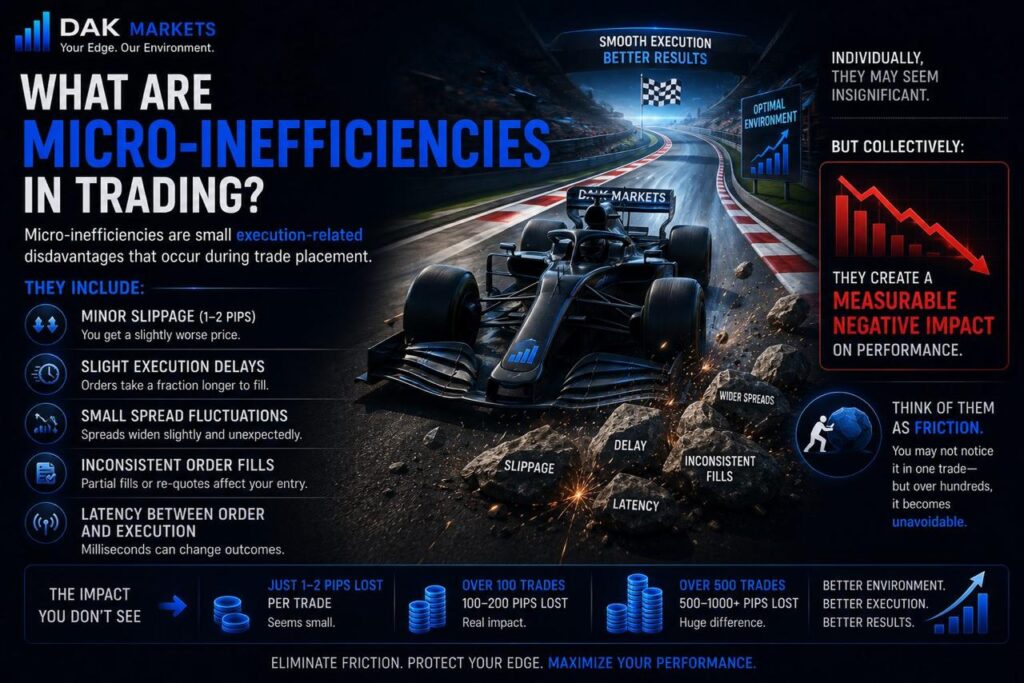
Micro-inefficiencies are small execution-related disadvantages that occur during trade placement.
They include:
- Minor slippage (1–2 pips)
- Slight execution delays
- Small spread fluctuations
- Inconsistent order fills
- Latency between order placement and execution
Individually, these may seem insignificant.
But collectively:
👉 They create a measurable negative impact on performance.
Think of them as friction.
You may not notice it in one trade — but over hundreds, it becomes unavoidable.
The Compounding Effect of Small Disadvantages
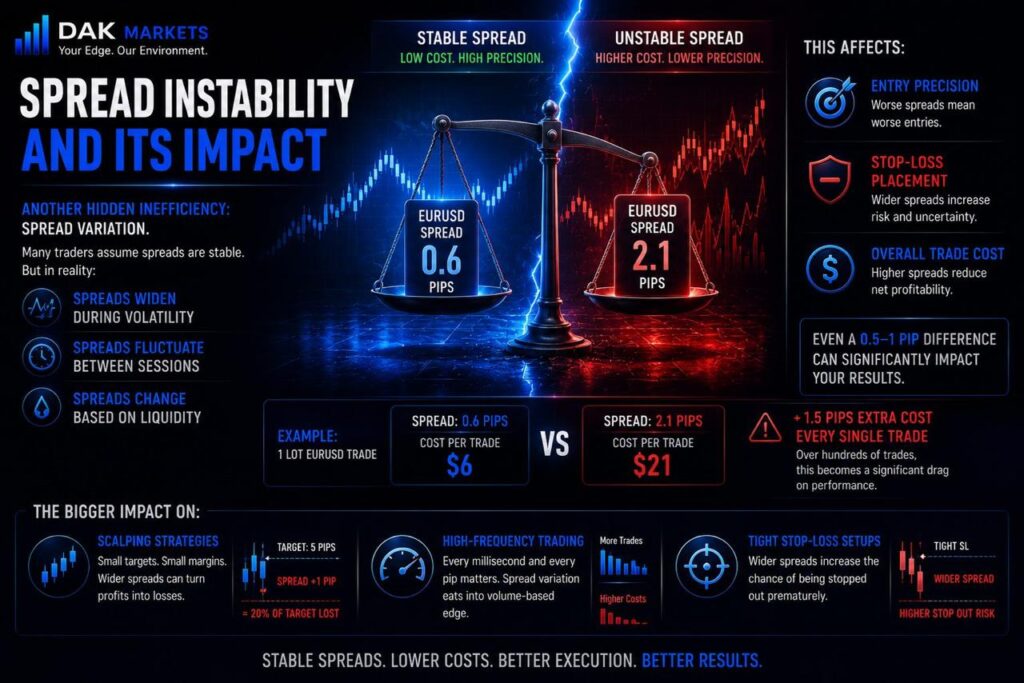
Here’s where most traders underestimate the problem.
Let’s break it down:
- You take 200 trades per month
- Each trade loses 1 pip due to inefficiency
That equals:
👉 200 pips lost monthly
Now scale that over time:
👉 200 pips × 12 months = 2400 pips per year
That’s not a small issue.
That’s the difference between:
- A profitable system
- And a losing one
This is why many traders feel like:
👉 “My strategy works in backtesting — but fails in live trading.”
Because backtests don’t account for real-world inefficiencies.
Why Backtesting Doesn’t Reveal the Truth
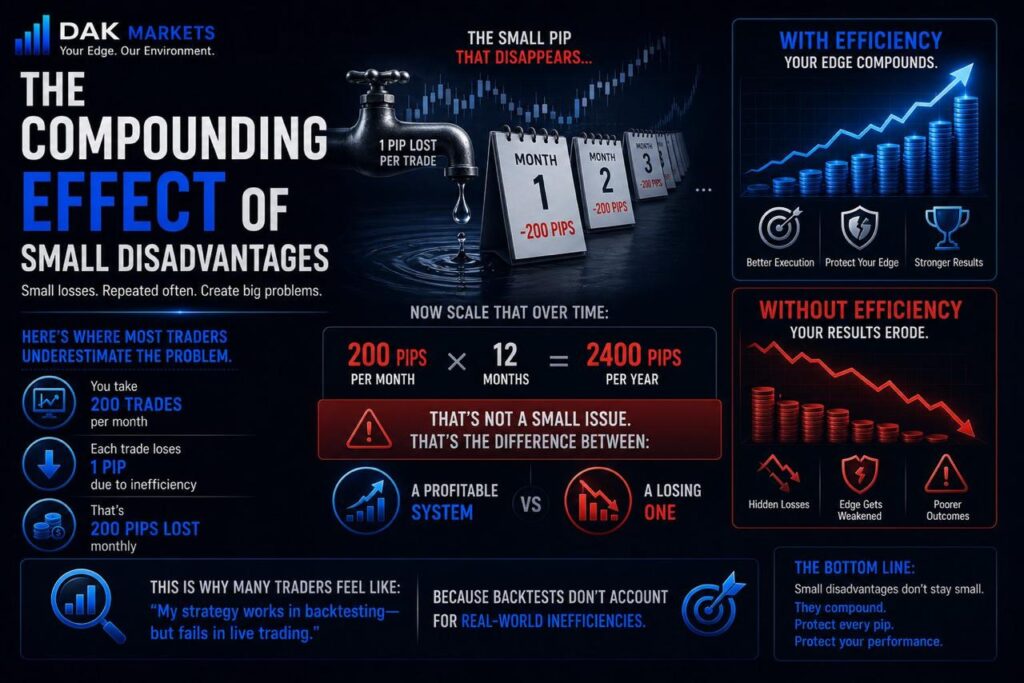
Backtesting assumes ideal conditions:
- Instant execution
- Perfect pricing
- Zero slippage
- Stable spreads
But real markets don’t operate like that.
In live trading:
- Orders must travel through infrastructure
- Liquidity must be matched
- Prices constantly change
This creates a gap between:
👉 Theoretical performance vs. real performance
And that gap is where micro-inefficiencies live.
Latency: The Invisible Delay
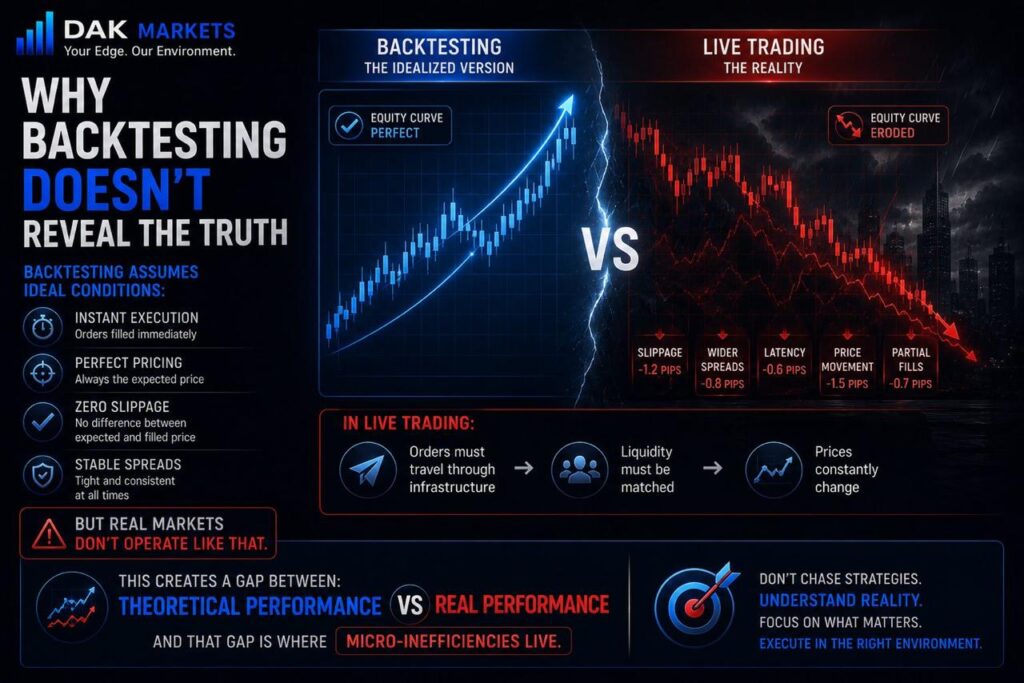
Latency is one of the most overlooked inefficiencies.
It refers to the time it takes for your order to reach the market and be executed.
Even milliseconds matter.
Because in fast-moving markets:
👉 Price can change before your order is filled.
This results in:
- Worse entry prices
- Reduced reward-to-risk ratios
- Missed optimal entries
Most traders never measure latency.
But they experience its effects daily.
Spread Instability and Its Impact
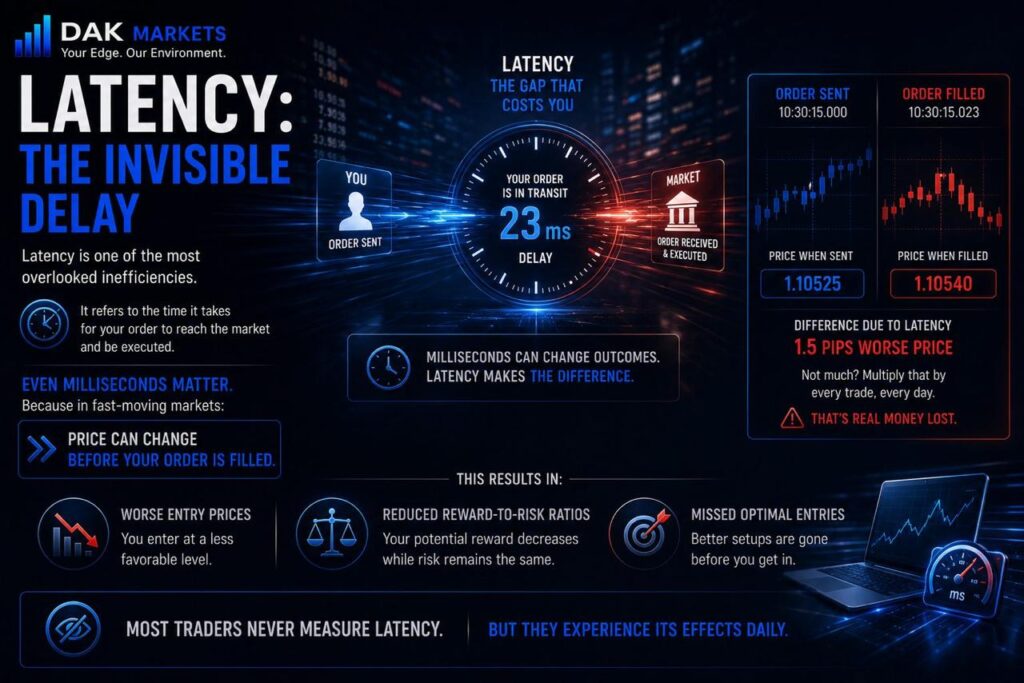
Another hidden inefficiency is spread variation.
Many traders assume spreads are stable.
But in reality:
- Spreads widen during volatility
- Spreads fluctuate between sessions
- Spreads change based on liquidity
This affects:
- Entry precision
- Stop-loss placement
- Overall trade cost
Even a 0.5–1 pip difference can significantly impact:
- Scalping strategies
- High-frequency trading
- Tight stop-loss setups
Slippage: The Silent Performance Killer
Slippage is one of the most well-known inefficiencies — but still underestimated.
It occurs when your order is filled at a different price than expected.
This can happen due to:
- Market volatility
- Low liquidity
- Execution delays
While occasional slippage is normal, consistent slippage is a problem.
Because it systematically reduces:
- Profit margins
- Trade accuracy
- Overall consistency
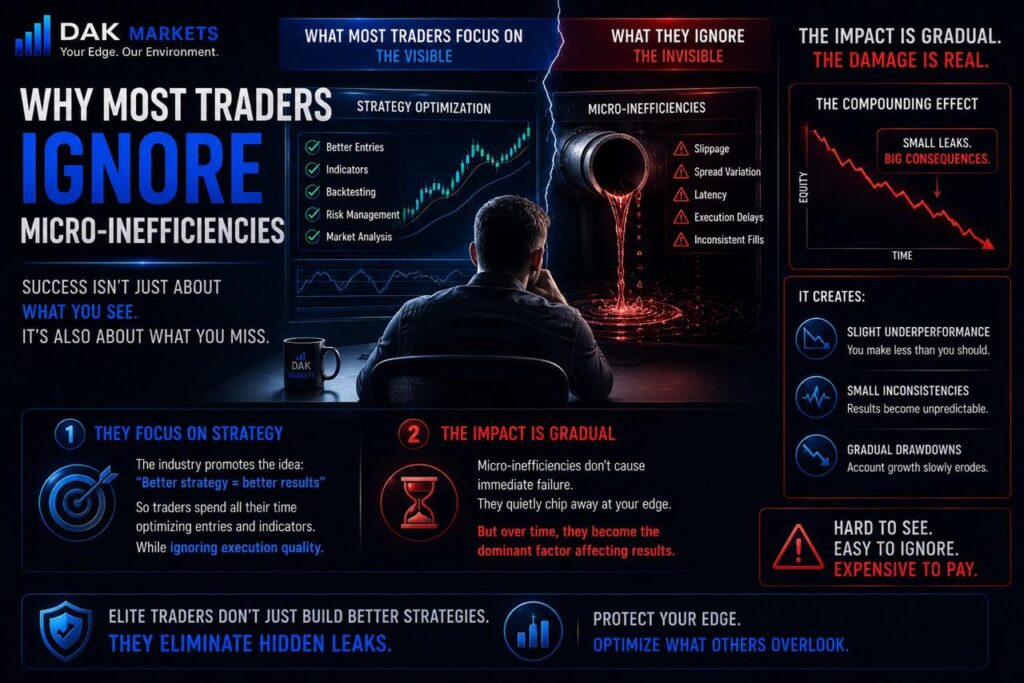
Why Most Traders Ignore Micro-Inefficiencies
There are two main reasons:
1. They Focus on Strategy
The industry promotes the idea that:
👉 “Better strategy = better results”
So traders spend all their time optimizing entries and indicators while ignoring execution quality.
2. The Impact Is Gradual
Micro-inefficiencies don’t cause immediate failure.
Instead, they create:
- Slight underperformance
- Small inconsistencies
- Gradual drawdowns
Which makes them harder to identify.
But over time:
👉 They become the dominant factor affecting results.
How to Reduce Micro-Inefficiencies
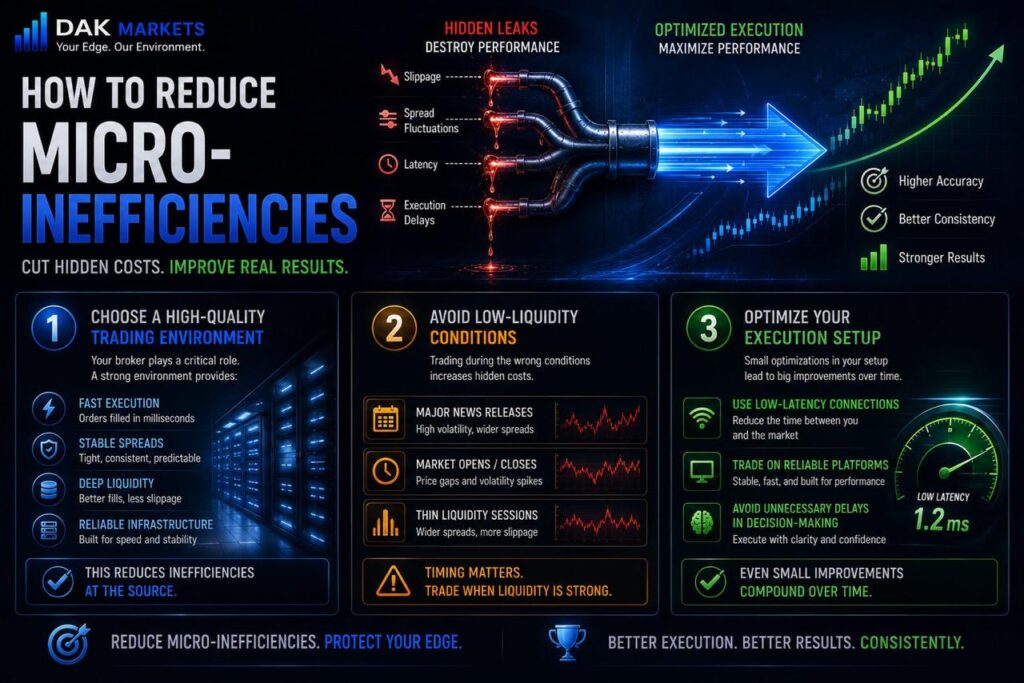
To improve performance, traders need to minimize these hidden costs.
1. Choose a High-Quality Trading Environment
Your broker plays a critical role.
A strong trading environment provides:
- Fast execution
- Stable spreads
- Deep liquidity
- Reliable infrastructure
This reduces inefficiencies at the source.
2. Avoid Low-Liquidity Conditions
Trading during:
- Major news releases
- Market opens and closes
- Thin liquidity sessions
Can increase inefficiencies significantly.
Timing matters.
3. Optimize Your Execution Setup
Consider:
- Using low-latency connections
- Trading on reliable platforms
- Avoiding unnecessary delays in decision-making
Even small improvements help.
How DAK Markets Minimizes Execution Inefficiencies
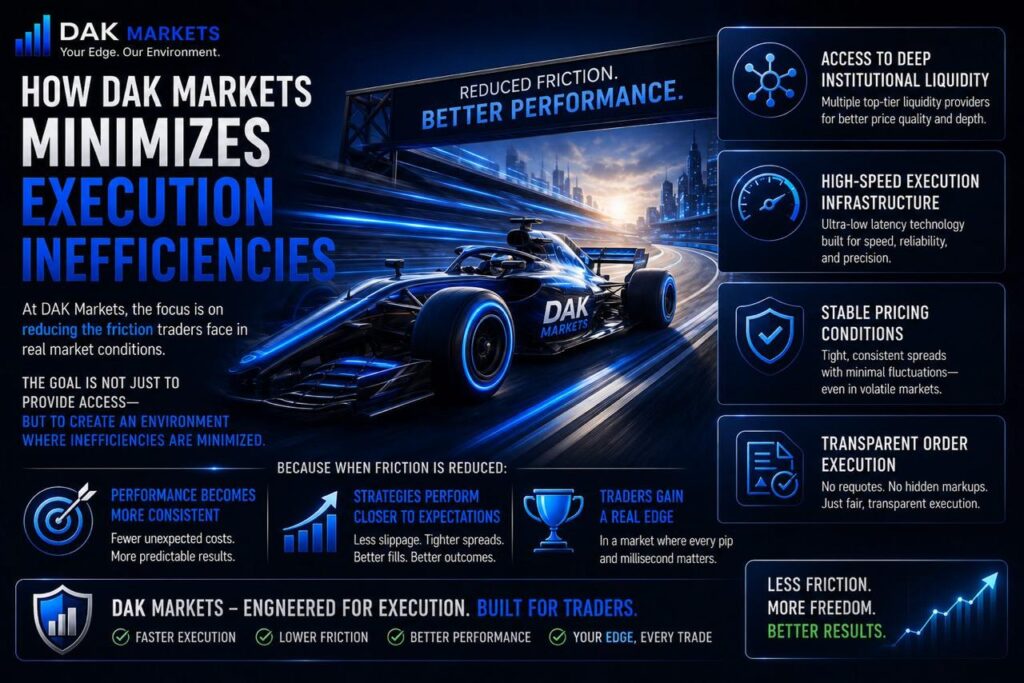
DAK Markets focuses on reducing the friction traders face in real market conditions.
This includes:
- Access to deep institutional liquidity
- High-speed execution infrastructure
- Stable pricing conditions
- Transparent order execution
The goal is not just to provide market access —
👉 But to create an environment where inefficiencies are minimized.
Because when friction is reduced:
- Performance becomes more consistent
- Strategies perform closer to expectations
- Traders gain a real edge
The Long-Term Advantage of Efficiency
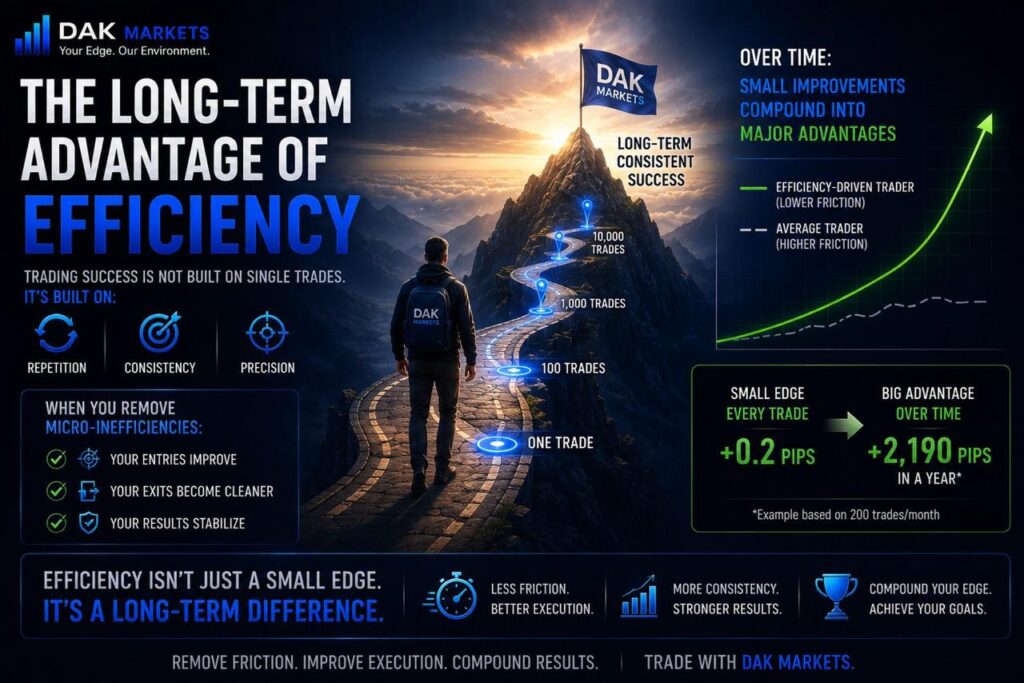
Trading success is not built on single trades.
It’s built on:
👉 Repetition
👉 Consistency
👉 Precision
When you remove micro-inefficiencies:
- Entries improve
- Exits become cleaner
- Results stabilize
Over time:
👉 Small improvements compound into major advantages.
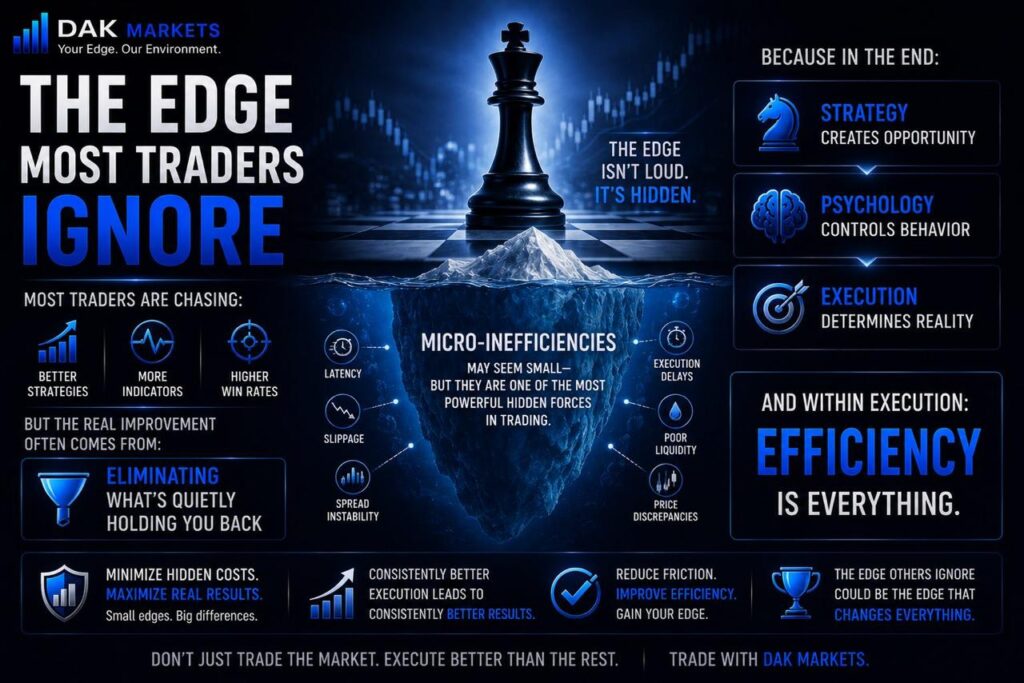
Final Thoughts: The Edge Most Traders Ignore
Most traders are chasing:
- Better strategies
- More indicators
- Higher win rates
But the real improvement often comes from:
👉 Eliminating what’s quietly holding you back.
Micro-inefficiencies may seem small — but they are one of the most powerful hidden forces in trading.
Because in the end:
- Strategy creates opportunity
- Psychology controls behavior
- Execution determines reality
And within execution:
👉 Efficiency is everything.