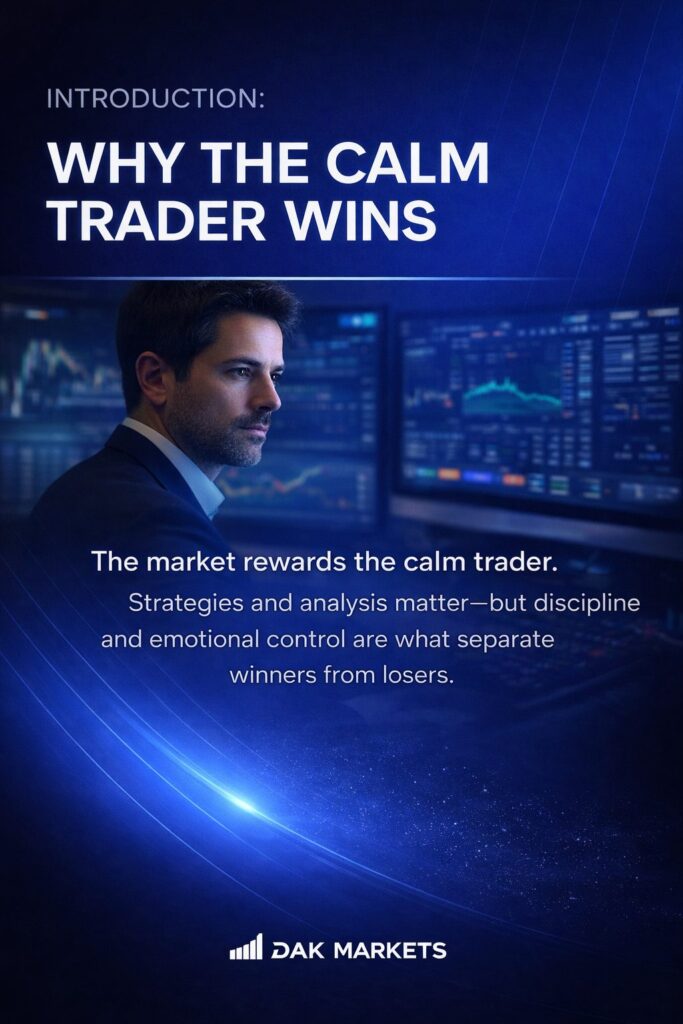
Introduction: Why the Calm Trader Wins
In financial markets, success is often misunderstood. Many traders believe that speed, intelligence, or complex strategies are the key to profitability. However, the reality is far simpler—and far more challenging.
The market rewards the calm trader.
This principle is at the core of long-term success. While strategies and technical analysis play a role, the ability to remain calm under pressure is what separates profitable traders from those who consistently lose.
At DAK Markets, we emphasize disciplined execution and emotional control because we understand that trading is not just a technical challenge—it is a psychological one.
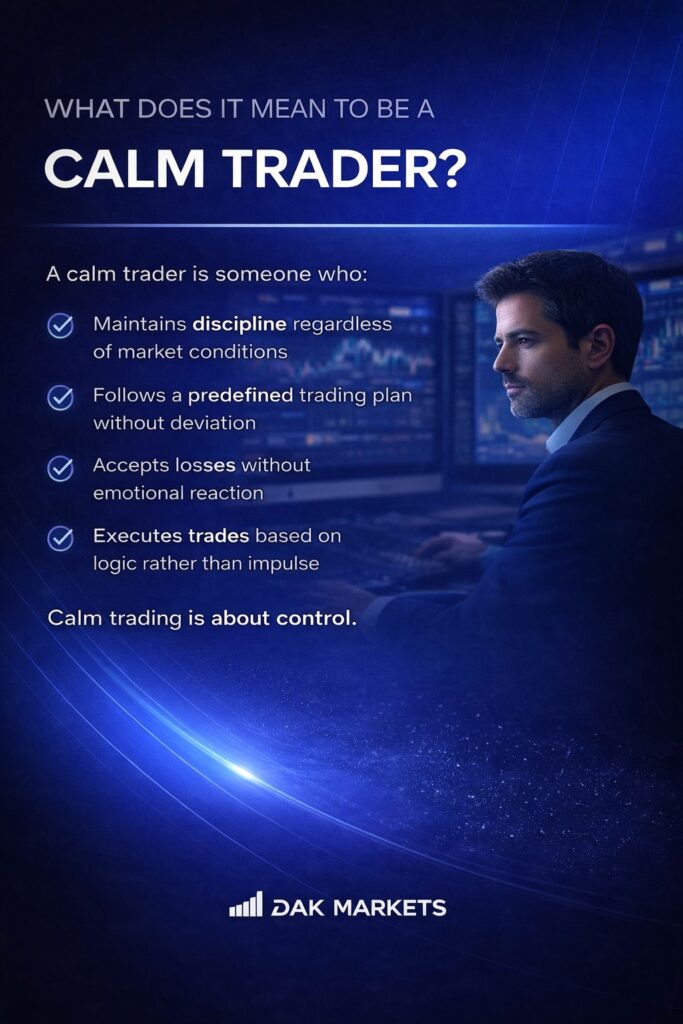
What Does It Mean to Be a Calm Trader?
A calm trader is not someone who avoids risk or never experiences emotion. Instead, a calm trader is someone who:
- Maintains discipline regardless of market conditions
- Follows a predefined trading plan without deviation
- Accepts losses without emotional reaction
- Executes trades based on logic rather than impulse
Calm trading is about control.
When markets become volatile, most traders react emotionally. They chase price movements, over-leverage positions, or exit trades prematurely. In contrast, the calm trader remains composed and focused.
This ability to stay grounded is what creates consistency.
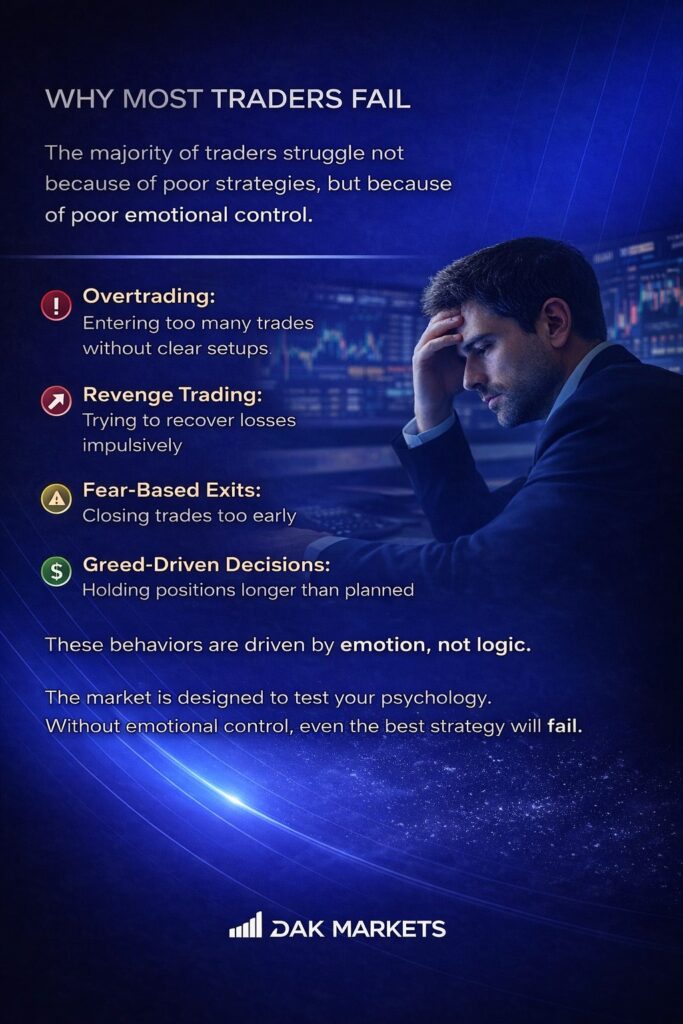
Why Most Traders Fail
The majority of traders struggle not because of poor strategies, but because of poor emotional control.
Common mistakes include:
- Overtrading: Entering too many trades without clear setups
- Revenge trading: Trying to recover losses impulsively
- Fear-based exits: Closing trades too early
- Greed-driven decisions: Holding positions longer than planned
These behaviors are driven by emotion, not logic.
The market is designed to test your psychology. Without emotional control, even the best strategy will fail.
The Psychology Behind Calm Trading
Trading triggers powerful emotions—fear, greed, excitement, and frustration. These emotions can override rational decision-making if not managed properly.
A calm trader understands that:
- Every trade has uncertainty
- Losses are part of the process
- Outcomes cannot be controlled—only execution can
This mindset allows traders to detach from individual results and focus on long-term performance.
The goal is not to eliminate emotion—but to prevent emotion from controlling your actions.
Discipline: The Foundation of Every Calm Trader
Discipline is what transforms knowledge into results.
Without discipline:
- Strategies are ignored
- Risk management breaks down
- Consistency disappears
With discipline:
- Trades are executed according to plan
- Risk is controlled at all times
- Long-term profitability becomes achievable
A calm trader is, above all, a disciplined trader.
This is why professional traders prioritize process over outcome. They understand that consistent execution leads to consistent results.
Risk Management: Staying Calm Under Pressure
One of the biggest reasons traders lose control is poor risk management.
When too much capital is at risk, emotions intensify. Fear and stress increase, leading to irrational decisions.
A calm trader avoids this by:
- Risking a small percentage per trade (e.g., 1%)
- Using stop-loss orders consistently
- Avoiding excessive leverage
- Maintaining a structured approach to capital preservation
Proper risk management creates confidence.
When you know that a single trade cannot significantly impact your account, it becomes much easier to remain calm and objective.
Execution Over Emotion
Successful trading is not about predicting the market perfectly—it is about executing consistently.
A calm trader focuses on:
- Following entry and exit rules
- Managing trades according to plan
- Avoiding impulsive decisions
Execution is everything.
Even a profitable strategy can fail if it is not executed properly. Emotional interference is one of the biggest barriers to consistent execution.
The calm trader removes this barrier by trusting the process.
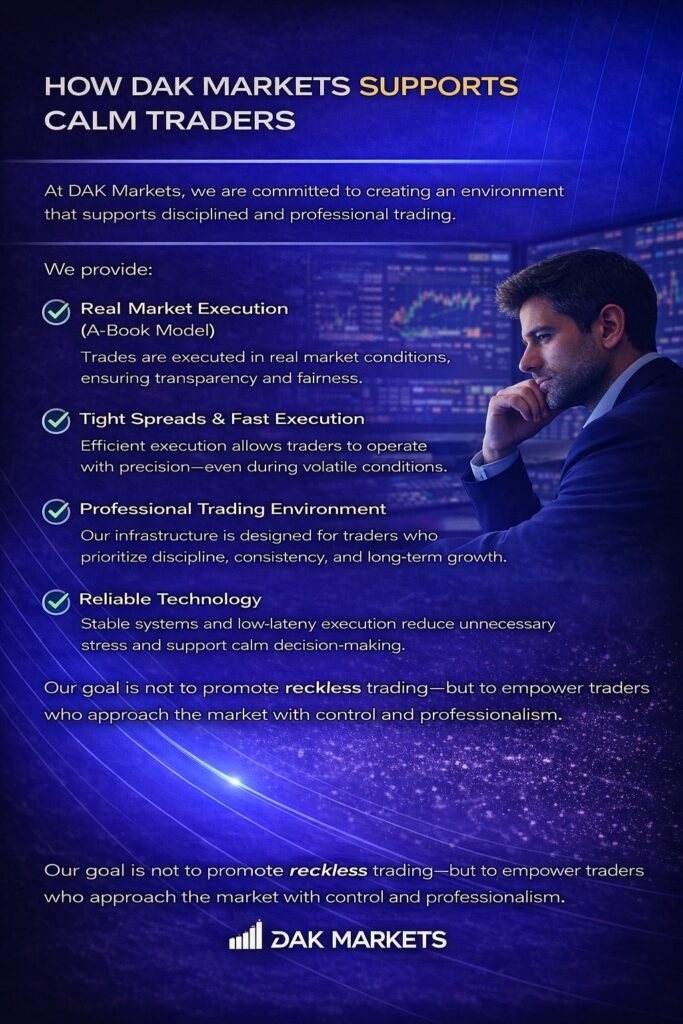
How DAK Markets Supports Calm Traders
At DAK Markets, we are committed to creating an environment that supports disciplined and professional trading.
We provide:
✔ Real Market Execution (A-Book Model)
Trades are executed in real market conditions, ensuring transparency and fairness.
✔ Tight Spreads & Fast Execution
Efficient execution allows traders to operate with precision—even during volatile conditions.
✔ Professional Trading Environment
Our infrastructure is designed for traders who prioritize discipline, consistency, and long-term growth.
✔ Reliable Technology
Stable systems and low-latency execution reduce unnecessary stress and support calm decision-making.
Our goal is not to promote reckless trading—but to empower traders who approach the market with control and professionalism.
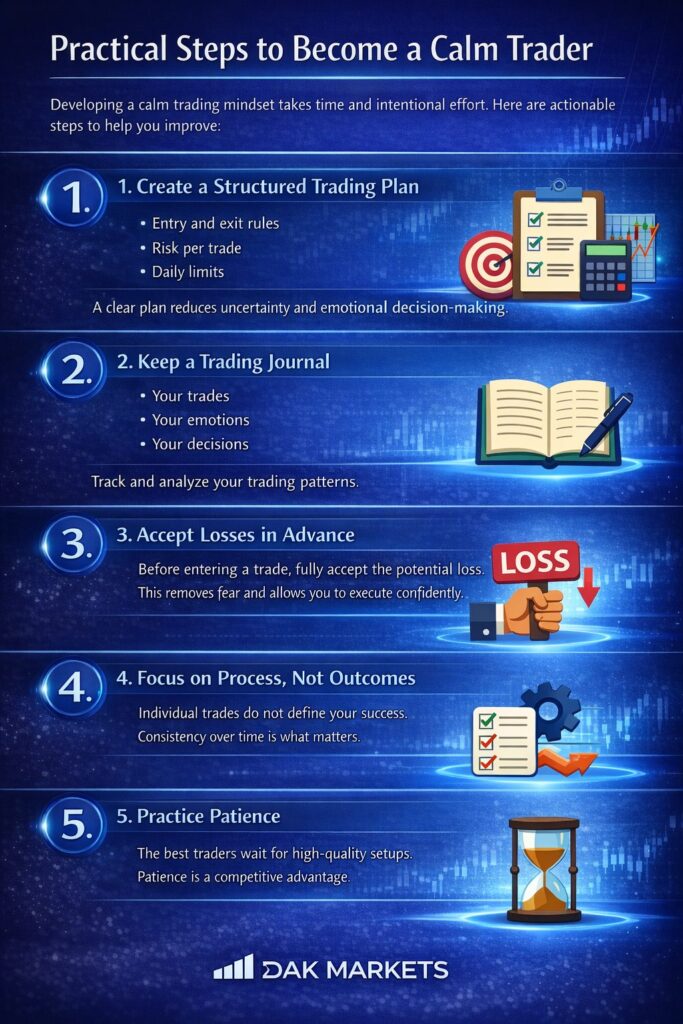
Practical Steps to Become a Calm Trader
Developing a calm trading mindset takes time and intentional effort. Here are actionable steps to help you improve:
1. Create a Structured Trading Plan
Define your:
- Entry and exit rules
- Risk per trade
- Daily limits
A clear plan reduces uncertainty and emotional decision-making.
2. Keep a Trading Journal
Track:
- Your trades
- Your emotions
- Your decisions
This builds self-awareness and helps identify patterns that lead to mistakes.
3. Accept Losses in Advance
Before entering a trade, fully accept the potential loss.
This removes fear and allows you to execute confidently.
4. Focus on Process, Not Outcomes
Individual trades do not define your success.
Consistency over time is what matters.
5. Practice Patience
The best traders wait for high-quality setups.
Patience is a competitive advantage.
Conclusion: Calm Is the Real Edge
The market does not reward speed, noise, or emotion.
It rewards discipline.
It rewards patience.
It rewards control.
The calm trader is not just more consistent—they are more dangerous in the market. While others react emotionally, they execute with precision.
At DAK Markets, we believe that true trading success comes from combining professional execution with a disciplined mindset.
Because in the end, your strategy matters—but your psychology determines whether it works.