
Introduction
In trading, success is often believed to come from strategy, indicators, or market knowledge. While these factors are important, they are not what ultimately separates profitable traders from struggling ones. The real difference lies in psychology—specifically, how traders interpret and respond to market events.
One of the most powerful psychological tools a trader can develop is cognitive reappraisal. This technique allows traders to reshape their emotional responses, maintain discipline, and make rational decisions even in high-pressure situations.
In this article, we’ll explore what cognitive reappraisal is, how it impacts trading performance, and how you can apply it to trade smarter and more consistently.
What Is Cognitive Reappraisal?
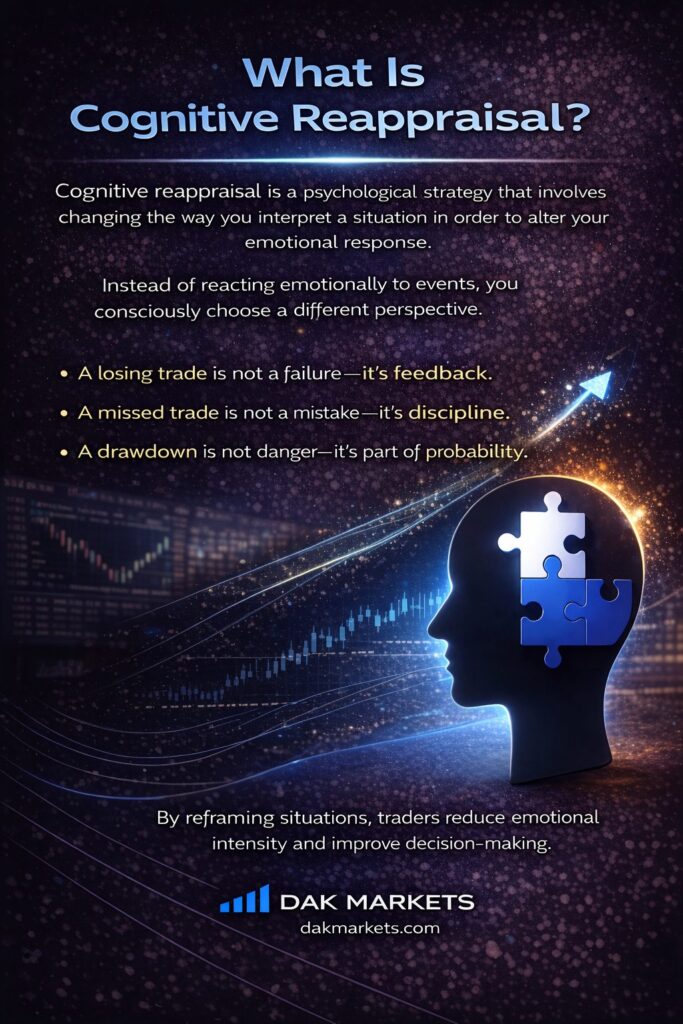
Cognitive reappraisal is a psychological strategy that involves changing the way you interpret a situation in order to alter your emotional response.
Instead of reacting emotionally to events, you consciously choose a different perspective.
For example:
- A losing trade is not a failure—it’s feedback.
- A missed trade is not a mistake—it’s discipline.
- A drawdown is not danger—it’s part of probability.
By reframing situations, traders reduce emotional intensity and improve decision-making.
Why Cognitive Reappraisal Is Critical in Trading
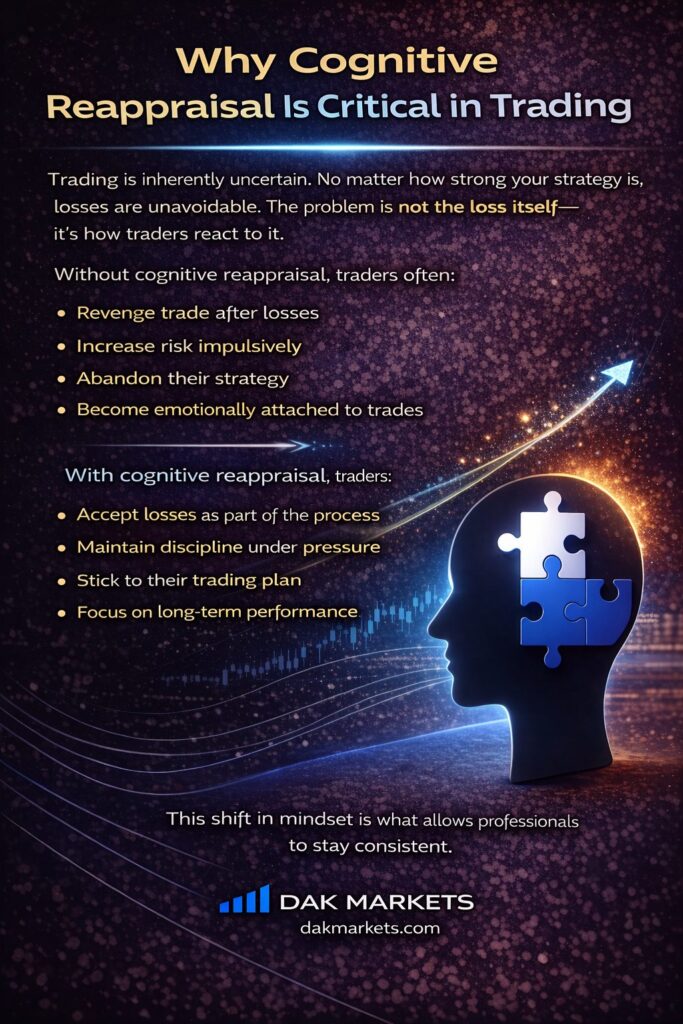
Trading is inherently uncertain. No matter how strong your strategy is, losses are unavoidable. The problem is not the loss itself—it’s how traders react to it.
Without cognitive reappraisal, traders often:
- Revenge trade after losses
- Increase risk impulsively
- Abandon their strategy
- Become emotionally attached to trades
These behaviors lead to inconsistency and account blowouts.
With cognitive reappraisal, traders:
- Accept losses as part of the process
- Maintain discipline under pressure
- Stick to their trading plan
- Focus on long-term performance
This shift in mindset is what allows professionals to stay consistent.
The Psychology Behind Trading Decisions
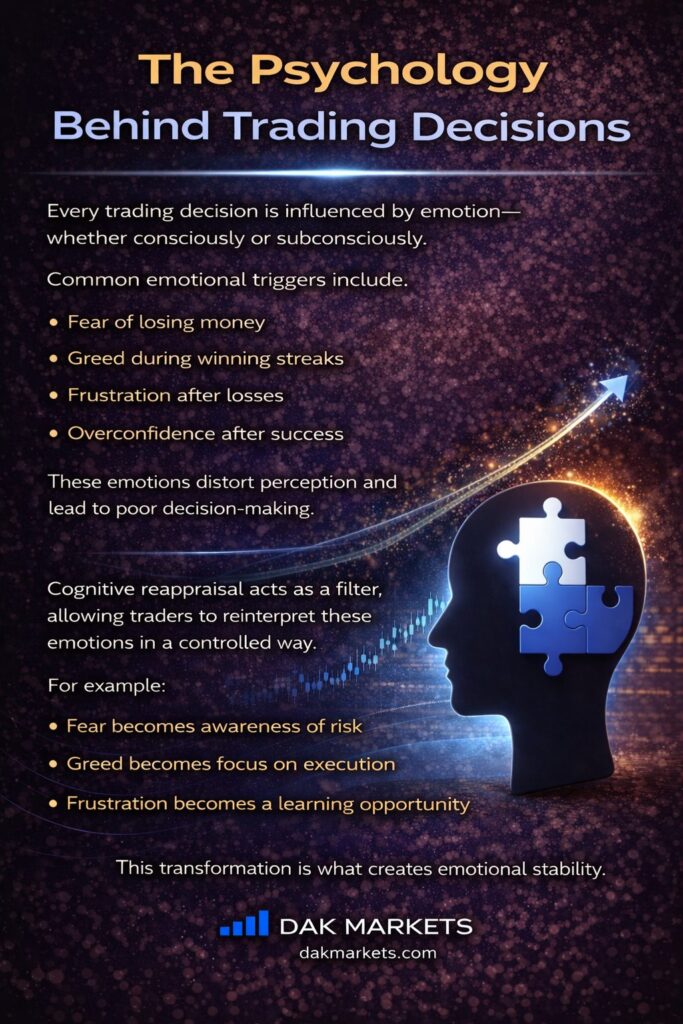
Every trading decision is influenced by emotion—whether consciously or subconsciously.
Common emotional triggers include:
- Fear of losing money
- Greed during winning streaks
- Frustration after losses
- Overconfidence after success
These emotions distort perception and lead to poor decision-making.
Cognitive reappraisal acts as a filter, allowing traders to reinterpret these emotions in a controlled way.
For example:
- Fear becomes awareness of risk
- Greed becomes focus on execution
- Frustration becomes a learning opportunity
This transformation is what creates emotional stability.
How Cognitive Reappraisal Improves Trading Performance
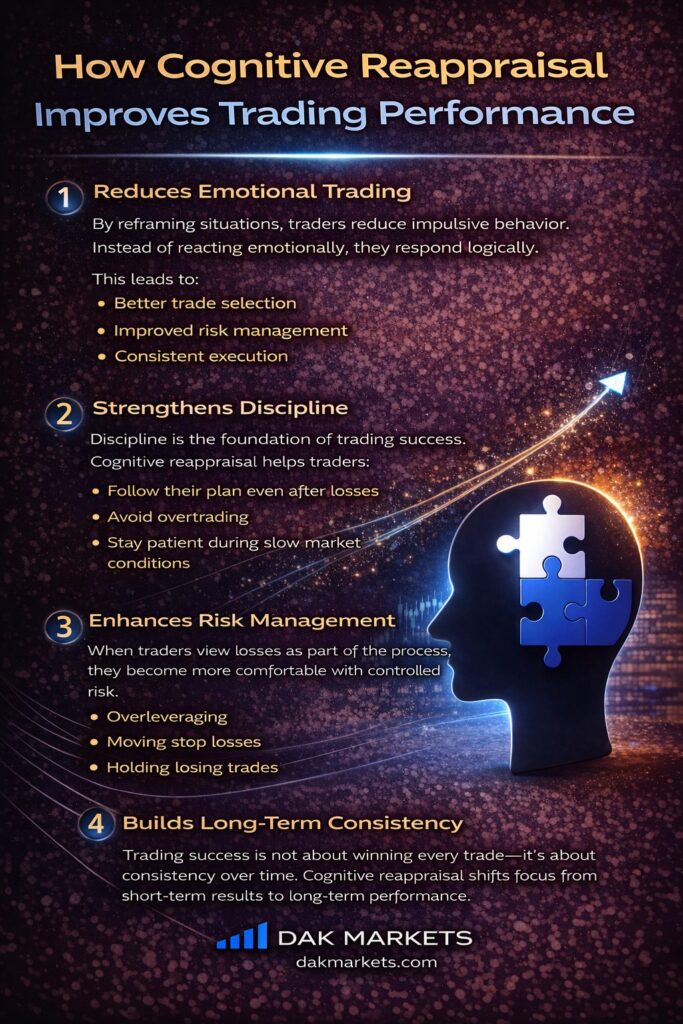
1. Reduces Emotional Trading
By reframing situations, traders reduce impulsive behavior. Instead of reacting emotionally, they respond logically.
This leads to:
- Better trade selection
- Improved risk management
- Consistent execution
2. Strengthens Discipline
Discipline is the foundation of trading success.
Cognitive reappraisal helps traders:
- Follow their plan even after losses
- Avoid overtrading
- Stay patient during slow market conditions
3. Enhances Risk Management
When traders view losses as part of the process, they become more comfortable with controlled risk.
This prevents:
- Overleveraging
- Moving stop losses
- Holding losing trades
4. Builds Long-Term Consistency
Trading success is not about winning every trade—it’s about consistency over time.
Cognitive reappraisal shifts focus from short-term results to long-term performance.
Practical Examples in Trading
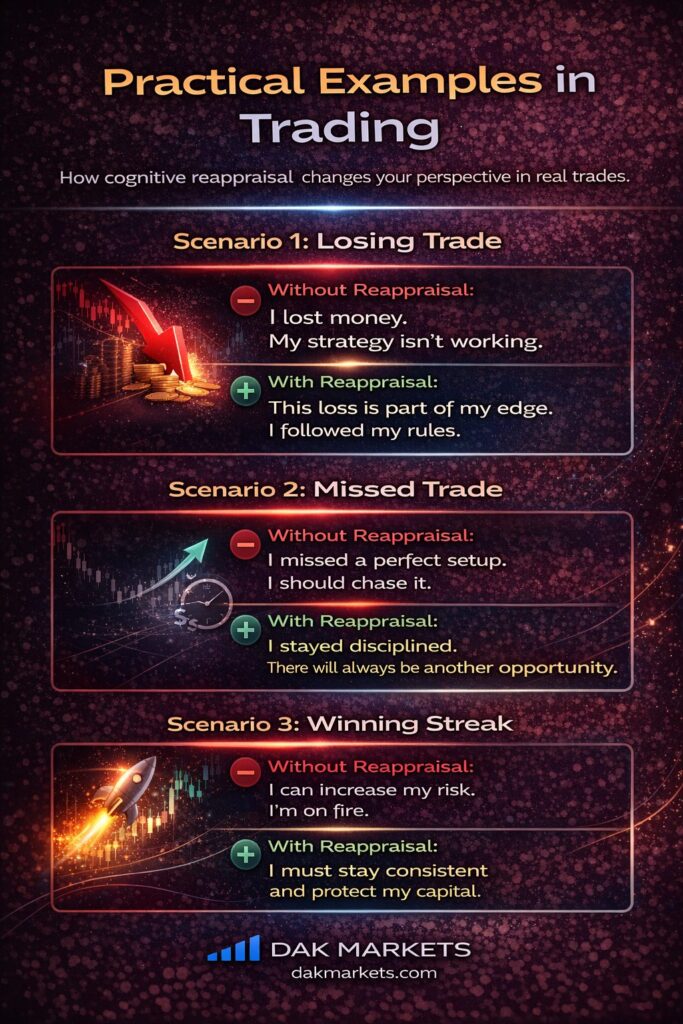
Scenario 1: Losing Trade
Without reappraisal:
“I lost money. My strategy isn’t working.”
With reappraisal:
“This loss is part of my edge. I followed my rules.”
Scenario 2: Missed Trade
Without reappraisal:
“I missed a perfect setup. I should chase it.”
With reappraisal:
“I stayed disciplined. There will always be another opportunity.”
Scenario 3: Winning Streak
Without reappraisal:
“I can increase my risk. I’m on fire.”
With reappraisal:
“I must stay consistent and protect my capital.”
How to Apply Cognitive Reappraisal in Trading
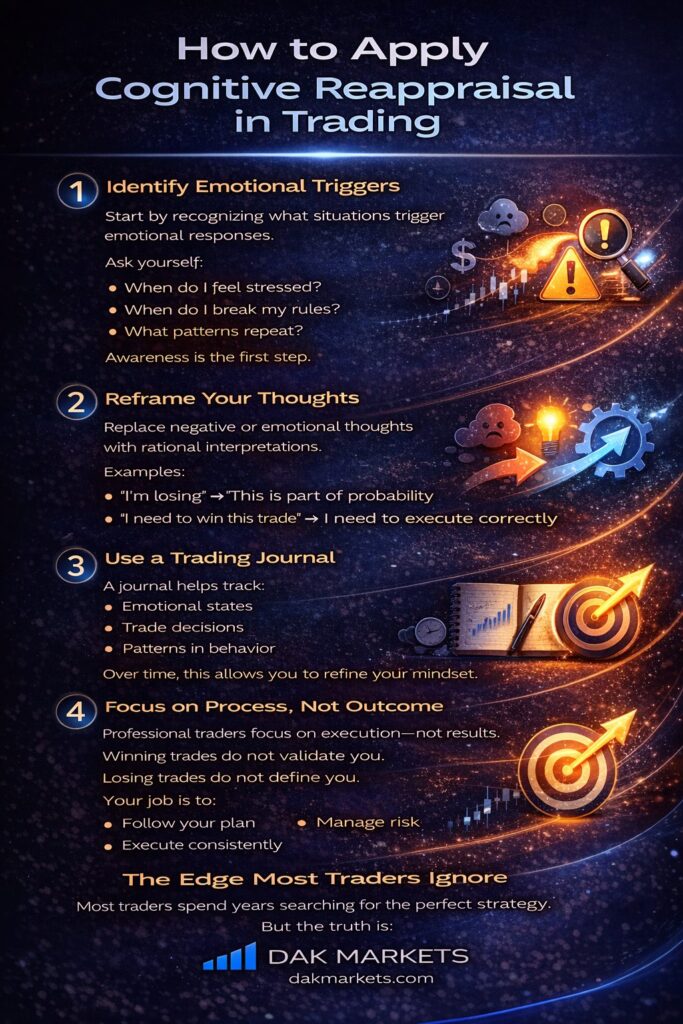
1. Identify Emotional Triggers
Start by recognizing what situations trigger emotional responses.
Ask yourself:
- When do I feel stressed?
- When do I break my rules?
- What patterns repeat?
Awareness is the first step.
2. Reframe Your Thoughts
Replace negative or emotional thoughts with rational interpretations.
Examples:
- “I’m losing” → “This is part of probability”
- “I need to win this trade” → “I need to execute correctly”
3. Use a Trading Journal
A journal helps track:
- Emotional states
- Trade decisions
- Patterns in behavior
Over time, this allows you to refine your mindset.
4. Focus on Process, Not Outcome
Professional traders focus on execution—not results.
Winning trades do not validate you. Losing trades do not define you.
Your job is to:
- Follow your plan
- Manage risk
- Execute consistently
5. Practice Consistently
Cognitive reappraisal is a skill. It improves with repetition.
The more you practice reframing situations, the more natural it becomes.
The Edge Most Traders Ignore
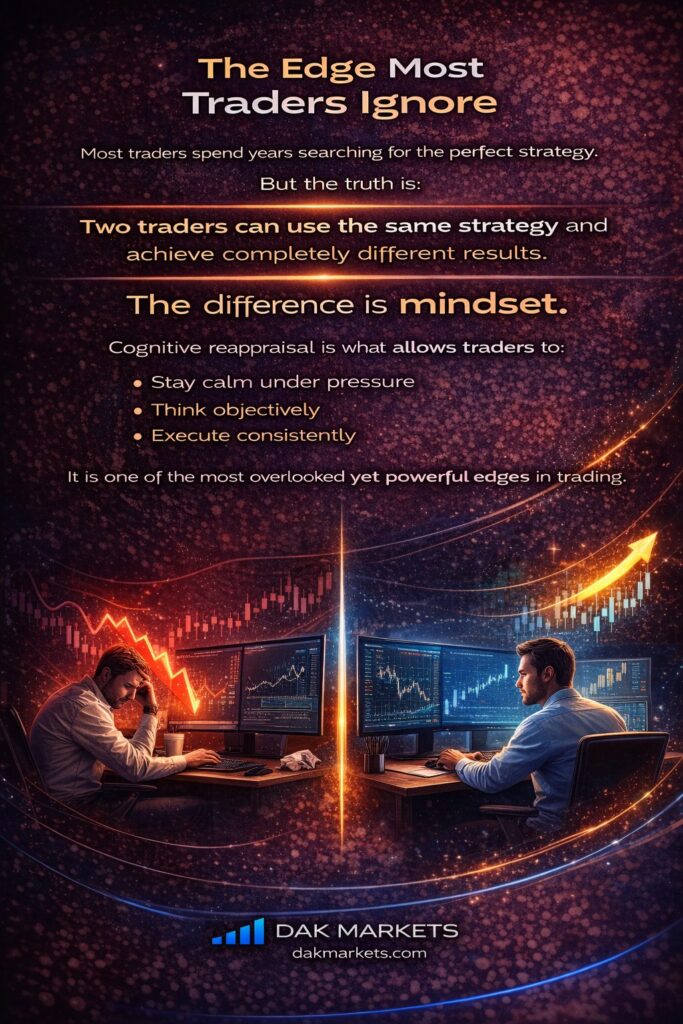
Most traders spend years searching for the perfect strategy.
But the truth is:
Two traders can use the same strategy and achieve completely different results.
The difference is mindset.
Cognitive reappraisal is what allows traders to:
- Stay calm under pressure
- Think objectively
- Execute consistently
It is one of the most overlooked yet powerful edges in trading.
Conclusion
Mastering your mind is one of the most important steps in becoming a successful trader.
Cognitive reappraisal gives you the ability to:
- Control your emotions
- Improve your decision-making
- Stay disciplined in any market condition
Trading is not about being right—it’s about being consistent.
When you learn to reframe your thoughts, you stop reacting to the market and start operating like a professional.