Introduction
In the world of financial markets, success is not determined solely by strategy or technical knowledge. One of the most overlooked yet critical factors in trading performance is psychology—specifically, confirmation bias in trading.
Many traders fail not because they lack skill, but because they unknowingly fall into cognitive traps that distort their decision-making. Among these, confirmation bias is one of the most dangerous.
Understanding how confirmation bias works—and how to avoid it—can significantly improve your trading results and long-term consistency.
What Is Confirmation Bias in Trading?
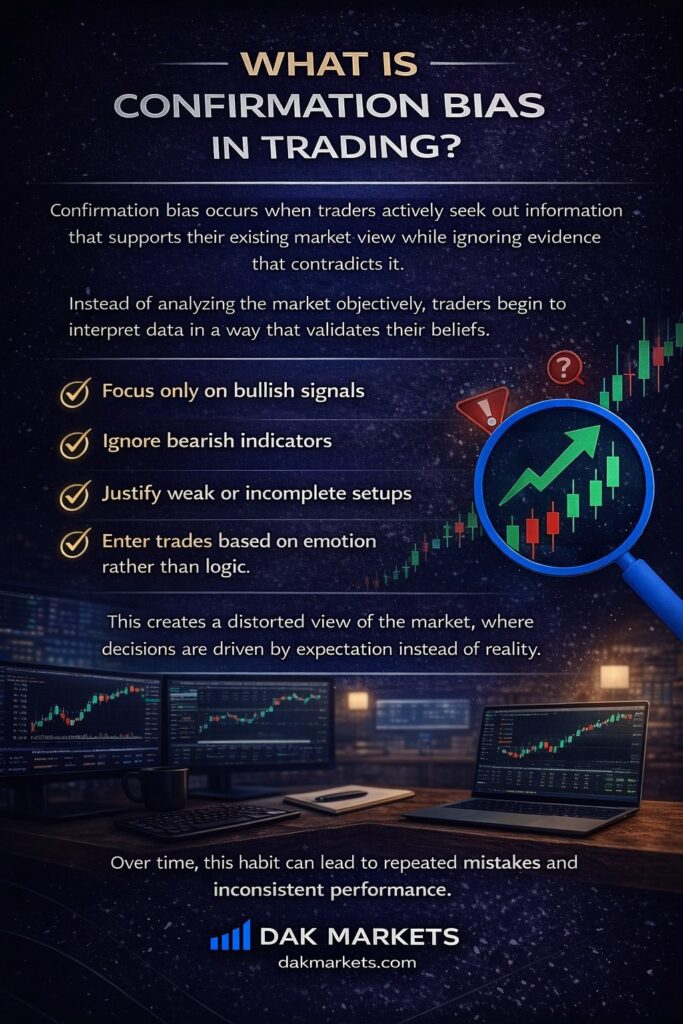
Confirmation bias occurs when traders actively seek out information that supports their existing market view while ignoring evidence that contradicts it.
Instead of analyzing the market objectively, traders begin to interpret data in a way that validates their beliefs.
For example, a trader who believes the market will move higher may:
- Focus only on bullish signals
- Ignore bearish indicators
- Justify weak or incomplete setups
- Enter trades based on emotion rather than logic
This creates a distorted view of the market, where decisions are driven by expectation instead of reality.
Over time, this habit can lead to repeated mistakes and inconsistent performance.
How Confirmation Bias Impacts Your Trading
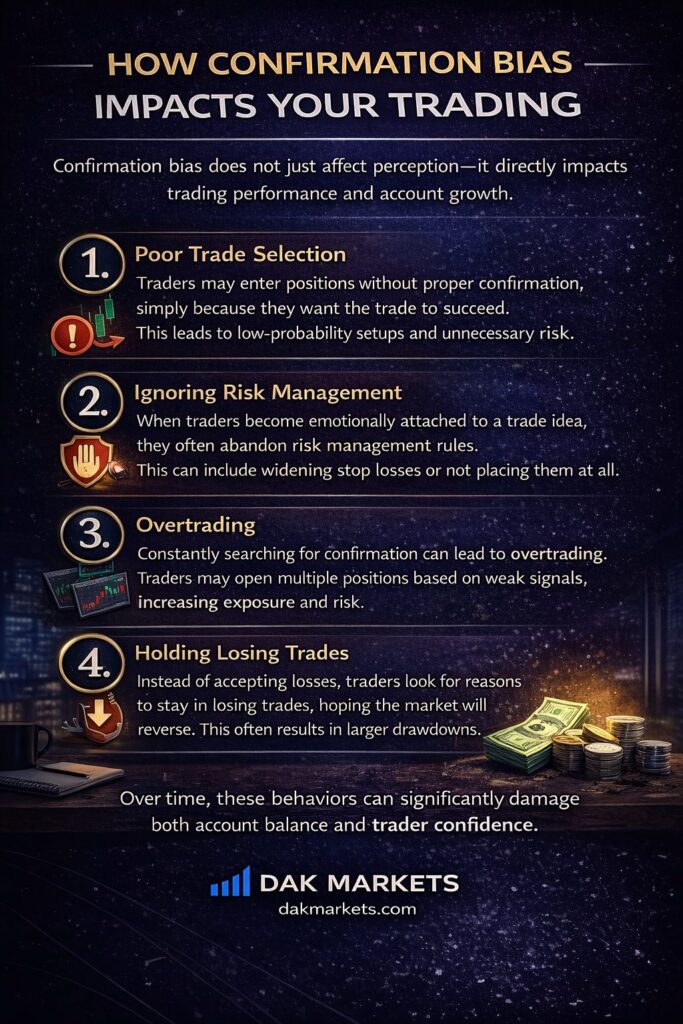
Confirmation bias does not just affect perception—it directly impacts trading performance and account growth.
1. Poor Trade Selection
Traders may enter positions without proper confirmation, simply because they want the trade to succeed. This leads to low-probability setups and unnecessary risk.
2. Ignoring Risk Management
When traders become emotionally attached to a trade idea, they often abandon risk management rules. This can include widening stop losses or not placing them at all.
3. Overtrading
Constantly searching for confirmation can lead to overtrading. Traders may open multiple positions based on weak signals, increasing exposure and risk.
4. Holding Losing Trades
Instead of accepting losses, traders look for reasons to stay in losing trades, hoping the market will reverse. This often results in larger drawdowns.
Over time, these behaviors can significantly damage both account balance and trader confidence.
Why Traders Fall Into This Trap
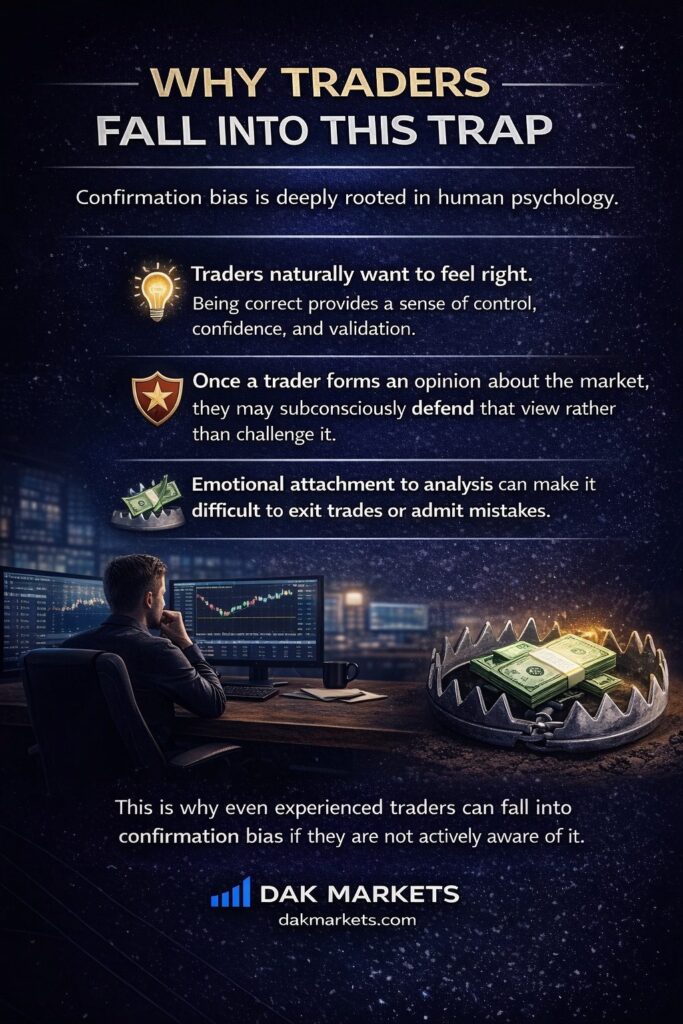
Confirmation bias is deeply rooted in human psychology.
Traders naturally want to feel right. Being correct provides a sense of control, confidence, and validation. However, the market does not reward being right—it rewards discipline and consistency.
Once a trader forms an opinion about the market, they may subconsciously defend that view rather than challenge it.
Additionally, emotional attachment to analysis can make it difficult to exit trades or admit mistakes.
This is why even experienced traders can fall into confirmation bias if they are not actively aware of it.
How Professional Traders Avoid Confirmation Bias
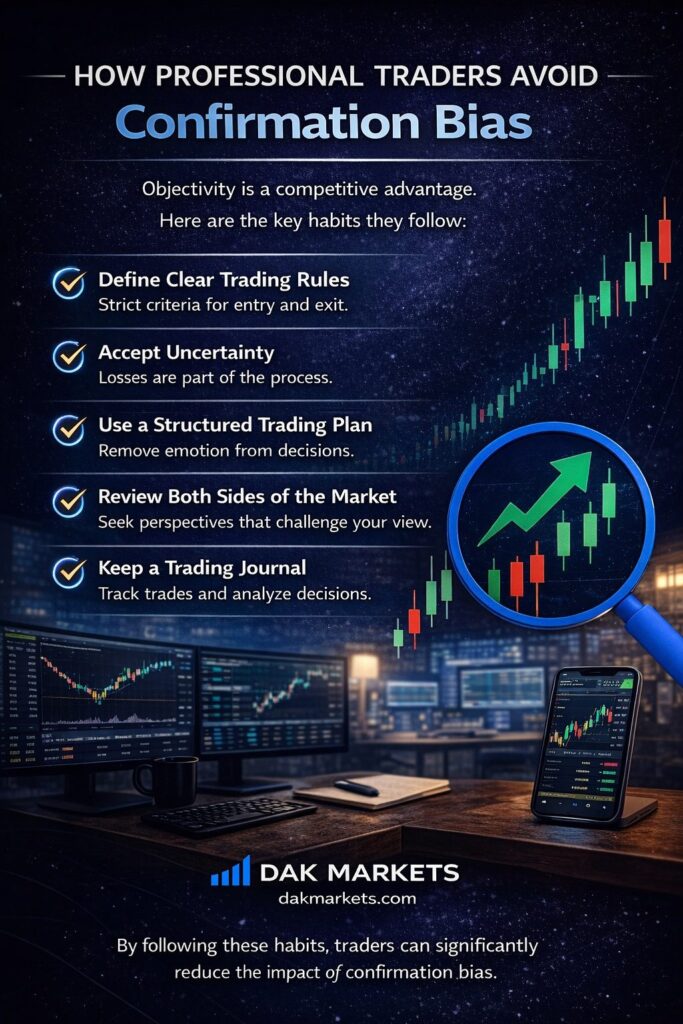
Professional traders understand that objectivity is a competitive advantage. They do not aim to prove themselves right—they aim to execute their strategy correctly.
Here are the key habits they follow:
1. Define Clear Trading Rules
Professional traders operate with strict entry and exit criteria. Trades are only taken when all conditions are met—no exceptions.
2. Accept Uncertainty
They understand that no trade is guaranteed. Losses are part of the process, and uncertainty is inherent in the market.
3. Use a Structured Trading Plan
A trading plan removes emotional decision-making. It provides a clear framework for execution.
4. Review Both Sides of the Market
Before entering a trade, professional traders actively look for reasons why the trade might fail. This balanced perspective reduces bias.
5. Keep a Trading Journal
Tracking trades helps identify patterns of behavior, including bias-driven decisions. Over time, this improves awareness and discipline.
By following these habits, traders can significantly reduce the impact of confirmation bias.
The Role of Your Trading Environment
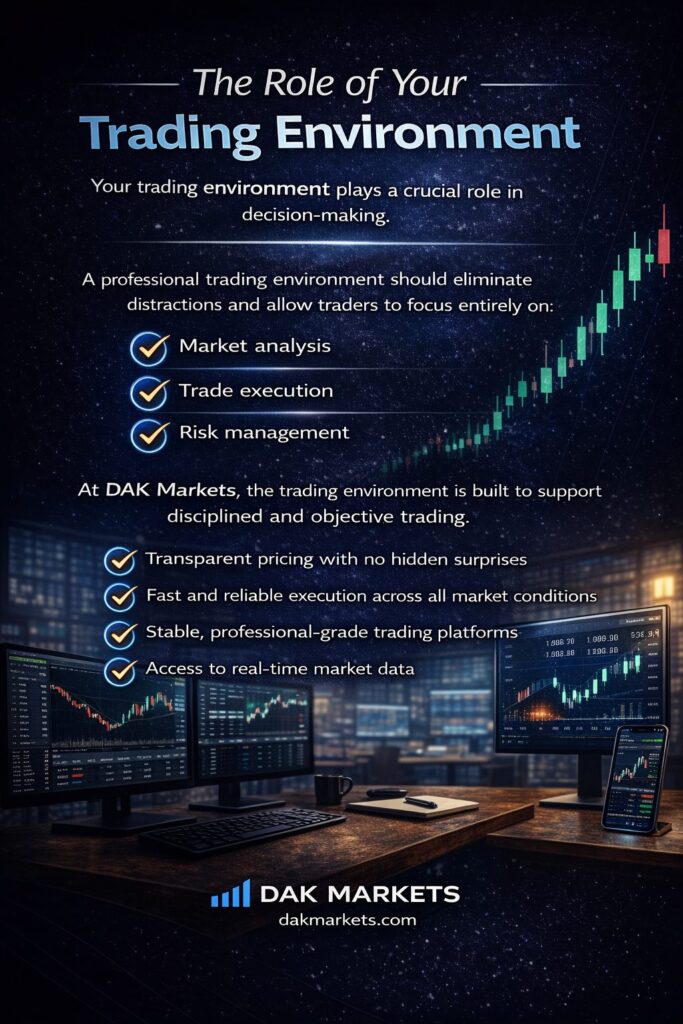
Your trading environment plays a crucial role in decision-making.
Even highly skilled traders can struggle if the tools and infrastructure they rely on are inconsistent or unreliable.
A professional trading environment should eliminate distractions and allow traders to focus entirely on:
- Market analysis
- Trade execution
- Risk management
When a broker lacks transparency or stability, traders may begin to second-guess their decisions. Concerns about slippage, pricing inconsistencies, or platform performance can interfere with clear thinking.
At DAK Markets, the trading environment is built to support disciplined and objective trading:
- Transparent pricing with no hidden surprises
- Fast and reliable execution across all market conditions
- Stable, professional-grade trading platforms
- Access to real-time market data
This foundation allows traders to operate with confidence and clarity.
Building a More Objective Trading Mindset
Overcoming confirmation bias requires intentional effort, self-awareness, and consistent practice.
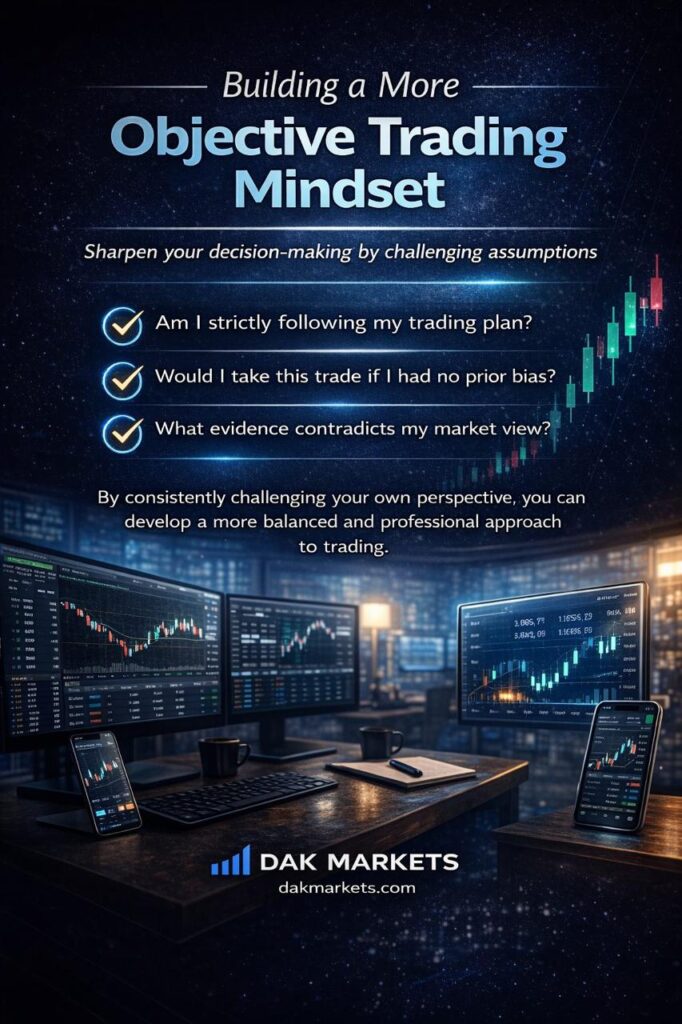
Traders can begin by asking themselves critical questions before entering any position:
- Am I following my trading plan?
- Would I take this trade if I had no bias?
- What evidence contradicts my idea?
These questions force traders to think objectively rather than emotionally.
By consistently challenging their own perspective, traders develop a more balanced and professional approach to the market.
Over time, this leads to:
- Better trade selection
- Improved risk management
- Greater consistency
Conclusion
Confirmation bias is one of the most common and dangerous psychological traps in trading.
It causes traders to see what they want to see, rather than what the market is actually showing. Left unchecked, it can lead to poor decisions, increased risk, and inconsistent results.
However, by developing self-awareness, following structured rules, and operating in a reliable trading environment, traders can overcome this bias.
Success in trading is not about being right—it is about being disciplined, consistent, and objective.
And those who master this mindset gain a powerful edge in the market.