Introduction: Why Central Banks Control the Market
If you want to understand what truly moves financial markets, you must understand one thing:
👉 Central banks are the most powerful players in the market.
While retail traders focus on charts and indicators, institutional traders closely follow central bank decisions.
Why?
Because central banks control:
- Interest rates
- Money supply
- Market liquidity
- Economic direction
At DAK Markets, we emphasize that trading success comes from understanding both technical execution and fundamental drivers. And nothing impacts fundamentals more than central banks.
What Is a Central Bank?
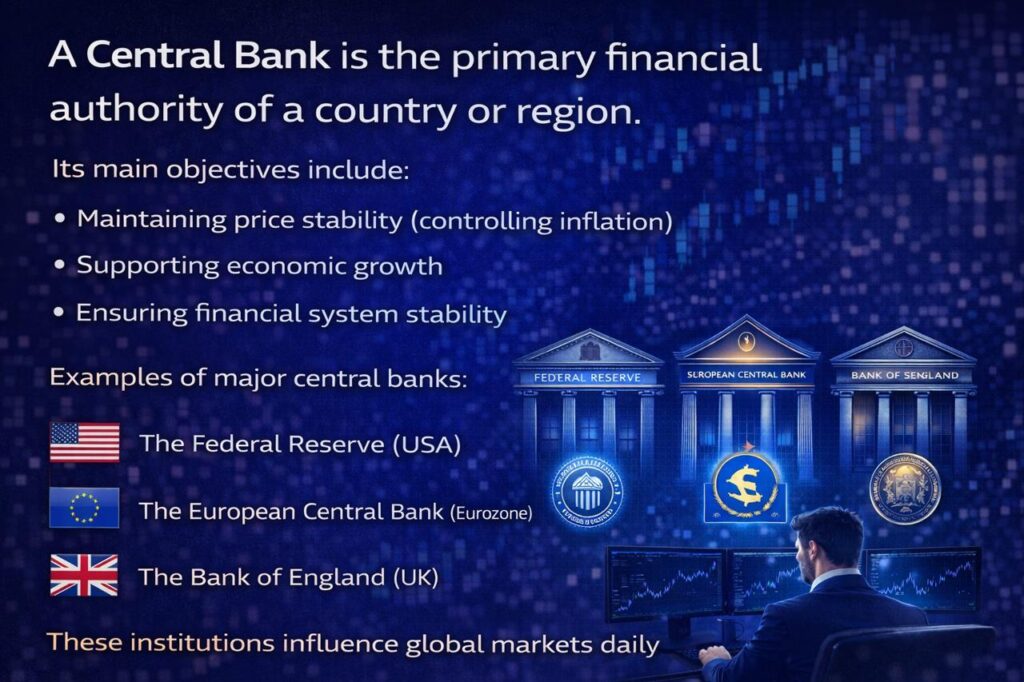
A central bank is the primary financial authority of a country or region.
Its main objectives include:
- Maintaining price stability (controlling inflation)
- Supporting economic growth
- Ensuring financial system stability
Examples of major central banks:
- The Federal Reserve (USA)
- The European Central Bank (Eurozone)
- The Bank of England (UK)
These institutions influence global markets daily.
Why Central Banks Matter to Traders
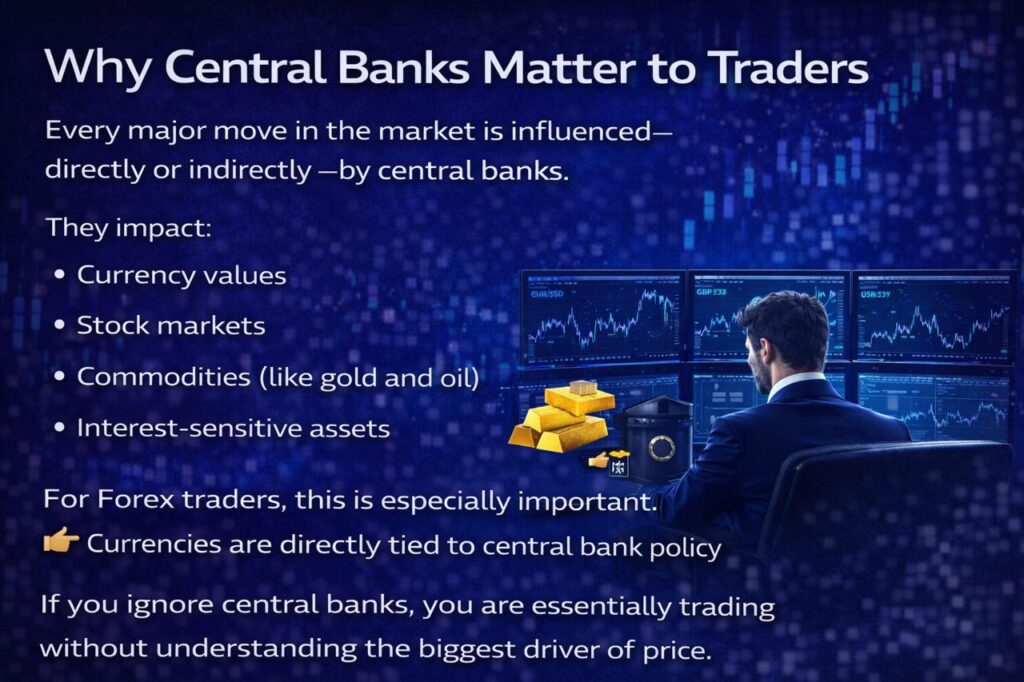
Every major move in the market is influenced—directly or indirectly—by central banks.
They impact:
- Currency values
- Stock markets
- Commodities (like gold and oil)
- Interest-sensitive assets
For Forex traders, this is especially important.
👉 Currencies are directly tied to central bank policy.
If you ignore central banks, you are essentially trading without understanding the biggest driver of price.
Interest Rates: The Most Important Tool
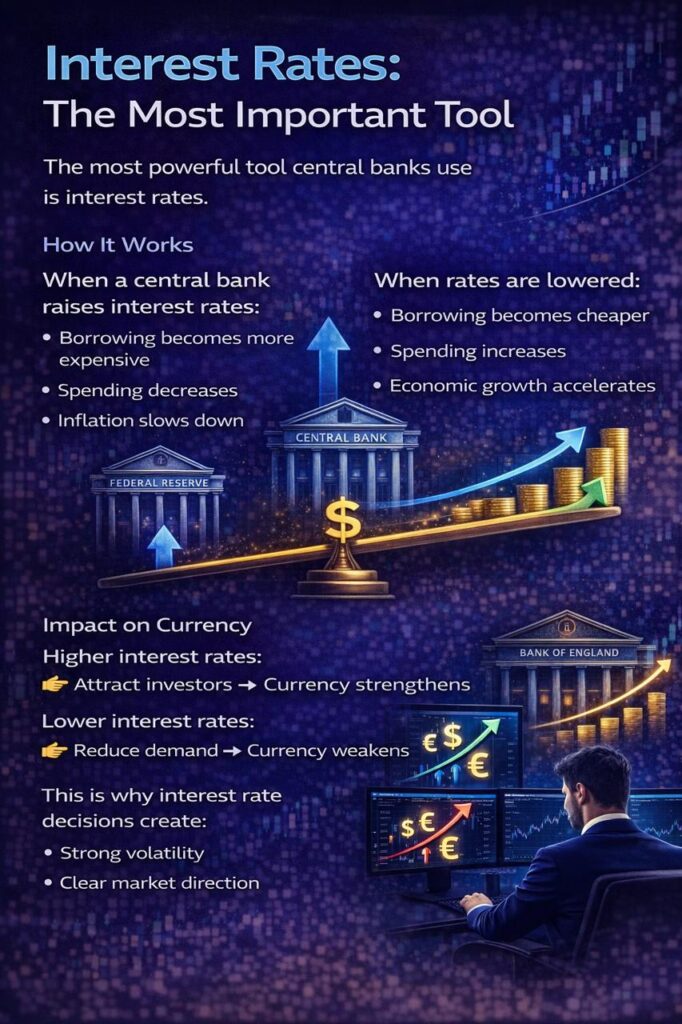
The most powerful tool central banks use is interest rates.
How It Works
When a central bank raises interest rates:
- Borrowing becomes more expensive
- Spending decreases
- Inflation slows down
When rates are lowered:
- Borrowing becomes cheaper
- Spending increases
- Economic growth accelerates
Impact on Currency
Higher interest rates:
👉 Attract investors → Currency strengthens
Lower interest rates:
👉 Reduce demand → Currency weakens
This is why interest rate decisions create:
- Strong volatility
- Clear market direction
Open Market Operations: Controlling Liquidity
Central banks also influence markets through open market operations.
This involves:
- Buying government bonds
- Selling government bonds
When Central Banks Buy Assets:
- Money enters the economy
- Liquidity increases
- Markets tend to rise
This is known as:
👉 Quantitative Easing (QE)
When Central Banks Sell Assets:
- Money is removed from the economy
- Liquidity decreases
- Markets slow down
This is known as:
👉 Quantitative Tightening (QT)
These actions directly affect:
- Stock markets
- Forex markets
- Risk sentiment
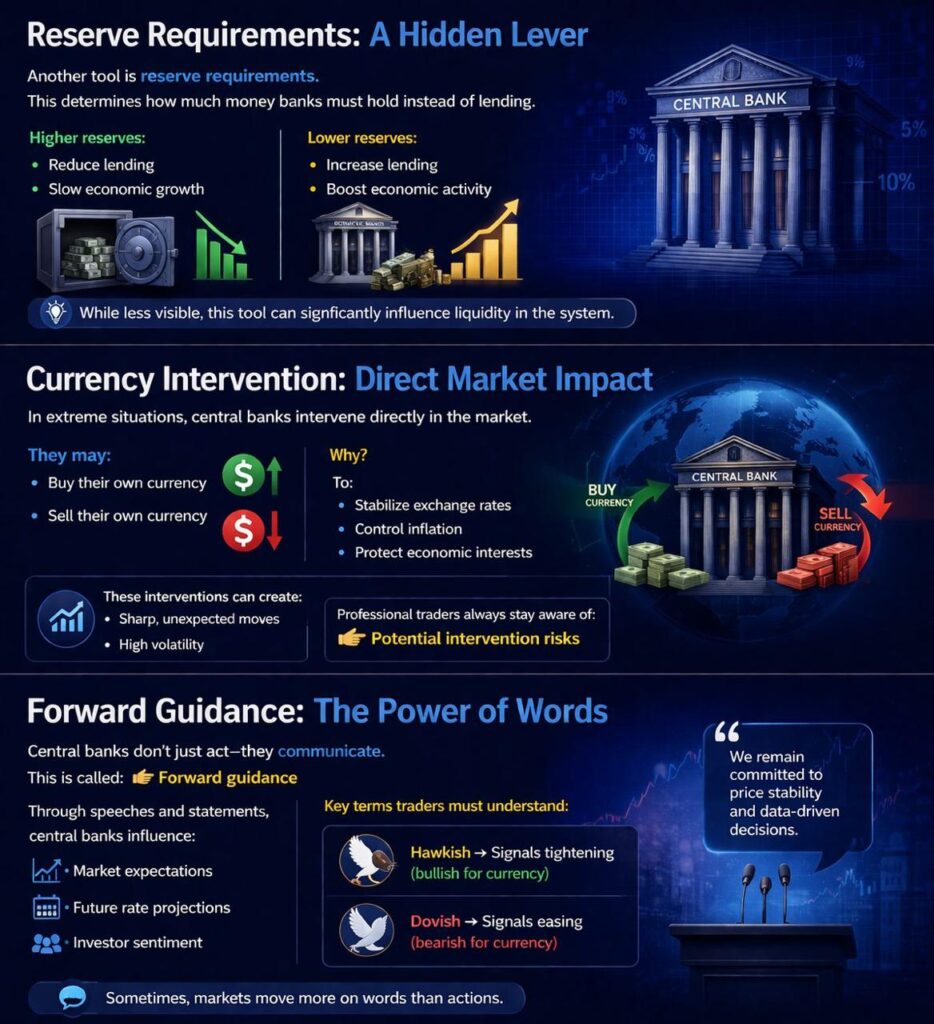
Reserve Requirements: A Hidden Lever
Another tool is reserve requirements.
This determines how much money banks must hold instead of lending.
Higher reserves:
- Reduce lending
- Slow economic growth
Lower reserves:
- Increase lending
- Boost economic activity
While less visible, this tool can significantly influence liquidity in the system.
Currency Intervention: Direct Market Impact
In extreme situations, central banks intervene directly in the market.
They may:
- Buy their own currency
- Sell their own currency
Why?
To:
- Stabilize exchange rates
- Control inflation
- Protect economic interests
These interventions can create:
- Sharp, unexpected moves
- High volatility
Professional traders always stay aware of:
👉 Potential intervention risks
Forward Guidance: The Power of Words
Central banks don’t just act—they communicate.
This is called:
👉 Forward guidance
Through speeches and statements, central banks influence:
- Market expectations
- Future rate projections
- Investor sentiment
Key terms traders must understand:
- Hawkish → Signals tightening (bullish for currency)
- Dovish → Signals easing (bearish for currency)
Sometimes, markets move more on words than actions.
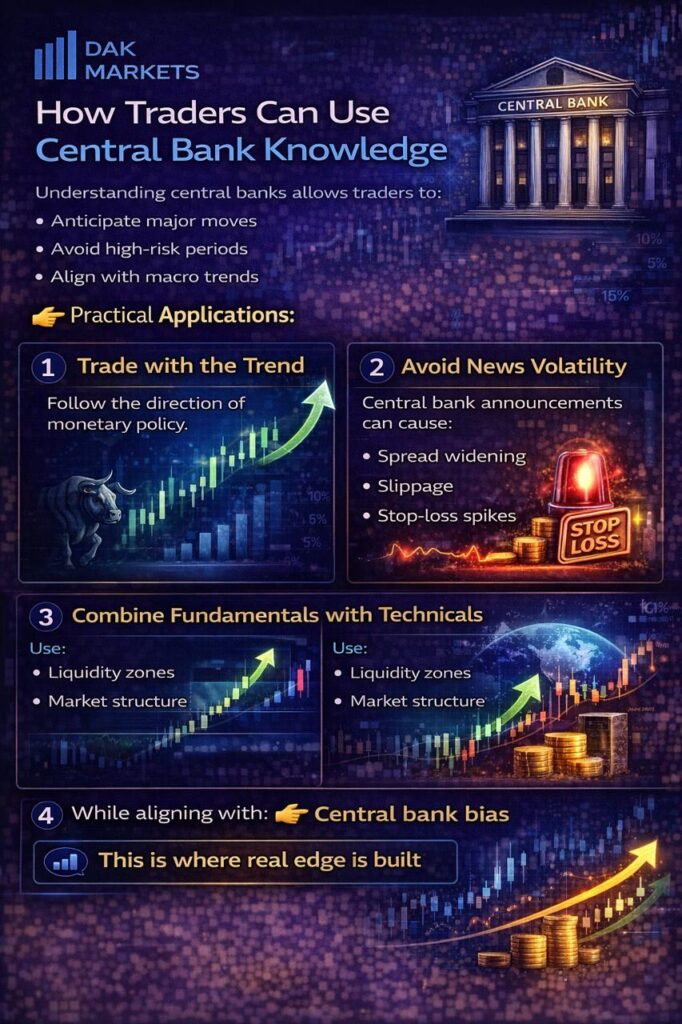
How Traders Can Use Central Bank Knowledge
Understanding central banks allows traders to:
- Anticipate major moves
- Avoid high-risk periods
- Align with macro trends
Practical Applications:
- Trade with the Trend
Follow the direction of monetary policy. - Avoid News Volatility
Central bank announcements can cause:- Spread widening
- Slippage
- Stop-loss spikes
- Combine Fundamentals with Technicals
Use:- Liquidity zones
- Market structure
- While aligning with:
- Central bank bias
👉 This is where real edge is built.
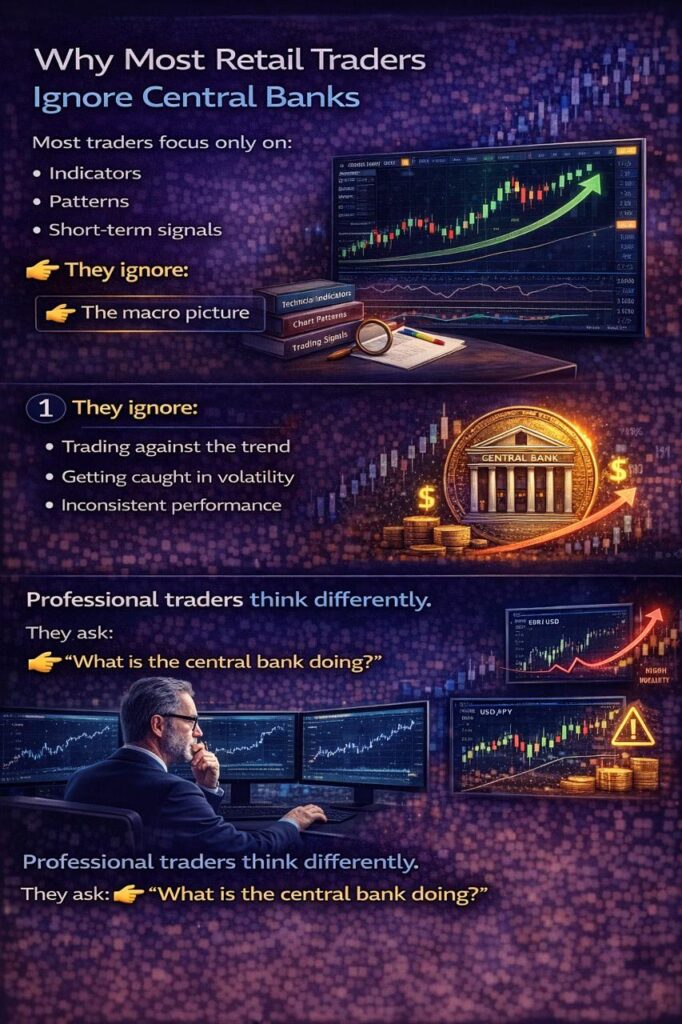
Why Most Retail Traders Ignore Central Banks
Most traders focus only on:
- Indicators
- Patterns
- Short-term signals
They ignore:
👉 The macro picture
This leads to:
- Trading against the trend
- Getting caught in volatility
- Inconsistent performance
Professional traders think differently.
They ask:
👉 “What is the central bank doing?”
The Role of Execution in High-Impact Events
Trading during central bank events requires:
- Fast execution
- Stable pricing
- Reliable infrastructure
Poor trading conditions can lead to:
- Slippage
- Delays
- Missed opportunities
At DAK Markets, we provide:
- Institutional-grade liquidity
- Fast execution speeds
- Stable trading conditions
- Advanced platforms like cTrader
This ensures that:
👉 Your performance is not limited by your broker

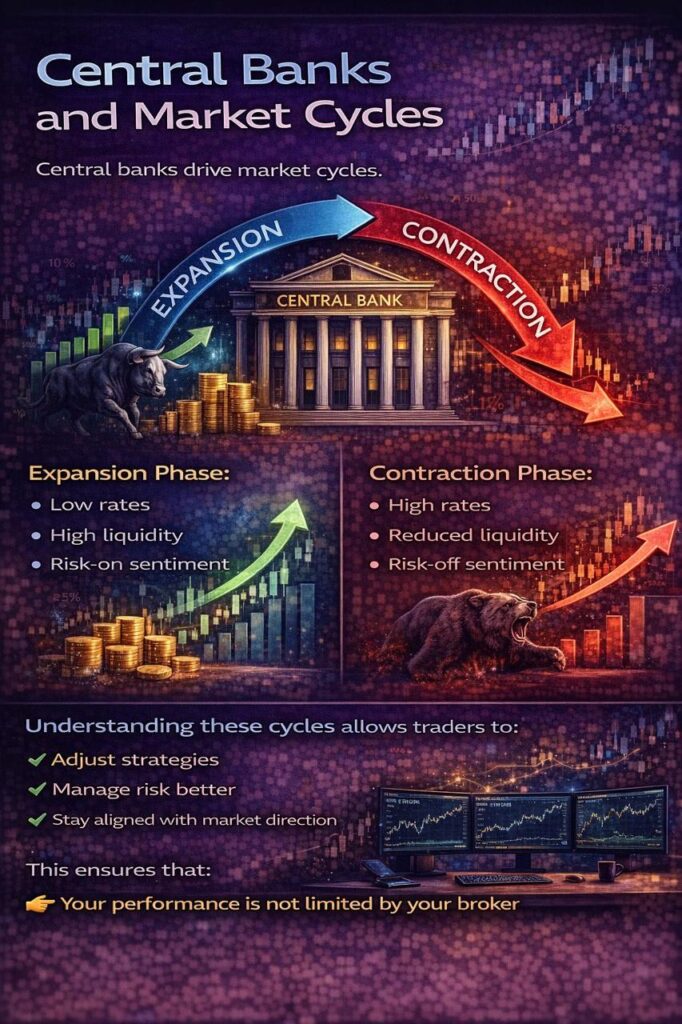
Central Banks and Market Cycles
Central banks drive market cycles.
Expansion Phase:
- Low rates
- High liquidity
- Risk-on sentiment
Contraction Phase:
- High rates
- Reduced liquidity
- Risk-off sentiment
Understanding these cycles allows traders to:
- Adjust strategies
- Manage risk better
- Stay aligned with market direction
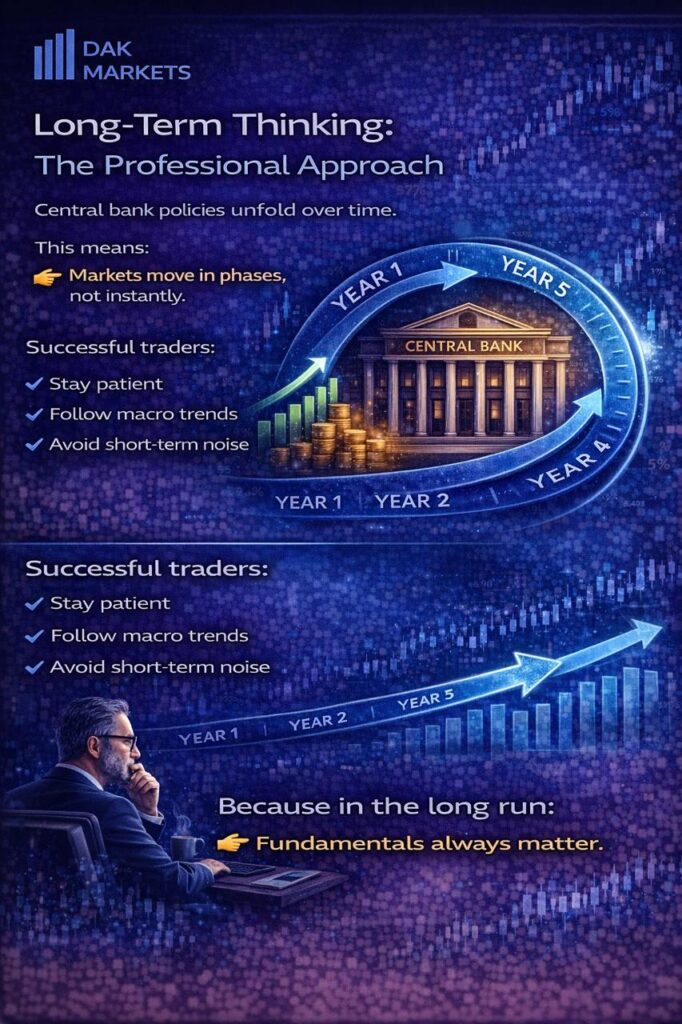
Long-Term Thinking: The Professional Approach
Central bank policies unfold over time.
This means:
👉 Markets move in phases, not instantly.
Successful traders:
- Stay patient
- Follow macro trends
- Avoid short-term noise
Because in the long run:
👉 Fundamentals always matter.
Conclusion: Trade with the Real Drivers
If you want to trade at a professional level, you must go beyond charts.
You must understand:
- Who moves the market
- Why price moves
- Where the economy is heading
Central banks provide these answers.
They are:
👉 The foundation of market direction
At DAK Markets, we believe that trading success comes from combining:
- Strong fundamentals
- Precise execution
- A reliable trading environment
Because in the end:
👉 The traders who understand the macro picture are the ones who stay consistent.