Many traders believe that improving a strategy as much as possible will increase their profits. At first, this idea sounds logical. After all, better optimization should lead to better performance.
However, the reality is often the opposite.
Over-optimization in trading is one of the most dangerous mistakes traders can make. Instead of improving a strategy, excessive optimization can actually weaken it. A strategy that looks perfect in backtests may fail quickly when applied to real market conditions.
Professional traders understand that markets are unpredictable. Therefore, the goal is not to create a perfect strategy. Instead, the goal is to build a robust trading system that performs well in different market environments.
At DAK Markets, experienced traders focus on simplicity, discipline, and realistic expectations rather than over-optimized strategies.
Let’s explore why over-optimization happens and how traders can avoid it.
What Is Over-Optimization in Trading?
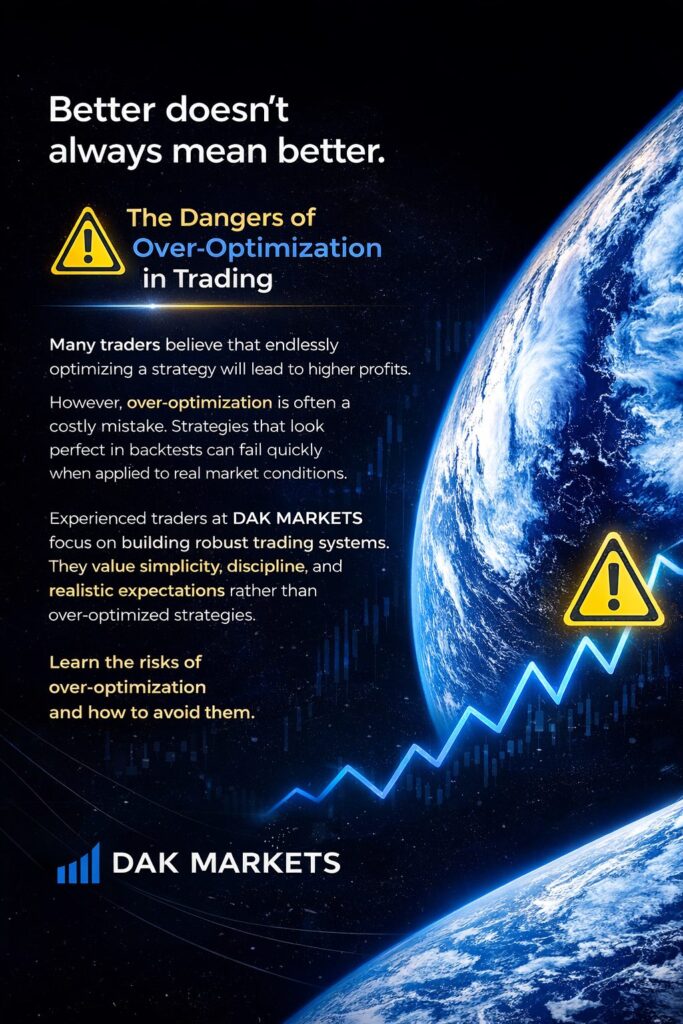
Over-optimization happens when traders adjust a trading strategy too much in order to achieve perfect results in historical data.
This often happens during backtesting. Traders repeatedly modify parameters until the strategy shows impressive profits in the past.
For example, a trader might adjust:
- Entry conditions
- Stop-loss levels
- Take-profit targets
- Indicator settings
- Time filters
Each adjustment may improve historical results slightly. However, after too many changes, the strategy becomes fitted only to past data.
This phenomenon is also called curve fitting.
A curve-fitted strategy performs extremely well on historical charts. Unfortunately, it often fails when applied to future market conditions.
Why Over-Optimization Is Dangerous
Many traders become excited when they see a strategy produce perfect results in backtesting. However, these results can be misleading.
Markets constantly change. Volatility shifts. Liquidity conditions evolve. Economic events create new patterns.
Because of this, a strategy designed only for past market conditions may collapse quickly in live trading.
Here are several reasons why over-optimization is dangerous.
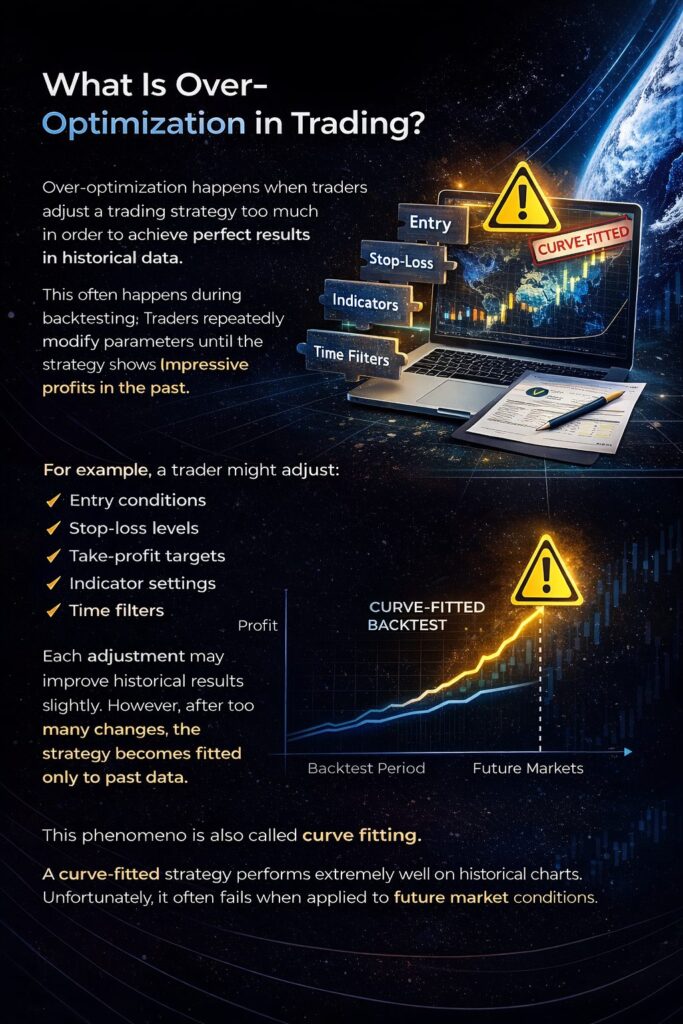
1. It Creates Unrealistic Expectations
A highly optimized strategy may show extremely high win rates in backtests.
However, these results rarely hold up in real trading.
When the strategy begins losing trades, traders become frustrated. As a result, they abandon the system before it has a chance to perform properly.
2. It Reduces Strategy Flexibility
Markets behave differently across time periods.
For example:
- Trending markets require different approaches than ranging markets
- High volatility environments require different risk management
- News events can create unpredictable price movements
Over-optimized strategies are often too rigid to adapt to these changing conditions.
3. It Encourages Emotional Trading
When traders believe they have found a “perfect” strategy, they often increase position sizes.
However, once losses appear, emotions quickly take control. Traders may panic, change the system, or overtrade.
This emotional response can lead to even larger losses.
The Difference Between Optimization and Over-Optimization
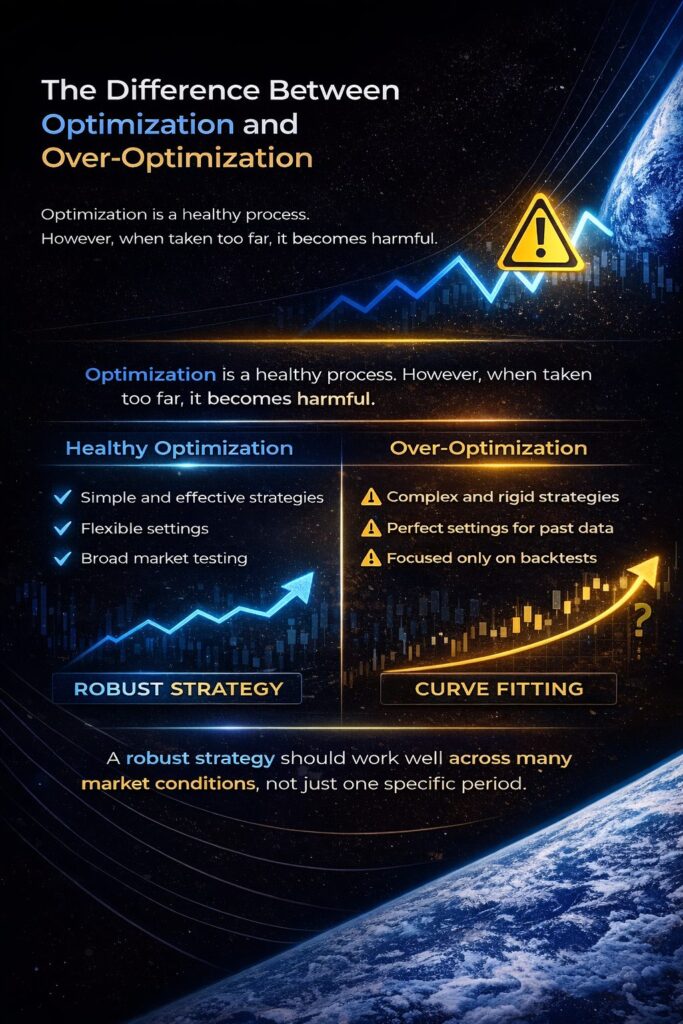
It is important to understand that optimization itself is not bad.
In fact, optimization is an important step in strategy development. Traders must test and refine their ideas.
The problem occurs when optimization goes too far.
Healthy optimization focuses on improving a strategy while keeping it simple. Over-optimization, on the other hand, focuses on achieving perfect historical performance.
Professional traders follow a simple rule:
A robust strategy should work well across many market conditions, not just one specific period.
Signs Your Trading Strategy Is Over-Optimized
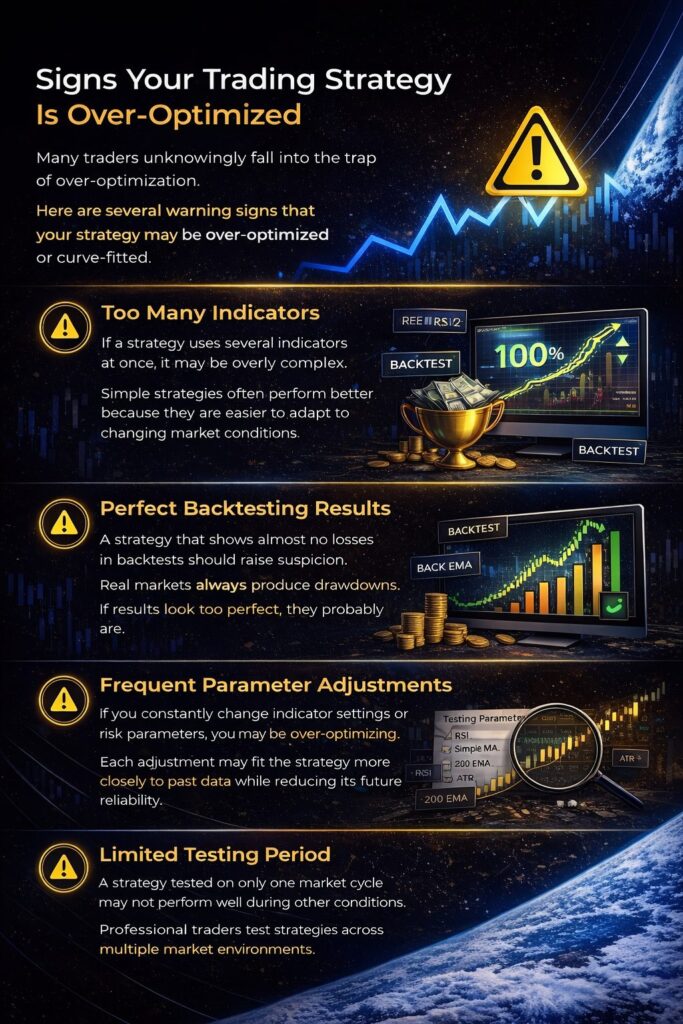
Many traders unknowingly fall into the trap of over-optimization.
Here are several warning signs that your strategy may be curve-fitted.
Too Many Indicators
If a strategy uses several indicators at once, it may be overly complex.
Simple strategies often perform better because they are easier to adapt to changing market conditions.
Perfect Backtesting Results
A strategy that shows almost no losses in backtests should raise suspicion.
Real markets always produce drawdowns.
If results look too perfect, they probably are.
Frequent Parameter Adjustments
If you constantly change indicator settings or risk parameters, you may be over-optimizing.
Each adjustment may fit the strategy more closely to past data while reducing its future reliability.
Limited Testing Period
A strategy tested on only one market cycle may not perform well during other conditions.
Professional traders test strategies across multiple market environments.
How Professional Traders Avoid Over-Optimization
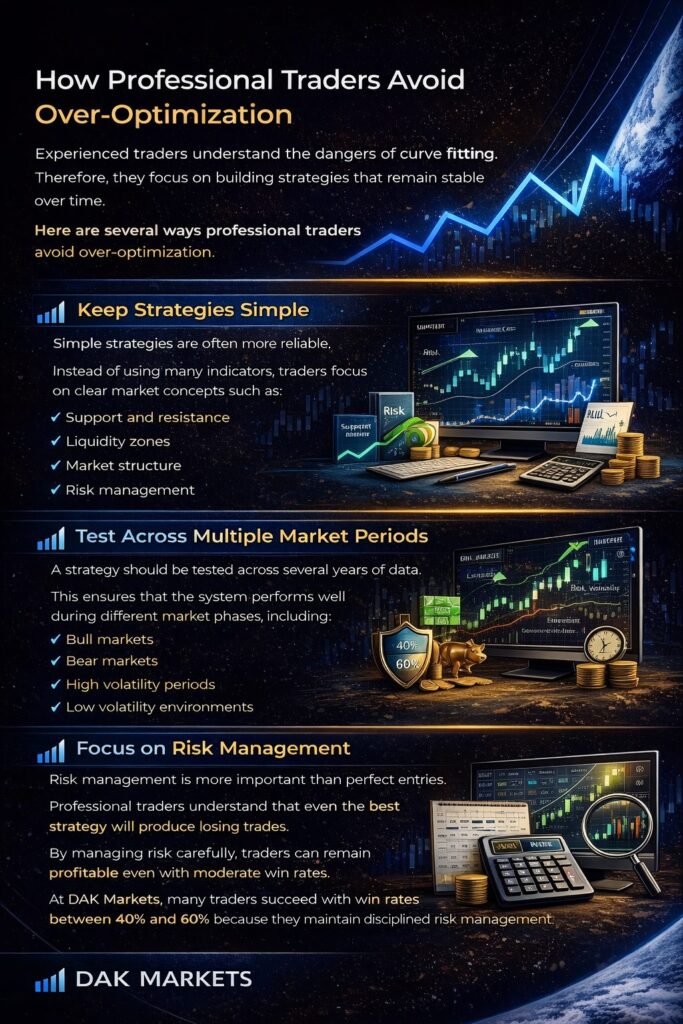
Experienced traders understand the dangers of curve fitting. Therefore, they focus on building strategies that remain stable over time.
Here are several ways professional traders avoid over-optimization.
Keep Strategies Simple
Simple strategies are often more reliable.
Instead of using many indicators, traders focus on clear market concepts such as:
- Support and resistance
- Liquidity zones
- Market structure
- Risk management
These principles remain consistent across different market conditions.
Test Across Multiple Market Periods
A strategy should be tested across several years of data.
This ensures that the system performs well during different market phases, including:
- Bull markets
- Bear markets
- High volatility periods
- Low volatility environments
Strategies that perform consistently across different conditions are more likely to succeed in live trading.
Focus on Risk Management
Risk management is more important than perfect entries.
Professional traders understand that even the best strategy will produce losing trades.
By managing risk carefully, traders can remain profitable even with moderate win rates.
At DAK Markets, many traders succeed with win rates between 40% and 60% because they maintain disciplined risk management.
Forward Testing
Forward testing involves running a strategy on live or demo markets after backtesting.
This step helps traders confirm whether the strategy performs well in real market conditions.
Forward testing also reveals weaknesses that may not appear during backtesting.
Why Robust Strategies Matter More Than Perfect Ones
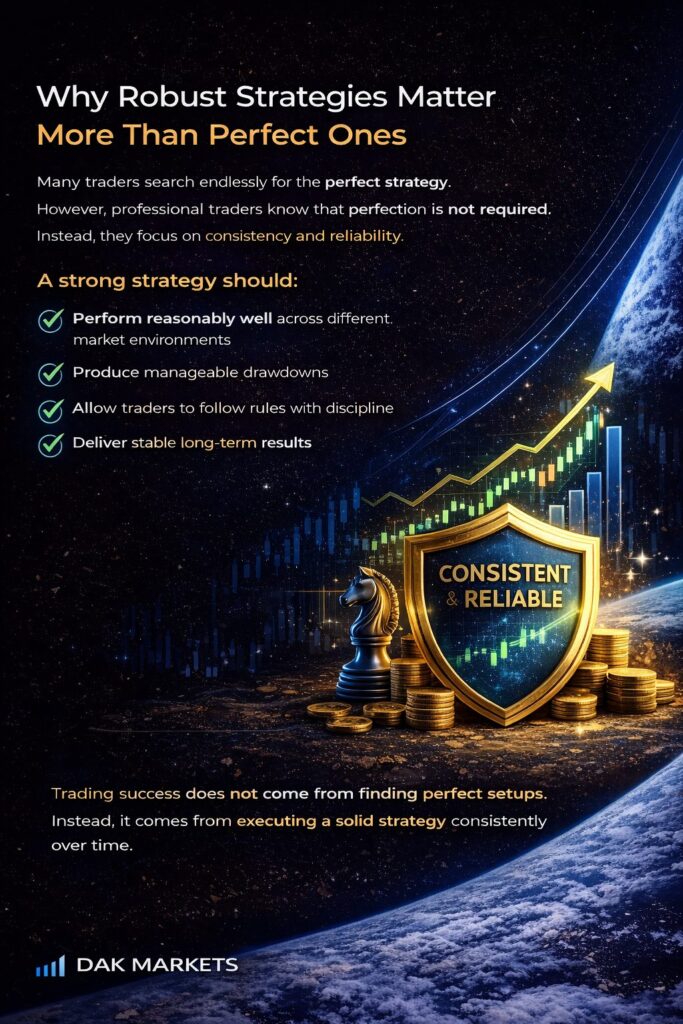
Many traders search endlessly for the perfect strategy.
However, professional traders know that perfection is not required.
Instead, they focus on consistency and reliability.
A strong strategy should:
- Perform reasonably well across different market environments
- Produce manageable drawdowns
- Allow traders to follow rules with discipline
- Deliver stable long-term results
Trading success does not come from finding perfect setups. Instead, it comes from executing a solid strategy consistently over time.
Final Thoughts
Over-optimization in trading is a common mistake among developing traders. While it may produce impressive backtesting results, it often leads to poor real-world performance.
Successful traders understand that markets are dynamic and unpredictable. Therefore, strategies must be flexible and robust rather than perfectly optimized.
By focusing on simplicity, proper testing, and strong risk management, traders can avoid the dangers of curve fitting.
At DAK Markets, traders are encouraged to build disciplined strategies that perform across changing market conditions. Long-term consistency always matters more than short-term perfection.
If you want to grow as a trader, remember this simple principle:
A strategy that survives many market environments is far more valuable than one that only looks perfect on historical charts.