In trading, every investor eventually develops a personal style — some prefer long positions, while others lean toward shorting the market. But understanding the risk and reward of short selling is crucial. What happens when a trader refuses to do anything except short? Is it a bold contrarian approach or a high-risk strategy driven by ego and illusion?
This article explores why some traders become addicted to shorting, why it often leads to emotional and financial burnout, and how a balanced, disciplined strategy is essential for long-term success in the financial markets.
1. The Psychology Behind Shorting the Market
Short selling can be exciting, fast, and seemingly lucrative. It allows traders to profit when markets fall—a concept that feels empowering, especially during volatile times. The allure comes from the speed of market declines; as the saying goes:
“Shorts take the elevator, longs take the stairs.”
From a structural standpoint, the risk and reward of short selling is inherently asymmetric — traders risk more than they can gain if discipline is lacking.
Bear markets tend to unfold rapidly, creating sharp, quick opportunities for profit. For traders who thrive on adrenaline and short-term wins, shorting feels like the ultimate test of skill.
However, there’s a psychological trap hidden within this mindset: the belief that being right about a market crash is more rewarding than steady, long-term growth. This ego-driven thinking can easily turn into a cycle of overconfidence, poor timing, and emotional trading.
2. The Reluctance to Go Long—And Its Opposite
It’s common to find investors who avoid short positions entirely. Long-term equity traders often stick to buy-and-hold strategies, focusing on value accumulation rather than quick profits. But at the other extreme are traders who only go short.
These traders see every rally as an opportunity to bet against the market. They believe downturns are where the “real money” is made—fast, powerful, and dramatic. To a degree, they’re not wrong. Downtrends can generate big profits quickly—but they’re also harder to predict, and far riskier to sustain.
The problem is that markets spend more time rising than falling. Over the past century, the long-term trend of financial markets has been upward, despite temporary crashes and corrections. By shorting exclusively, traders are fighting both probability and momentum.
3. The Lure of Fast Profits: Why It’s a Double-Edged Sword
The appeal of shorting lies in speed. Watching the market collapse while your position grows exponentially feels rewarding—especially when others are losing. But these moments are rare and often unpredictable.
Timing the top of a bull run or the start of a crash is notoriously difficult, even for institutional traders. Entering too early can be just as damaging as being wrong entirely. A market can remain irrational longer than your account can stay solvent.
This is why many short-biased traders experience frequent small losses and occasional big wins. Unfortunately, the few wins often reinforce a false sense of confidence, while the constant grind of drawdowns erodes emotional stability.
4. The Psychological Toll of Constant Bearishness
Trading is as much psychological as it is analytical. Being perpetually bearish means living in a constant state of pessimism and waiting for disaster. That mindset can take a toll not only on your trading results but also on your emotional well-being.
When you’re always short, every market rally feels like a personal insult. You may find yourself doubling down on losing positions, waiting for the “inevitable crash” that never comes. Meanwhile, opportunity after opportunity passes you by on the long side.
This emotional fatigue often leads to revenge trading, poor risk management, and tunnel vision—where traders ignore data that doesn’t confirm their bearish bias.
5. Trading on Ego: The Silent Account Killer
One of the most dangerous motivations in trading is ego. Some traders short the market not because it’s the right setup, but because they want to prove they’re right when others are wrong.
This ego-driven behavior creates a cycle of stubbornness—refusing to cut losses, ignoring trend changes, and fighting the market’s natural direction. The need to be right can quickly outweigh the goal of being profitable.
You’ll often hear traders say things like, “Everyone’s too bullish, this can’t last.” While contrarian thinking can sometimes be valuable, doing it for the sake of ego rather than data leads to ruin. Markets reward discipline, not pride.
For every famous contrarian who made millions shorting a bubble, there are thousands of traders who lost everything trying to do the same.

6. The Risk-Reward Reality of Shorting
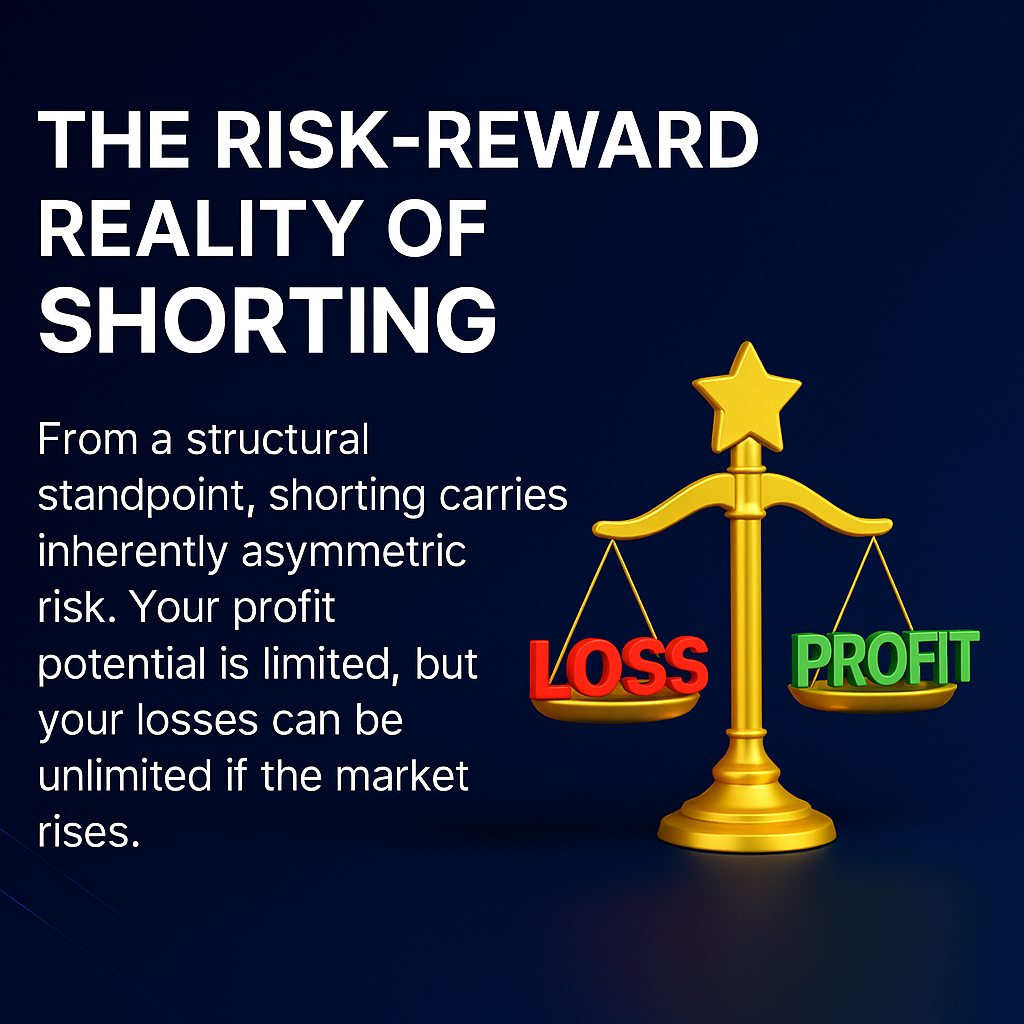
From a structural standpoint, shorting carries inherently asymmetric risk. When you go long, your potential loss is limited to your initial investment, but your upside is theoretically infinite. When you short, the opposite is true—your profit potential is limited, but your losses can be unlimited if the market rises.
Without strict stop-loss rules, even a small upward move can trigger margin calls, stop-outs, or catastrophic losses. This asymmetry means that successful shorting requires exceptional timing, discipline, and risk control—qualities that most traders struggle to maintain consistently.
7. The Right Way to Use Short Selling
Short selling itself isn’t the problem—it’s how traders use it. When applied strategically, it’s a powerful risk management tool. Institutional traders often short markets to hedge long positions, reduce portfolio exposure, or exploit short-term volatility.
The key is balance. A trader who knows when and why to short has a tactical edge. But when shorting becomes a trader’s identity, it transitions from strategy to addiction.
Before entering a short, ask yourself:
- Am I shorting based on clear data or emotional bias?
- Do I have a defined stop-loss and risk-reward plan?
- What would invalidate my trade idea?
If you can’t answer these questions confidently, you’re not executing a strategy—you’re gambling.
Learn more about the risk and reward of short selling from Investopedia’s detailed guide
8. Final Thoughts: Let Go of Ego, Trade with Clarity
Success in trading doesn’t come from always being right—it comes from managing risk and staying adaptable. The market doesn’t care whether you prefer long or short positions; it rewards those who respect its dynamics and prepare for every outcome.
If you find yourself always looking for reasons to short, pause and reflect. Ask whether it’s strategy—or ego—that’s guiding your trades. Sometimes, the best move is to step back, reassess, and trade with a clearer, more balanced perspective.
At DAK Markets, we believe trading should be built on transparency, discipline, and real market access. Whether you’re trading long or short, our A-Book execution model ensures every trade goes directly to the market with no dealing desk interference—so your success truly depends on your strategy, not broker manipulation.
📈 Trade Smart. Stay Objective. Grow with DAK Markets.
DAK Markets connects traders to institutional-grade liquidity and transparent execution through the cTrader platform — providing the technology, environment, and tools you need to trade like a professional.
👉 Visit DAKMarkets.com to experience real market execution today.