For most traders, buying low and selling high — the classic “long” position — feels natural. It’s how we’ve been taught to think since childhood: you invest in something expecting it to rise in value.
But shorting the market? Selling high to buy back lower? That feels… unnatural.
Even intimidating.
If you’ve ever hesitated to take a short trade — even when your analysis was perfect — you’re not alone. The fear of short selling is one of the most common mental barriers traders face. Yet, overcoming that fear is essential if you want to evolve into a complete, confident trader.
In this guide, DAK Markets breaks down why traders fear shorting, what opportunities they’re missing, and how to conquer that fear through structure, data, and discipline.
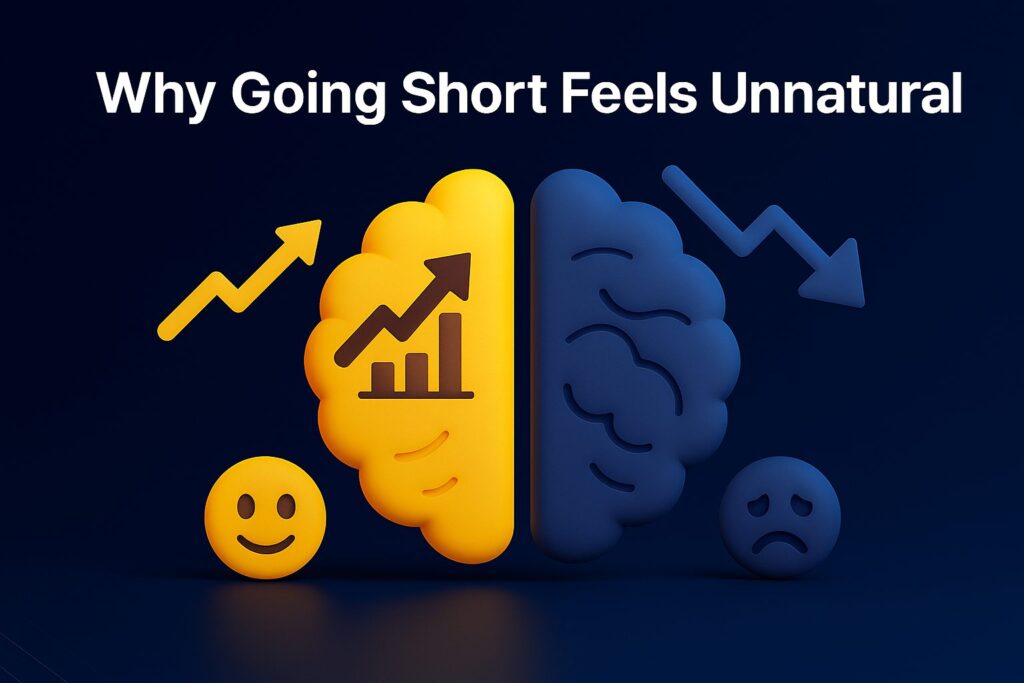
Understanding the Fear of Short Selling
Short selling (or “going short”) means selling a financial instrument first, expecting to buy it back at a lower price for profit. While it sounds simple, many traders hesitate to short — even when market conditions clearly favor it.
Here’s why.
1. Psychological Bias
Humans are wired to think in terms of growth. We associate “up” with success and “down” with loss or negativity. This bias affects trading more than we realize.
When you go short, you’re essentially betting against an asset — and that feels wrong to most people, even subconsciously.
However, in trading, direction doesn’t matter — probability does. You’re not betting against an idea or a company; you’re trading market structure and momentum.
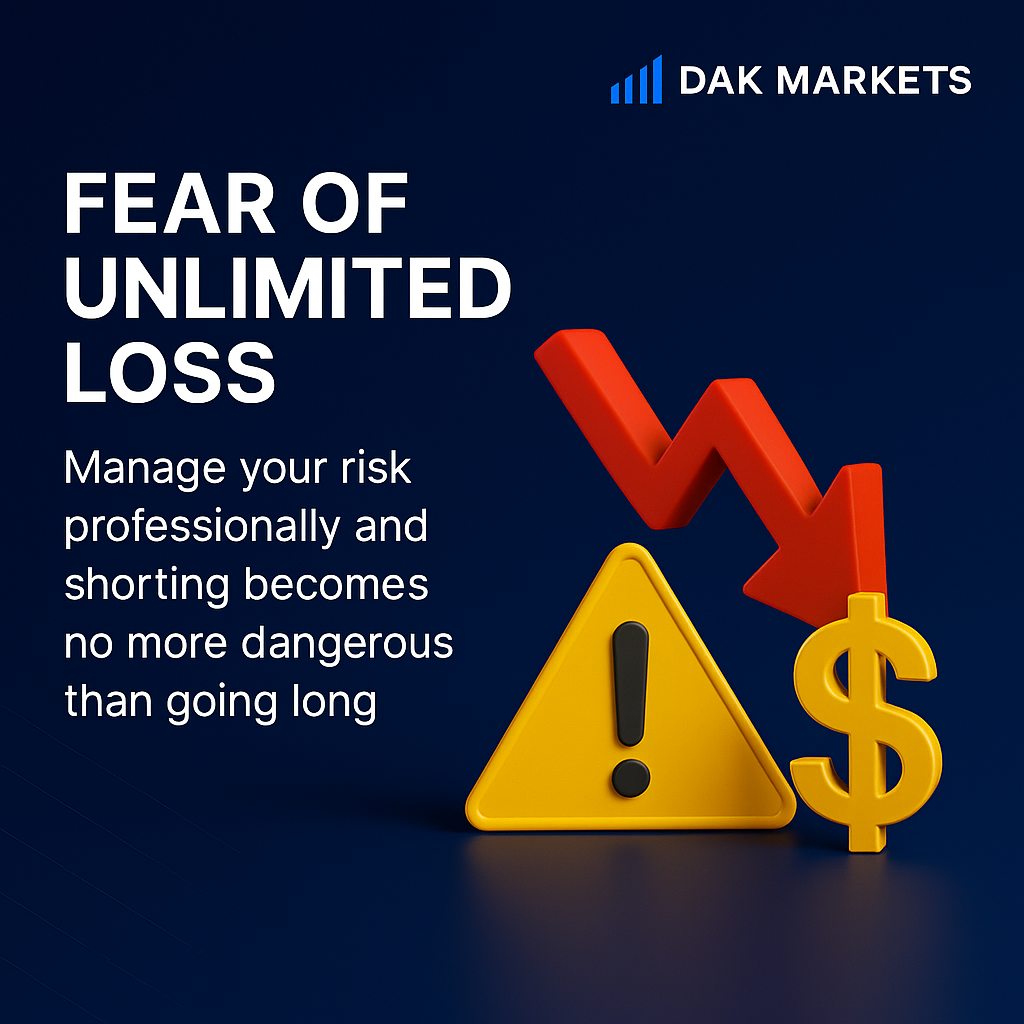
2. Fear of Unlimited Loss
A common misconception is that short positions are “too risky” because losses can theoretically be unlimited if the market keeps rising.
But in reality? With proper risk management, the danger is no greater than a long position.
Using stop-losses, defined lot sizes, and position sizing, traders can control downside risk with precision.
At DAK Markets, our traders use the cTrader platform to execute stop-loss orders instantly and transparently — ensuring every trade is protected by structure, not emotion.
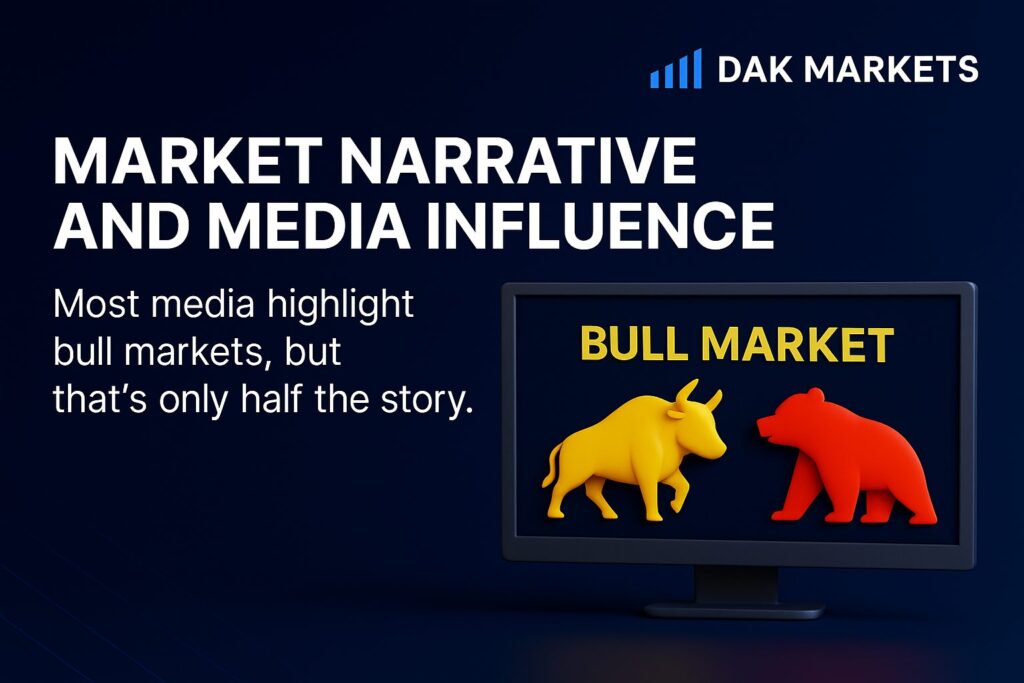
3. Market Narrative and Media Influence
Most of the financial content people consume — from TV to social media — celebrates bull markets. The heroes of Wall Street are the investors who “buy the dip” and hold for years.
But the reality is that markets don’t just rise — they cycle.
Shorting isn’t about negativity or pessimism; it’s about participating in the other half of the market that most people ignore.
Some of the most profitable traders in history built fortunes by identifying overextended assets and capitalizing on their corrections.
4. Lack of Experience
Many traders never practice shorting during their early learning phase. They only focus on long setups, which creates a mental gap.
When an opportunity to short arises, they freeze — not because it’s riskier, but because it’s unfamiliar.
And in trading, unfamiliarity equals hesitation.
That hesitation costs opportunities — and over time, it limits your ability to trade confidently in all market conditions.

The Opportunity You’re Missing
Here’s the truth:
Some of the biggest, cleanest, and fastest moves in the markets happen on the downside.
When fear grips the market, liquidity spikes, volatility increases, and price collapses can deliver massive trading opportunities.
As the saying goes:
“Fear is more powerful than greed.”

That means downtrends often move faster and more violently than uptrends. For traders who understand how to short effectively, this volatility becomes an advantage.
Being afraid to short is like playing the trading game with one hand tied behind your back.
When you embrace shorting, you double your opportunity — because you can profit in any market direction.
How to Overcome the Fear of Shorting
Conquering your hesitation toward short trades isn’t about taking reckless risks. It’s about building confidence through knowledge, data, and repetition.
Here’s how to do it step by step.
1. Reframe What Shorting Really Means
You’re not “betting against” the market — you’re trading direction.
Shorting isn’t negative. It’s a professional approach to capturing profit from downward movement, just as buying captures upward movement.
Once you remove the emotion and reframe shorting as simply another opportunity, the fear begins to fade.
Think of it this way: you’re not fighting the market — you’re flowing with it, no matter the direction.
2. Backtest Short Setups Separately
Data kills doubt.
Take your trading strategy and test it on short setups exclusively.
How does your system perform during bearish conditions? What are your win rates, average returns, and risk-to-reward ratios on short trades?
Seeing that your method performs equally well on both sides of the market helps you build confidence grounded in facts — not emotion.
3. Practice Shorting in a Demo Environment
Confidence comes from repetition.
Use a demo account on DAK Markets’ cTrader platform to practice shorting setups.
Focus on pattern recognition, entry precision, and execution speed.
This is not about making money — it’s about rewiring your brain to treat short trades as normal, data-driven opportunities instead of something to fear.
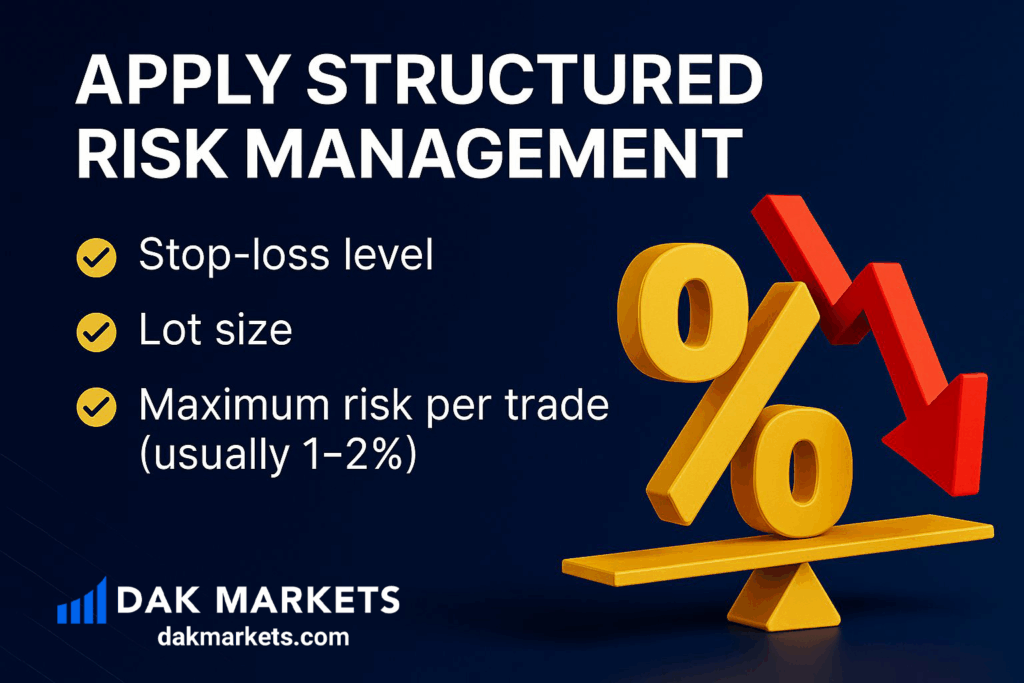
4. Apply Structured Risk Management
Short trades require the same level of discipline as long trades — no more, no less.
Define your:
- Stop-loss level
- Lot size
- Maximum risk per trade (usually 1–2%)
Risk doesn’t discriminate between long and short.
The key is to stay consistent with your risk parameters so that every trade — up or down — is managed with precision and professionalism.
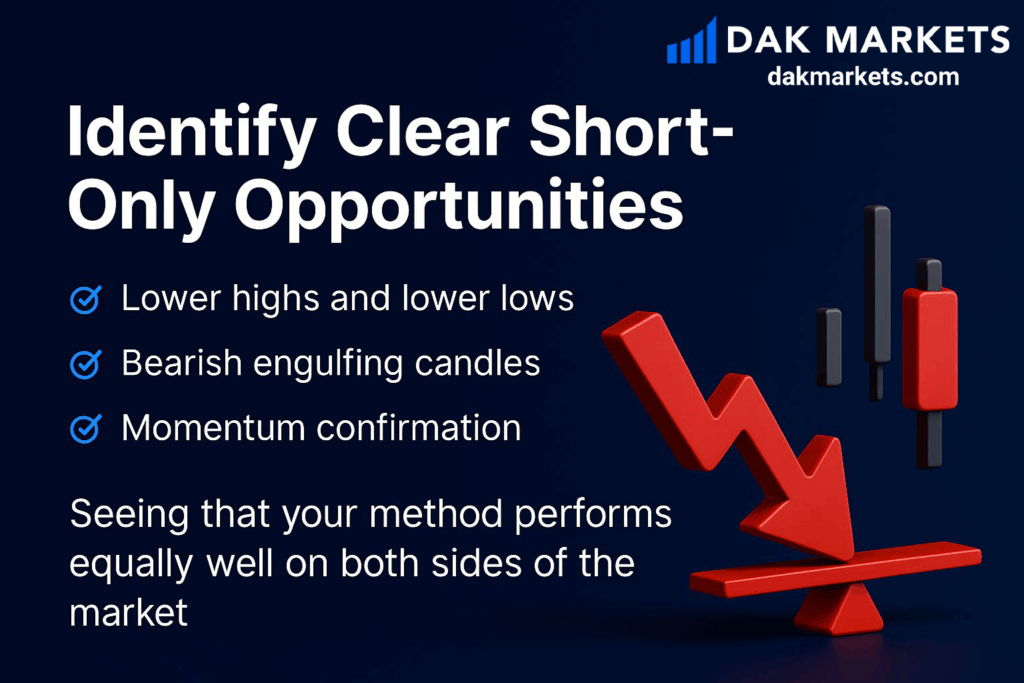
5. Identify Clear Short-Only Opportunities
Don’t short just because you can.
Focus on assets showing clear signs of weakness:
- Lower highs and lower lows
- Bearish engulfing candles
- Momentum confirmation from multiple timeframes
When the technicals align and momentum shifts, that’s your cue.
Wait for clean confirmations, and execute without hesitation.
Remember, patience is power — and timing is everything.
The Benefits of Embracing Short Selling
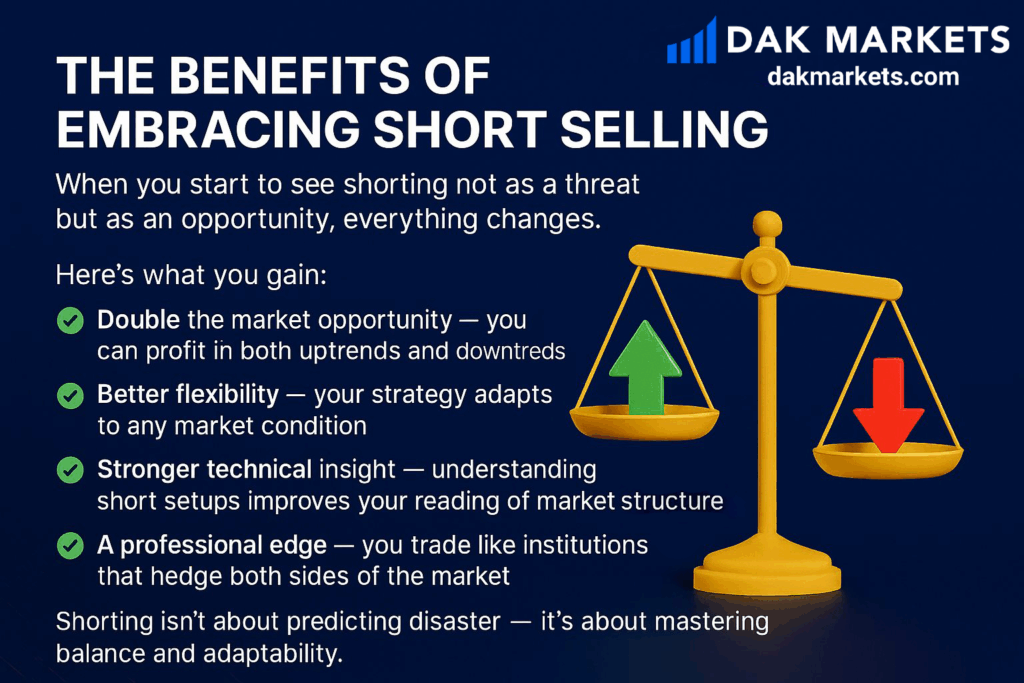
When you start to see shorting not as a threat but as an opportunity, everything changes.
Here’s what you gain:
✅ Double the market opportunity — you can profit in both uptrends and downtrends.
✅ Better flexibility — your strategy adapts to any market condition.
✅ Stronger technical insight — understanding short setups improves your reading of market structure.
✅ A professional edge — you trade like institutions that hedge both sides of the market.
Shorting isn’t about predicting disaster — it’s about mastering balance and adaptability.
Final Thought: Trade Without Fear
Fear of short selling doesn’t make you a bad trader — it just means you haven’t yet built enough familiarity and confidence with that side of the market.
Once you understand how shorting works, backtest it, and practice it under controlled risk, it becomes just another tool in your professional trading arsenal.
At DAK Markets, we believe traders should master both sides of the market — long and short — with transparency, discipline, and real market access.
Our A-Book execution model ensures every trade, whether long or short, goes directly to the market with zero dealing desk interference — empowering traders with fairness and precision.
💡 Because real traders don’t just profit when the market goes up — they profit when others panic.
📈 Start Trading with Confidence
Experience real A-Book execution, deep institutional liquidity, and transparency with DAK Markets.
Learn more at DAKMarkets.com.