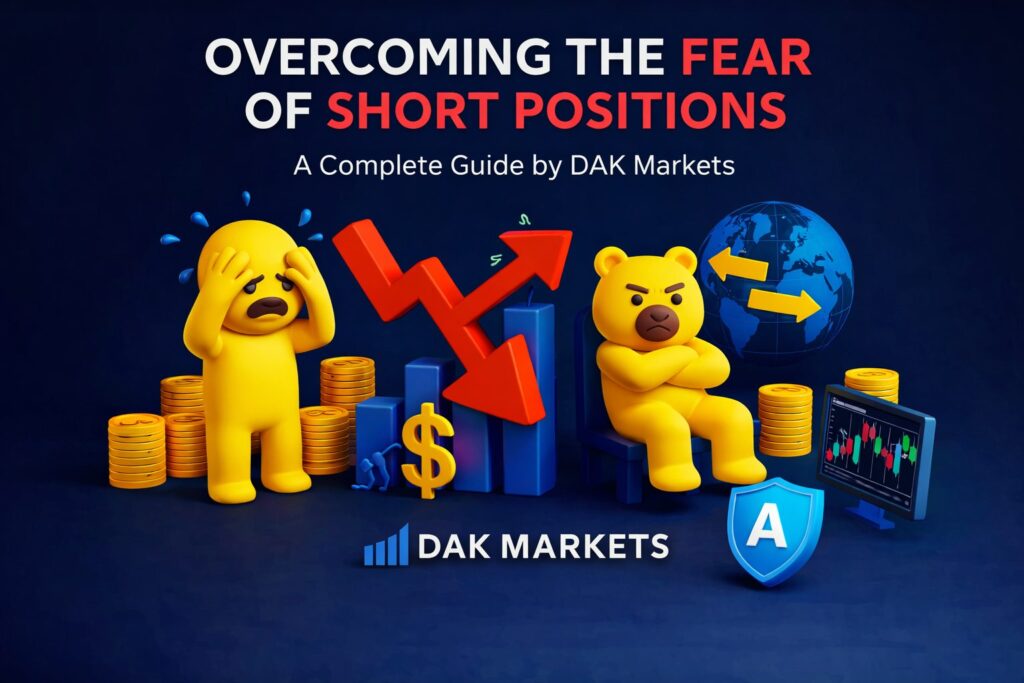
A Complete Guide by DAK Markets
In the world of online trading, one psychological barrier continues to limit many traders: the fear of short positions. While modern markets allow traders to profit in both rising and falling conditions, a significant number of traders still avoid selling or shorting altogether.
At DAK Markets, we frequently see this pattern among beginners and even experienced traders transitioning from traditional investing. Understanding why traders fear short positions—and how to overcome that fear—can dramatically improve performance, flexibility, and long-term consistency.
This article explores the psychology behind shorting, the myths around unlimited risk, and how proper risk management and execution through a true A-Book broker like DAK Markets can help traders operate confidently in both directions.
What Is a Short Position in Trading?
Before addressing fear, it’s important to clarify what short selling actually means.
A short position is when a trader sells an asset first with the intention of buying it back later at a lower price. If the price falls, the trader profits from the difference.
In forex trading specifically, every trade inherently involves buying one currency and selling another. The idea of “shorting” is therefore natural within currency markets. Yet psychologically, many traders still feel more comfortable buying than selling.

Why Do Traders Fear Short Positions?
1. Traditional Investing Bias
Many traders begin their journey through stock investing. In long-term investing, growth is typically the expectation. Stocks tend to rise over time due to economic expansion, innovation, and corporate earnings growth.
Because of this, investors are conditioned to associate:
- Buying = positive
- Selling = negative
- Market decline = crisis
When these investors move into leveraged trading, they often carry this bias with them. Selling feels “wrong” or unnatural—even though in short-term trading, price direction is neutral.

2. Fear of Unlimited Loss
One of the most repeated arguments against short selling is the idea of “unlimited risk.”
Technically, in theory:
- A stock can only fall to zero.
- But it can rise indefinitely.
While this is mathematically true, in practical trading environments with Stop Loss orders and structured risk management, risk is always defined and limited.
At DAK Markets, traders operate in a structured trading environment with full control over:
- Stop Loss placement
- Position sizing
- Margin requirements
- Real-time execution through liquidity providers
When proper risk management is applied, the concept of unlimited loss becomes irrelevant.
The real risk is not shorting.
The real risk is trading without defined risk.

3. Emotional Association with “Red”
Charts use green for bullish candles and red for bearish ones. Over time, traders subconsciously associate red with loss, danger, or negativity.
This psychological trigger may sound trivial, but cognitive biases in trading are powerful. Traders often unconsciously prefer buying because it aligns with “positive” visual cues.
However, markets do not care about color psychology. Price movement is opportunity—regardless of direction.

4. Optimism Bias
Human beings are naturally optimistic. We prefer believing that markets will rise. Betting against growth can feel uncomfortable because it conflicts with our internal bias toward expansion and progress.
This bias leads traders to:
- Hold long positions longer
- Avoid selling opportunities
- Miss strong downtrends
Professional traders understand that markets move in cycles. Trends reverse. Corrections happen. Volatility is constant.
Being able to trade both directions increases opportunity—not risk.

The Reality: Shorting Is a Neutral Trading Tool
In leveraged trading environments such as forex, indices, commodities, and CFDs, shorting is not aggressive or immoral. It is simply a directional position.
Through DAK Markets’ A-Book execution model, trades are routed directly to liquidity providers. This means:
- If you go long and win → liquidity provider pays.
- If you go short and win → liquidity provider pays.
- DAK Markets earns from transactional volume, not your directional bias.
There is no conflict of interest regarding long or short positions.
Execution is neutral. The market decides.

How to Overcome the Fear of Short Positions
1. Redefine Risk
Fear often comes from misunderstanding risk. Instead of focusing on direction, focus on:
- Risk per trade (e.g., 0.5%–1%)
- Stop Loss placement
- Risk-to-reward ratio
- Total portfolio exposure
If your risk is predefined, short positions are no more dangerous than long positions.
Professional traders do not ask:
“Is this long or short?”
They ask:
“Is the risk defined?”
2. Start With Smaller Position Sizes
If shorting feels uncomfortable, reduce size temporarily. Trade half your normal lot size while building confidence.
Gradual exposure helps retrain your psychological response.
Comfort comes from repetition under controlled risk.
3. Backtest Both Directions
Many traders discover through backtesting that their strategy performs equally well—or better—during bearish phases.
Use historical data to test:
- Bull market performance
- Bear market performance
- Sideways market performance
Data replaces fear with logic.
4. Understand That Downtrends Can Be Faster
Market declines are often sharper and faster than uptrends. Panic accelerates moves.
This does not mean shorting is easier.
But it does mean opportunity exists.
Traders who only buy are limiting themselves to half of the market cycle.
5. Separate Ego From Execution
Sometimes fear of shorting is not fear at all—it is ego.
Some traders subconsciously believe:
“I know this will go up.”
When price falls, they resist accepting that they were wrong.
Professional trading requires neutrality.
At DAK Markets, traders who succeed long-term are those who:
- Adapt quickly
- Accept directional changes
- Follow structure over opinion
The market is not personal.

The Advantage of Trading With a Structured Broker
Overcoming psychological barriers is easier when trading in a professional environment.
DAK Markets provides:
- Institutional-grade liquidity
- Transparent A-Book routing
- Tight spreads
- Stable execution infrastructure
- No artificial dealing desk intervention
When traders know their orders are executed transparently, emotional hesitation decreases.
Confidence increases when:
- Slippage is fair
- Execution is fast
- Risk tools are reliable
Psychological growth requires structural support.

Shorting in Forex vs Stocks
In forex, every trade already includes both a buy and a sell. If you sell EUR/USD, you are buying USD and selling EUR.
The concept of “shorting” is not exotic—it is inherent to currency trading.
This makes fear of short positions even less rational in forex markets compared to traditional equity investing.

Risk Management Remains the Core
Regardless of direction:
- Never oversize positions.
- Always use Stop Loss orders.
- Maintain consistent risk percentages.
- Avoid emotional doubling down.
Short positions do not cause losses.
Poor risk management does.

Final Thoughts: Trading Without Directional Bias
Avoiding short positions limits flexibility and reduces opportunity.
Markets move up and down. Volatility creates profit potential in both directions. Traders who restrict themselves to one side operate with half the available edge.
At DAK Markets, we believe successful trading comes from:
- Structured risk management
- Emotional discipline
- Neutral execution
- Transparent order routing
- Professional infrastructure
If you fear short positions, focus on process—not prediction.
Confidence does not come from being right.
It comes from managing risk correctly.
Trade both directions.
Trade with structure.
Trade with discipline.
Trade with DAK Markets.