A Trading Psychology Guide by DAK Markets
In financial markets, strategy and technical knowledge are essential—but they are not enough. Two traders can use the same system, trade the same instrument, and operate under the same market conditions, yet produce very different results.
Why?
Because trading performance is deeply connected to personality.
At DAK Markets, we believe that understanding your psychological tendencies is one of the most powerful steps toward becoming a consistently profitable trader. Self-awareness allows traders to manage emotions, improve discipline, and align strategy with temperament.
Let’s explore how knowing your personality can transform your trading results.

Why Personality Matters in Trading
Trading is a performance activity conducted under uncertainty. It demands:
- Emotional control
- Rapid decision-making
- Risk tolerance
- Patience
- Discipline
These qualities are influenced by personality traits.
Some traders are naturally cautious and analytical. Others are impulsive and aggressive. Some thrive in fast-moving markets; others prefer slow, structured setups.
There is no “perfect trading personality.” The key is alignment. When your trading style matches your personality, consistency improves. When there is a mismatch, stress and emotional mistakes increase.

The Three Psychological States in Trading
A helpful framework for understanding personality in trading comes from Transactional Analysis, which categorizes behavior into three ego states:
- The Parent
- The Adult
- The Child
Although originally developed for psychology, this model provides powerful insight into trading behavior.

The Adult State: The Professional Trader
The “Adult” state represents rational, objective, and data-driven thinking. When traders operate in this state, they:
- Follow their trading plan
- Respect Stop Loss levels
- Accept losses calmly
- Focus on probabilities rather than predictions
- Evaluate trades objectively
In this state, traders trade what they see—not what they hope.
At DAK Markets, this is the mindset we encourage. Professional trading requires calm decision-making supported by structured risk management and reliable execution infrastructure.
The Child State: Emotional Trading
The “Child” state reflects impulsiveness, fear of missing out (FOMO), excitement, and frustration.
In trading, this state appears when:
- You chase price after missing an entry
- You increase position size after a win
- You hesitate due to fear
- You revenge trade after a loss
- You override your strategy based on emotion
While creativity and adaptability can be strengths, emotional trading often leads to inconsistency.
Without awareness, traders may repeatedly sabotage their own performance.
The Parent State: Self-Criticism and Overcontrol
The “Parent” state appears when traders become overly critical of themselves.
Examples include:
- Harsh self-judgment after losses
- Obsessive review of missed opportunities
- Perfectionism that prevents execution
- Fear of repeating past mistakes
While accountability is healthy, excessive self-criticism creates stress and hesitation.
Professional growth requires constructive evaluation—not emotional punishment.
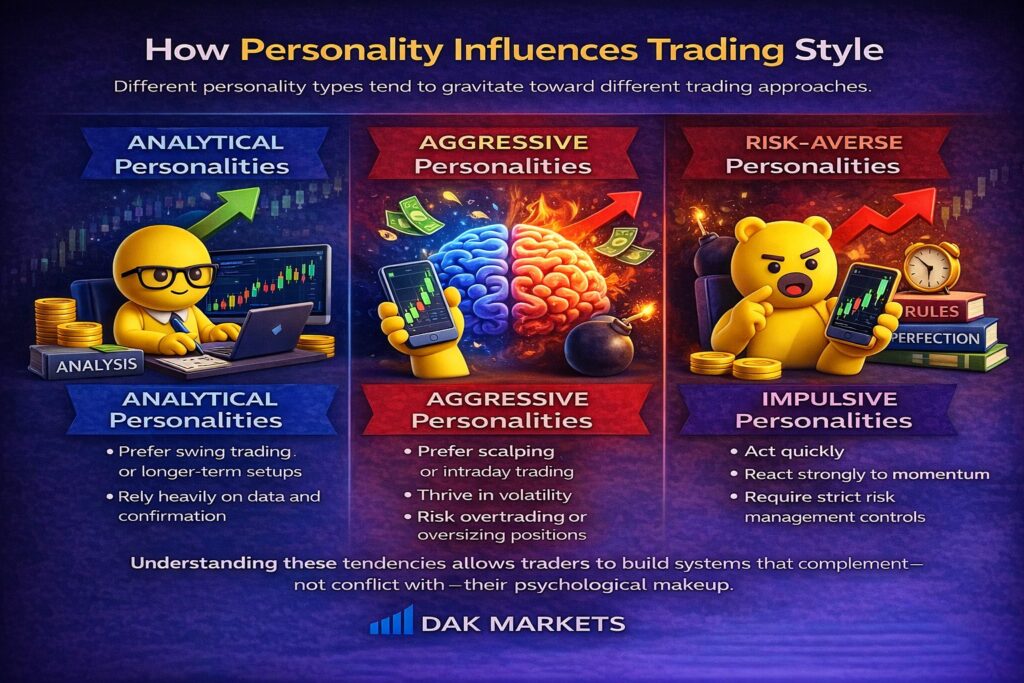
How Personality Influences Trading Style
Different personality types tend to gravitate toward different trading approaches.
Analytical Personalities
- Prefer swing trading or longer-term setups
- Rely heavily on data and confirmation
- May struggle with decisiveness in fast markets
Aggressive Personalities
- Prefer scalping or intraday trading
- Thrive in volatility
- Risk overtrading or oversizing positions
Risk-Averse Personalities
- Prioritize capital preservation
- Trade smaller size
- May exit trades too early
Impulsive Personalities
- Act quickly
- React strongly to momentum
- Require strict risk management controls
Understanding these tendencies allows traders to build systems that complement—not conflict with—their psychological makeup.

Self-Awareness: The Foundation of Consistency
Self-awareness is the ability to recognize:
- What you are feeling
- Why you are reacting
- Whether your behavior aligns with your plan
Before entering a trade, ask:
- Am I trading based on my strategy?
- Am I reacting emotionally?
- How will I feel if this trade loses?
- Does this position respect my risk parameters?
These simple questions shift traders into the “Adult” state—rational and structured.
At DAK Markets, we often emphasize that trading success begins with discipline before execution.

Aligning Strategy With Personality
One of the most common mistakes traders make is copying strategies that do not fit their temperament.
For example:
- A slow, analytical trader may struggle with high-frequency scalping.
- An aggressive trader may feel bored waiting days for a swing setup.
Instead of forcing adaptation, traders should design systems around their strengths.
This includes:
- Choosing appropriate timeframes
- Setting realistic profit targets
- Defining risk tolerance
- Creating structured entry and exit rules
A well-aligned strategy reduces psychological friction.

The Role of Risk Management in Personality Control
No personality type is immune to emotional pressure.
This is why risk management is critical.
Clear risk management rules include:
- Fixed percentage risk per trade
- Maximum daily drawdown limits
- Strict Stop Loss placement
- Defined position sizing
Risk management protects traders from emotional escalation.
At DAK Markets, our infrastructure ensures transparent order execution, institutional liquidity access, and stable performance—allowing traders to focus on discipline rather than technical reliability.

Emotional Awareness During Live Trading
Markets constantly test psychological stability.
Consider these scenarios:
- A winning streak may increase overconfidence.
- A losing streak may trigger self-doubt.
- Sudden volatility may trigger panic.
By recognizing which ego state you are operating from—Adult, Child, or Parent—you can interrupt emotional cycles.
The goal is not to eliminate emotion.
The goal is to prevent emotion from controlling execution.

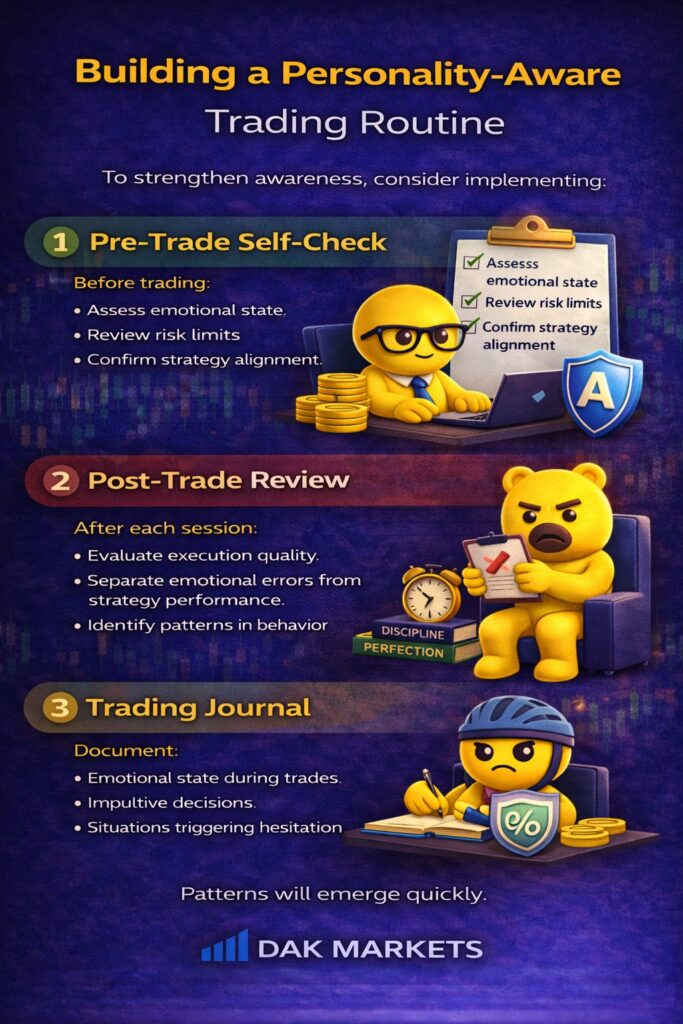
Building a Personality-Aware Trading Routine
To strengthen awareness, consider implementing:
1. Pre-Trade Self-Check
Before trading:
- Assess emotional state
- Review risk limits
- Confirm strategy alignment
2. Post-Trade Review
After each session:
- Evaluate execution quality
- Separate emotional errors from strategy performance
- Identify patterns in behavior
3. Trading Journal
Document:
- Emotional state during trades
- Impulsive decisions
- Situations triggering hesitation
Patterns will emerge quickly.
Why Professional Infrastructure Supports Psychological Growth
Psychological discipline is easier when supported by stable execution and transparent trading conditions.
DAK Markets provides:
- A-Book execution model
- Direct liquidity routing
- Tight spreads
- No dealing desk manipulation
- Transparent trade processing
When traders trust their broker’s infrastructure, mental energy can focus on discipline and strategy—not execution concerns.
Confidence in structure reduces emotional interference.

Final Thoughts: Trading Is Personal
The market does not need to change for you to improve.
You need to understand yourself.
Personality influences decision-making, risk tolerance, and emotional reaction. When traders become aware of their behavioral tendencies, they gain control over them.
Professional trading is not about eliminating personality.
It is about managing it.
At DAK Markets, we believe long-term trading success is built on:
- Self-awareness
- Structured risk management
- Discipline
- Transparent execution
- Emotional neutrality
Know your personality.
Align your strategy.
Control your risk.
And trade with confidence.
Trade with DAK Markets.