In today’s digital world, traders are constantly exposed to success stories, profit screenshots, luxury lifestyles, and bold claims of “easy money.” Social media platforms, trading forums, and online communities are filled with examples of traders who appear to be making consistent profits effortlessly.
While this content can be motivating, it can also be dangerous.
If you want long-term success in the financial markets, you must learn how to avoid herd mentality in trading. Following the crowd, reacting emotionally to market hype, and chasing quick profits often lead to overtrading, poor risk management, and account blow-ups.
In this article, we’ll explore how crowd psychology affects trading decisions, why social media can distort trading expectations, and how to build discipline to protect your trading performance.

The Psychology of Herd Mentality in Trading
Herd mentality in trading refers to the tendency of traders to follow what others are doing rather than sticking to their own trading strategy. This behavior is deeply rooted in human psychology.
As social beings, we are naturally influenced by our environment. When we see many traders buying a particular asset, we feel pressure to join them. When everyone is posting profits, we feel the fear of missing out (FOMO).
In trading, this can manifest as:
- Entering trades without proper analysis
- Copying strategies without understanding them
- Increasing risk to match others’ results
- Abandoning a tested trading plan
- Taking impulsive positions based on hype
The problem is simple: markets reward discipline, not popularity.

Social Media and the Illusion of Easy Trading Profits
One of the biggest drivers of crowd behavior in trading is social media.
Platforms are full of:
- Luxury lifestyle posts from “successful traders”
- Screenshots of large profits
- Claims of high daily returns
- Viral trade ideas
- Influencers promoting aggressive strategies
This creates the illusion that trading is fast, easy, and highly profitable with minimal effort.
However, what you rarely see are:
- Losing streaks
- Emotional stress
- Risk management discipline
- Years of learning and backtesting
- The reality of drawdowns
The cult of success in trading distorts expectations. Many new traders believe they must achieve rapid gains to be successful. As a result, they take unnecessary risks.

How FOMO Destroys Trading Accounts
FOMO (Fear of Missing Out) is one of the most damaging emotions in trading psychology.
It occurs when traders see others profiting and feel compelled to enter trades late, often at poor price levels.
FOMO trading typically leads to:
- Buying at market tops
- Selling at market bottoms
- Ignoring risk-reward ratios
- Breaking position sizing rules
- Entering trades without confirmation
Over time, this behavior leads to overtrading and capital erosion.
Professional traders understand that opportunities are constant. Missing one trade does not mean missing success.

Information Overload and Decision Paralysis
Another major issue in modern trading is information inflation.
Traders today have access to:
- Economic news
- Market analysis
- Trading signals
- YouTube channels
- Podcasts
- Telegram groups
- Trading forums
- Twitter/X commentary
While information can be helpful, too much conflicting analysis can create confusion.
Information overload often results in:
- Hesitation during trade execution
- Doubt about strategy validity
- Constant strategy switching
- Loss of confidence
- Emotional stress
Instead of improving performance, excessive information can weaken discipline.
Successful traders filter information carefully and focus only on what aligns with their trading system.

The Dangers of Overtrading
Overtrading is one of the most common consequences of crowd influence and unrealistic expectations.
Overtrading happens when traders:
- Take too many trades per day
- Trade outside their strategy
- Increase position size to recover losses
- Trade out of boredom
- Trade to “keep up” with others
More trades do not equal more profits. In fact, overtrading increases transaction costs, emotional fatigue, and risk exposure.
In trading, sometimes less is more.
Patience often outperforms activity.

How to Avoid Being Influenced by the Crowd in Trading
If you want to build consistency, you must learn how to think independently.
Here are practical steps to avoid herd mentality in trading:
1. Develop a Clear Trading Plan
A well-defined trading plan includes:
- Entry rules
- Exit rules
- Stop Loss placement
- Risk per trade
- Maximum daily loss
- Trade frequency limits
When you have a structured plan, external noise becomes less relevant.

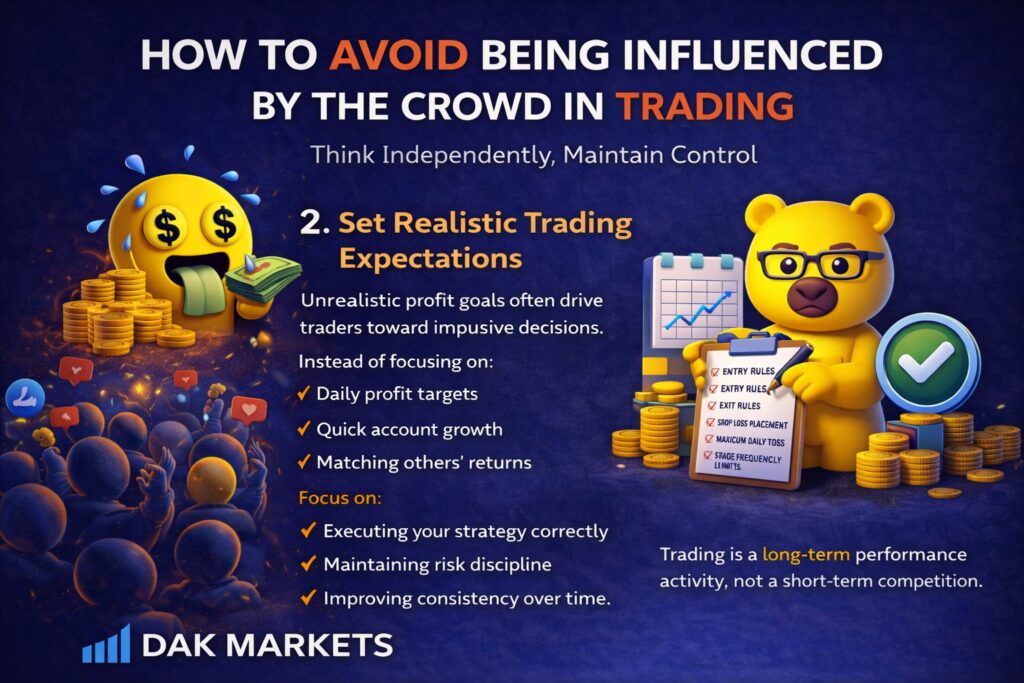
2. Set Realistic Trading Expectations
Unrealistic profit goals often drive traders toward impulsive decisions.
Instead of focusing on:
- Daily profit targets
- Quick account growth
- Matching others’ returns
Focus on:
- Executing your strategy correctly
- Maintaining risk discipline
- Improving consistency over time
Trading is a long-term performance activity, not a short-term competition.
3. Limit Social Media Exposure
If you notice that social media triggers emotional reactions, reduce exposure.
Consider:
- Unfollowing hype-driven accounts
- Setting time limits for market news
- Avoiding constant P&L comparisons
- Scheduling specific times for research
Protecting your mental clarity is part of risk management.

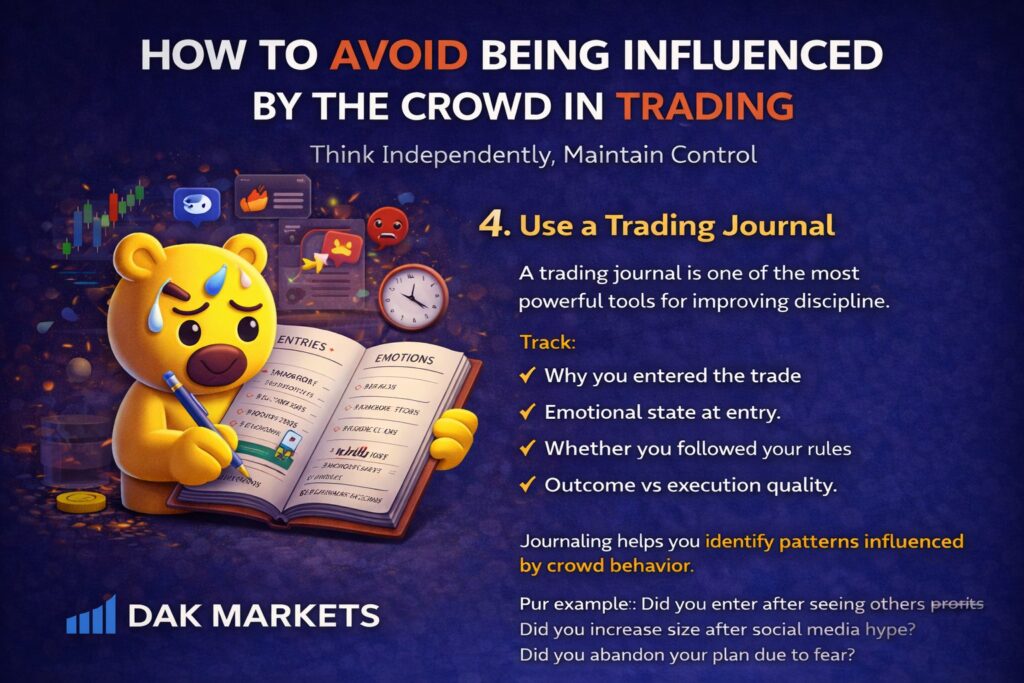
4. Use a Trading Journal
A trading journal is one of the most powerful tools for improving discipline.
Track:
- Why you entered the trade
- Emotional state at entry
- Whether you followed your rules
- Outcome vs execution quality
Journaling helps you identify patterns influenced by crowd behavior.
For example:
- Did you enter after seeing others profit?
- Did you increase size after social media hype?
- Did you abandon your plan due to fear?
Awareness reduces repetition of mistakes.
5. Focus on Personal Growth, Not Competition
Trading is not a race against other traders.
Success depends on:
- Skill development
- Emotional control
- Risk management
- Strategic consistency
Comparing yourself to others often leads to frustration.
Instead, measure progress based on:
- Improved discipline
- Reduced impulsive trades
- Better execution quality
- Controlled drawdowns
Long-term improvement beats short-term hype.

Independent Thinking Is a Competitive Advantage
Markets are driven by crowd behavior. When many traders act emotionally, price volatility increases.
Ironically, the majority often loses money.
Independent traders who:
- Stick to their strategy
- Avoid emotional reactions
- Manage risk strictly
- Filter information wisely
have a competitive edge.
Discipline creates separation from the crowd.

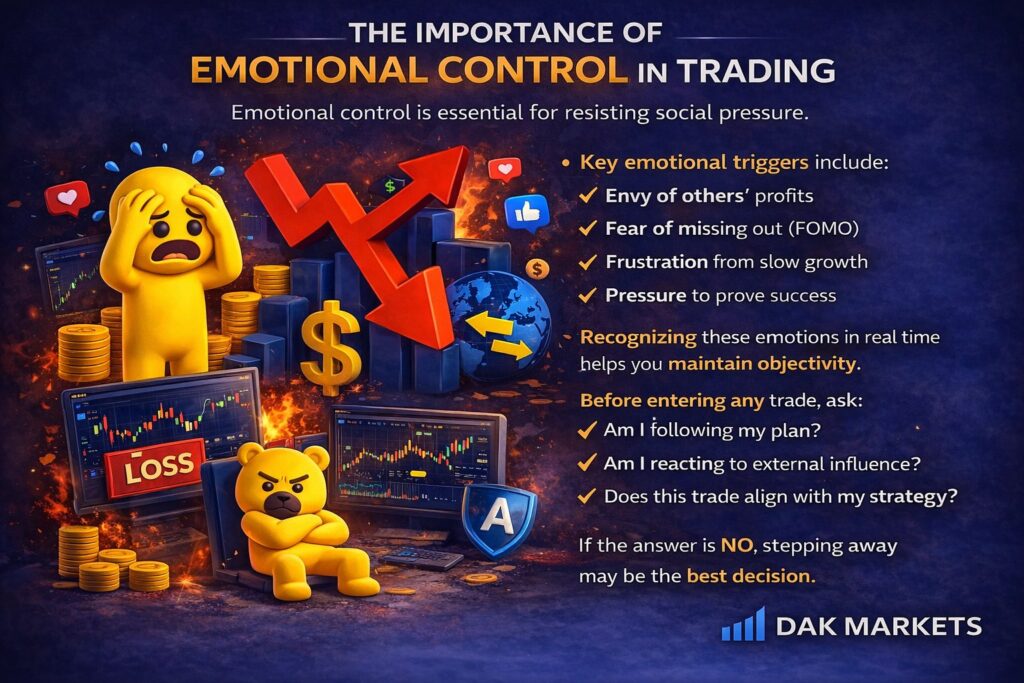
The Importance of Emotional Control in Trading
Emotional control is essential for resisting social pressure.
Key emotional triggers include:
- Envy of others’ profits
- Fear of missing out
- Frustration from slow growth
- Pressure to prove success
Recognizing these emotions in real time helps you maintain objectivity.
Before entering any trade, ask:
- Am I following my plan?
- Am I reacting to external influence?
- Does this trade align with my strategy?
If the answer is no, stepping away may be the best decision.
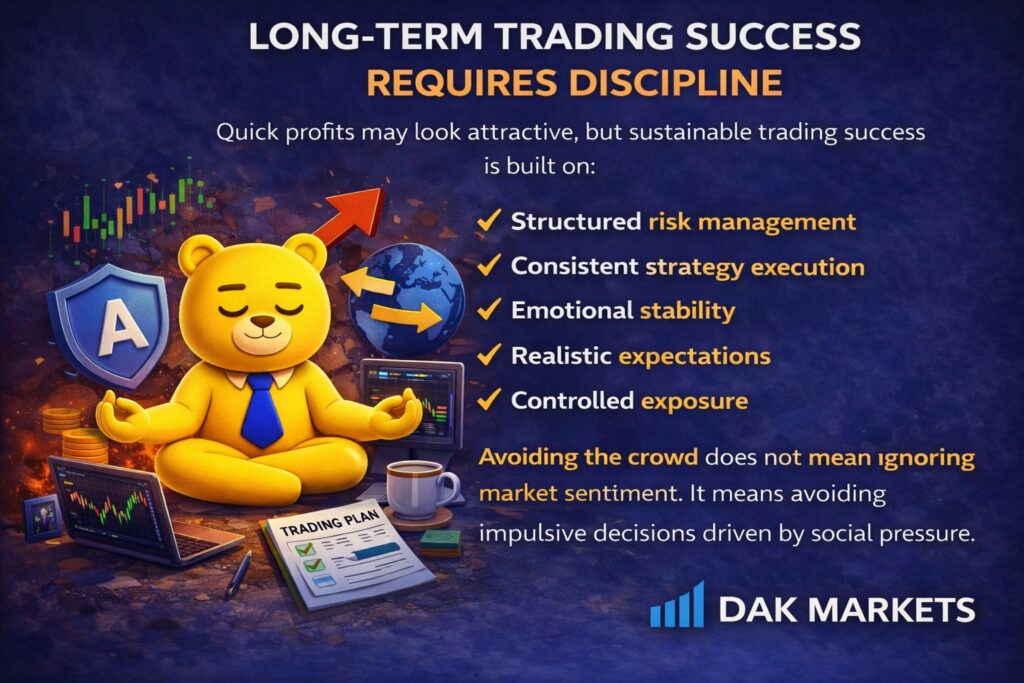
Long-Term Trading Success Requires Discipline
Quick profits may look attractive, but sustainable trading success is built on:
- Structured risk management
- Consistent strategy execution
- Emotional stability
- Realistic expectations
- Controlled exposure
Avoiding the crowd does not mean ignoring market sentiment. It means avoiding impulsive decisions driven by social pressure.
Professional traders operate with clarity, patience, and independence.
Final Thoughts: Stay Focused on Your Strategy
The trading community can be inspiring, but it can also be distracting.
If you want consistent results:
- Avoid herd mentality in trading
- Protect yourself from FOMO
- Filter information carefully
- Stick to your trading plan
- Focus on disciplined execution
The crowd will always chase trends, react emotionally, and seek quick gains.
Your advantage lies in doing the opposite.
Trading success is not about keeping up with others.
It is about mastering yourself.