Trading Psychology and Self-Esteem: How the Dunning-Kruger Effect and Impostor Syndrome Impact Your Trading Results
In the world of online trading, success is often associated with strategy, technical analysis, and risk management. However, one of the most overlooked factors influencing trading performance is self-esteem in trading psychology.
Both overconfidence and lack of confidence can significantly impact decision-making in financial markets. Two powerful psychological phenomena—the Dunning-Kruger effect and impostor syndrome in trading—can quietly sabotage even the most well-structured trading plans.
At DAK Markets, we believe that mastering trading psychology is just as important as understanding charts and indicators. In this article, we’ll explore how self-esteem affects traders, how cognitive biases influence performance, and what practical steps you can take to protect your trading capital and consistency.

Why Self-Esteem Matters in Trading
Self-esteem in trading refers to how traders perceive their own abilities, knowledge, and decision-making skills. It influences:
- Risk tolerance
- Position sizing
- Trade frequency
- Strategy confidence
- Emotional control
When self-esteem is unbalanced—either too high or too low—it leads to behavioral distortions.
Healthy self-confidence supports disciplined execution.
Unhealthy self-esteem creates impulsive or hesitant behavior.
Understanding the difference is critical for long-term profitability.

The Dunning-Kruger Effect in Trading
The Dunning-Kruger effect is a cognitive bias where individuals with limited knowledge overestimate their abilities. In trading, this phenomenon is particularly common among beginners.
How It Appears in Trading
Traders affected by the Dunning-Kruger effect may:
- Believe a few profitable trades confirm mastery
- Underestimate market complexity
- Ignore risk management principles
- Increase position sizes too quickly
- Overtrade due to excessive confidence
Early success in favorable market conditions can reinforce this false confidence. Profits may be attributed to skill rather than market momentum or luck.
This leads to dangerous behaviors such as:
- Excessive leverage
- Ignoring Stop Loss rules
- Chasing trades
- Dismissing opposing analysis
Eventually, market volatility exposes the gaps in knowledge.

Overconfidence and Overtrading
Overconfidence often results in overtrading, one of the leading causes of trading account losses.
Overtrading occurs when traders:
- Enter too many positions daily
- Trade outside their strategy
- Increase risk to “maximize” profits
- Refuse to accept losses
More trades do not equal more profits. In fact, excessive trading increases emotional fatigue and transaction costs.
Professional traders understand that selective execution is more powerful than constant activity.
At DAK Markets, we emphasize structured trading supported by disciplined risk management. Overconfidence without structure is unsustainable.

Confirmation Bias and Market Blindness
Another common issue tied to overconfidence is confirmation bias.
Confirmation bias occurs when traders seek information that supports their existing beliefs while ignoring contradictory evidence.
In trading, this can look like:
- Only reading bullish analysis when long
- Ignoring negative economic signals
- Dismissing warning signs
- Refusing to close losing trades
This psychological trap amplifies losses and distorts objective analysis.
Recognizing confirmation bias is a key step toward improving trading psychology.

Impostor Syndrome in Trading
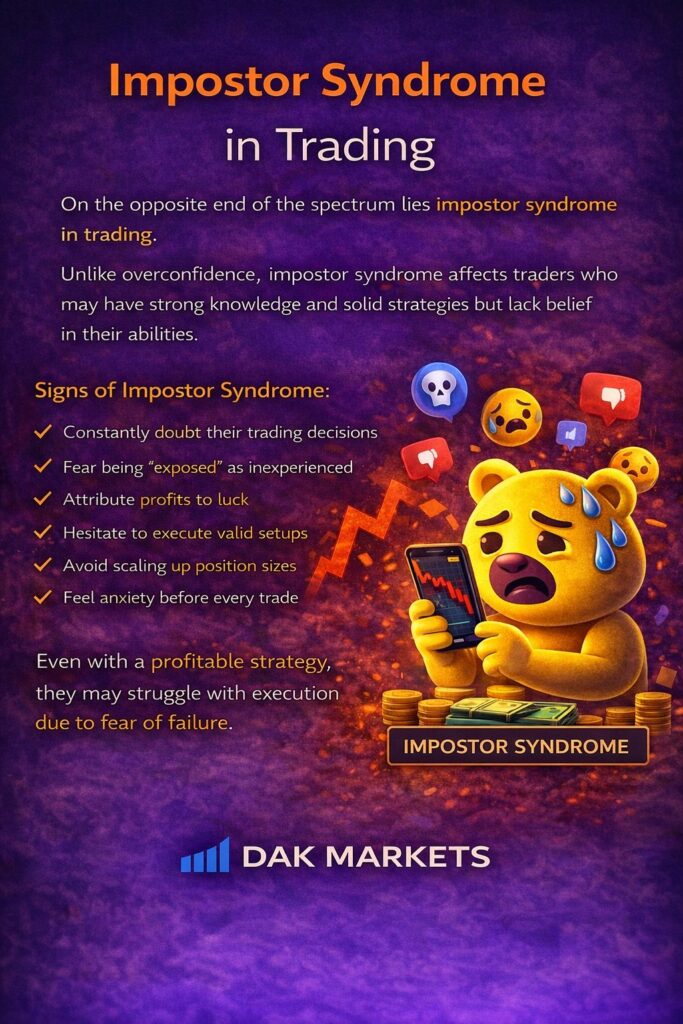
On the opposite end of the spectrum lies impostor syndrome in trading.
Unlike overconfidence, impostor syndrome affects traders who may have strong knowledge and solid strategies but lack belief in their abilities.
Signs of Impostor Syndrome
Traders experiencing impostor syndrome may:
- Constantly doubt their trading decisions
- Fear being “exposed” as inexperienced
- Attribute profits to luck
- Hesitate to execute valid setups
- Avoid scaling up position sizes
- Feel anxiety before every trade
Even with a profitable strategy, they may struggle with execution due to fear of failure.
The Emotional Cost of Self-Doubt
Impostor syndrome creates chronic stress. Traders become overly cautious, hesitant, and emotionally drained.
Common consequences include:
- Missed trading opportunities
- Paralysis during execution
- Constant strategy switching
- Over-analysis leading to inaction
- Burnout
Ironically, traders suffering from impostor syndrome may have better long-term potential than overconfident traders—but their lack of self-trust limits growth.

How Self-Esteem Distorts Risk Management
Both overconfidence and self-doubt interfere with risk management.
Overconfident Traders:
- Risk too much per trade
- Increase leverage unnecessarily
- Ignore maximum drawdown rules
Traders with Low Confidence:
- Risk too little to achieve meaningful returns
- Close trades prematurely
- Avoid valid setups
Balanced self-esteem allows traders to apply consistent position sizing and stick to predefined risk percentages.
At DAK Markets, maintaining disciplined risk exposure is essential for sustainable trading performance.

The Role of a Trading Journal in Psychological Growth
One of the most effective tools for correcting self-esteem distortions is a trading journal.
A structured journal should track:
- Entry and exit points
- Risk percentage
- Trade rationale
- Emotional state
- Post-trade reflections
Objective data helps traders separate emotion from performance.
For example:
- Overconfident traders may discover inconsistent execution patterns.
- Self-doubting traders may realize their strategy performs better than they assumed.
Data removes guesswork from self-evaluation.

Building Healthy Trading Confidence
Healthy trading confidence is built on:
- Education and skill development
- Backtesting and forward testing
- Consistent execution
- Realistic expectations
- Continuous learning
Confidence should come from preparation—not from isolated winning trades.
Likewise, self-doubt can be reduced through measurable performance analysis.

Practical Steps to Overcome Self-Esteem Biases in Trading
Here are actionable strategies to improve trading psychology:
1. Practice Self-Reflection
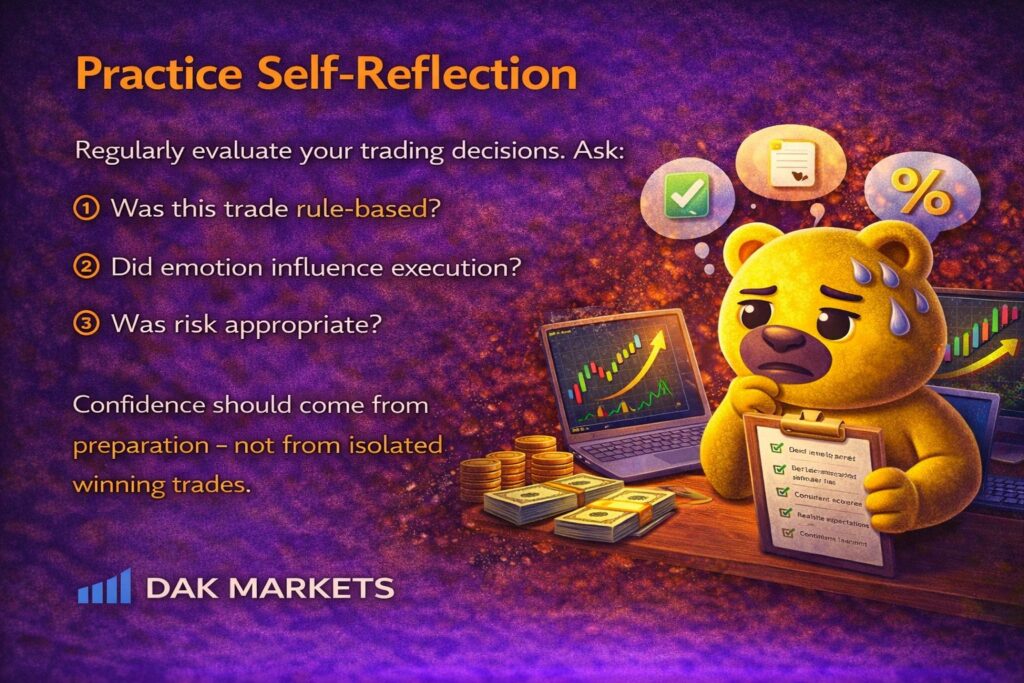
Regularly evaluate your trading decisions. Ask:
- Was this trade rule-based?
- Did emotion influence execution?
- Was risk appropriate?
2. Define Clear Risk Management Rules
Set:
- Fixed percentage risk per trade
- Daily loss limits
- Maximum drawdown thresholds
Consistency builds stability.

3. Avoid Comparing Yourself to Others
Social media comparisons distort perception. Focus on personal growth, not competition.

4. Seek Constructive Feedback
Mentorship or peer review can help identify blind spots.

5. Accept That Trading Is a Long-Term Journey
Market mastery requires patience. No trader knows everything.
As many professionals say: Trading success is a journey, not a destination.

The Importance of Continuous Learning
Financial markets evolve constantly. Strategies require refinement.
Traders who believe they know everything stop improving.
Traders who constantly doubt themselves stop executing.
The ideal mindset lies between the two extremes:
- Confident but humble
- Decisive but adaptable
- Disciplined but flexible
At DAK Markets, we encourage traders to combine technical knowledge with psychological discipline.

Final Thoughts: Find Balance in Your Trading Psychology
Self-esteem in trading can either accelerate growth or destroy accounts.
The Dunning-Kruger effect leads to overconfidence and excessive risk.
Impostor syndrome leads to hesitation and emotional exhaustion.
The solution is balanced self-awareness supported by:
- Structured risk management
- Objective journaling
- Continuous education
- Emotional discipline
Markets reward consistency, not ego.
Whether you struggle with overconfidence or self-doubt, the key is to build data-driven confidence rooted in preparation and discipline.
Master your psychology.
Control your risk.
Trade with clarity.
With the right mindset and structured approach, long-term success in the financial markets becomes achievable.