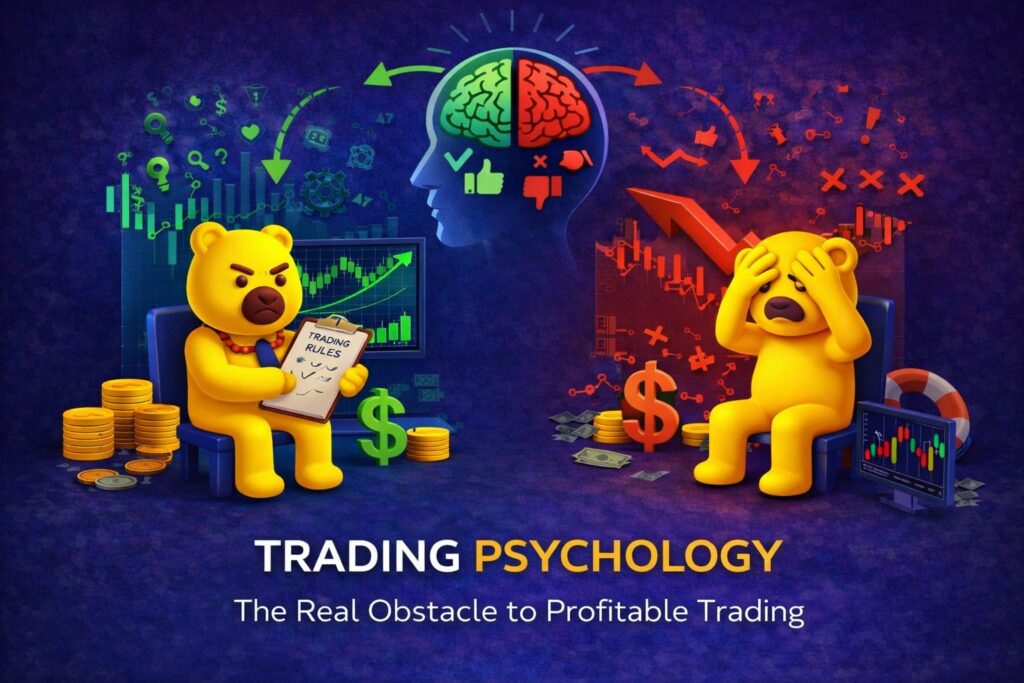
When traders think about improving their performance, they usually focus on strategy, indicators, or market analysis. They search for better entry signals, improved risk-reward ratios, or advanced trading tools.
But in reality, the biggest obstacle to consistent profitability is not the market.
It’s the mind.
At DAK Markets, we have seen that trading psychology often plays a greater role in long-term performance than technical knowledge alone. Cognitive biases, emotional reactions, and mental shortcuts silently influence trading decisions — often leading to unnecessary losses.
In this article, we’ll explore why your head can become your greatest enemy in forex and CFD trading, the most common cognitive biases affecting traders, and how to fight them effectively.
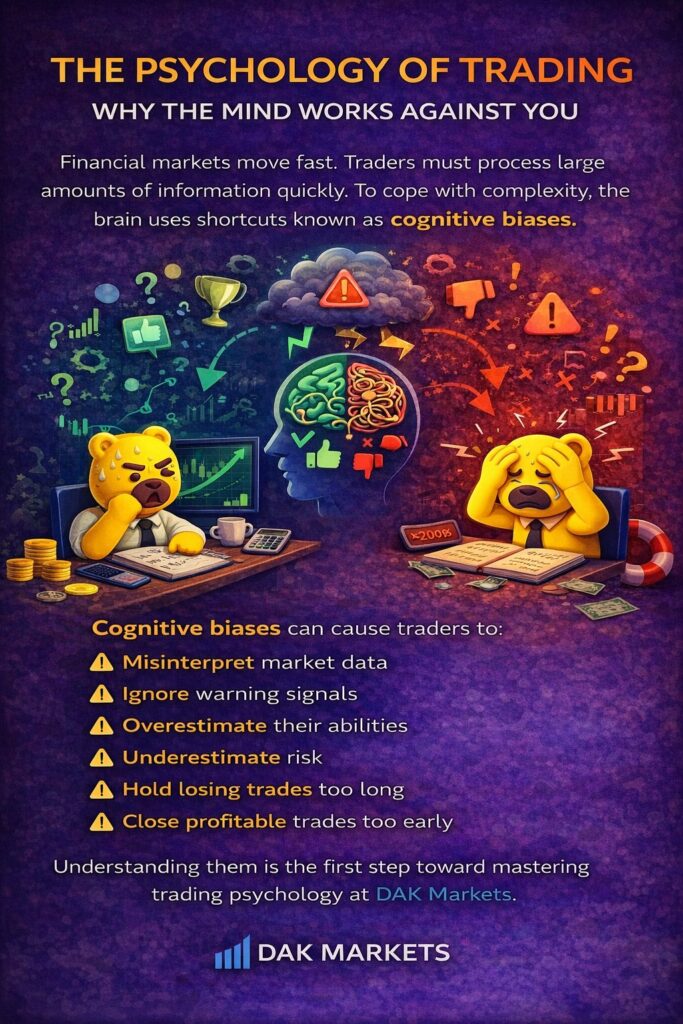
The Psychology of Trading: Why the Mind Works Against You
Financial markets move fast. Traders must process large amounts of information quickly. To cope with complexity, the brain uses shortcuts known as cognitive biases.
These mental shortcuts help us in everyday life — but in trading, they often distort reality.
Cognitive biases can cause traders to:
- Misinterpret market data
- Ignore warning signals
- Overestimate their abilities
- Underestimate risk
- Hold losing trades too long
- Close profitable trades too early
Without awareness, these biases quietly destroy trading performance.
Understanding them is the first step toward mastering trading psychology at DAK Markets.
1. Confirmation Bias in Forex Trading
One of the most dangerous psychological traps is confirmation bias.
This occurs when traders search for information that supports their existing beliefs while ignoring data that contradicts them.
For example:
- You believe EUR/USD will rise.
- You only read bullish analysis.
- You ignore bearish technical signals.
- You refuse to close the trade when momentum shifts.
Instead of objectively analyzing the market, you defend your position.
This leads to poor decision-making and increased drawdowns.

How to Fight Confirmation Bias
- Always analyze both bullish and bearish scenarios.
- Ask yourself: “What would prove me wrong?”
- Follow a structured trading plan instead of personal opinions.
- Stick to predefined Stop Loss levels.
At DAK Markets, disciplined decision-making is essential for sustainable trading success.
2. Recency Bias: Overreacting to Recent Events
Recency bias causes traders to give more importance to recent events while ignoring long-term context.
If the market has moved strongly upward for a few days, traders may assume it will continue indefinitely.
Similarly, after several losing trades, traders may believe their strategy no longer works.
This emotional reaction leads to:
- Overtrading
- Strategy switching
- Increased risk-taking
- Abandoning long-term plans
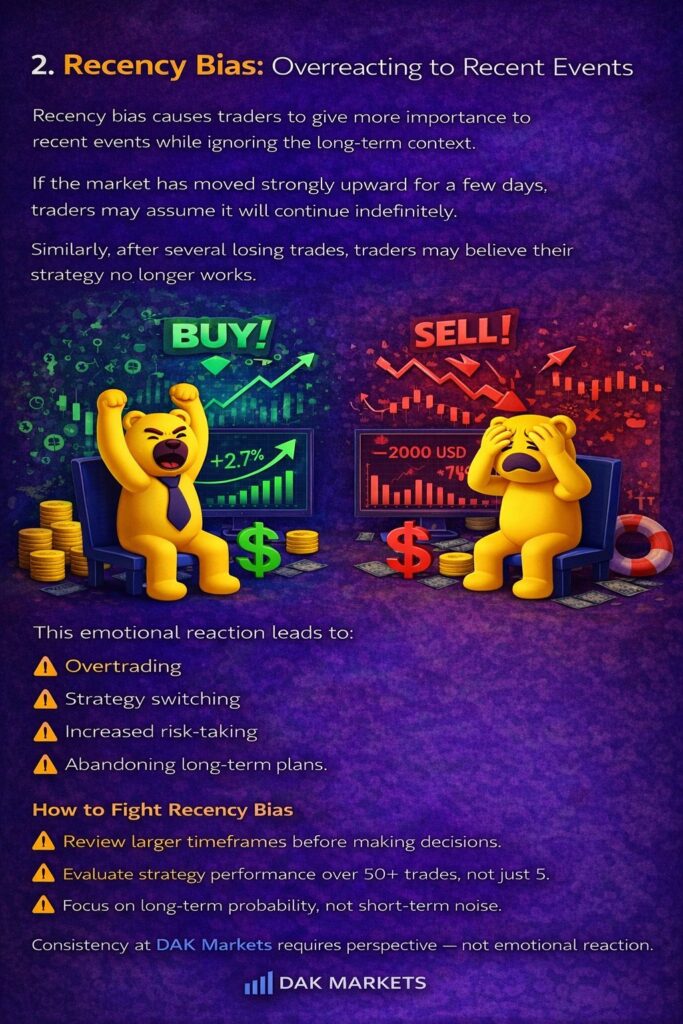
How to Fight Recency Bias
- Review larger timeframes before making decisions.
- Evaluate strategy performance over 50+ trades, not 5.
- Focus on long-term probability, not short-term noise.
Consistency at DAK Markets requires perspective — not emotional reaction.
3. Hindsight Bias: “I Knew It All Along”
Hindsight bias makes traders believe they predicted an outcome after it already happened.
After a strong move, traders may say:
- “It was obvious.”
- “I knew this would happen.”
This creates overconfidence.
The danger? Traders begin taking unnecessary risks because they believe their predictive ability is superior.
In reality, markets involve probability and uncertainty — not certainty.
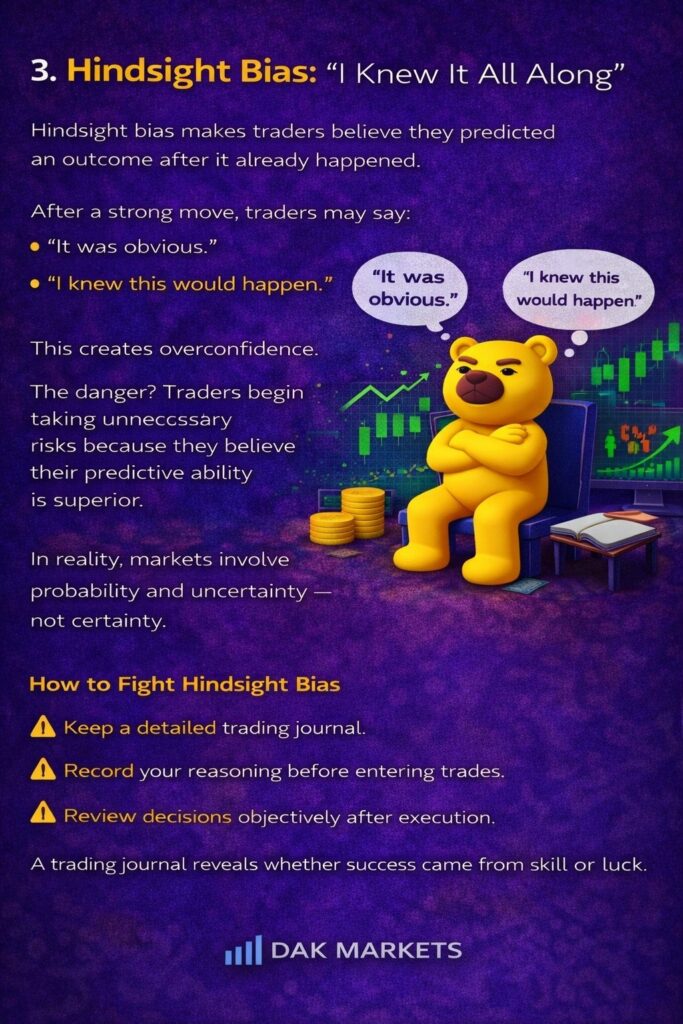
How to Fight Hindsight Bias
- Keep a detailed trading journal.
- Record your reasoning before entering trades.
- Review decisions objectively after execution.
A trading journal reveals whether success came from skill or luck.
4. Loss Aversion: The Fear of Taking Losses
Loss aversion bias makes traders fear losses more than they value gains.
This often results in:
- Holding losing trades too long
- Closing profitable trades too early
- Moving Stop Loss levels
- Avoiding valid setups due to fear
Ironically, trying to avoid losses often increases them.
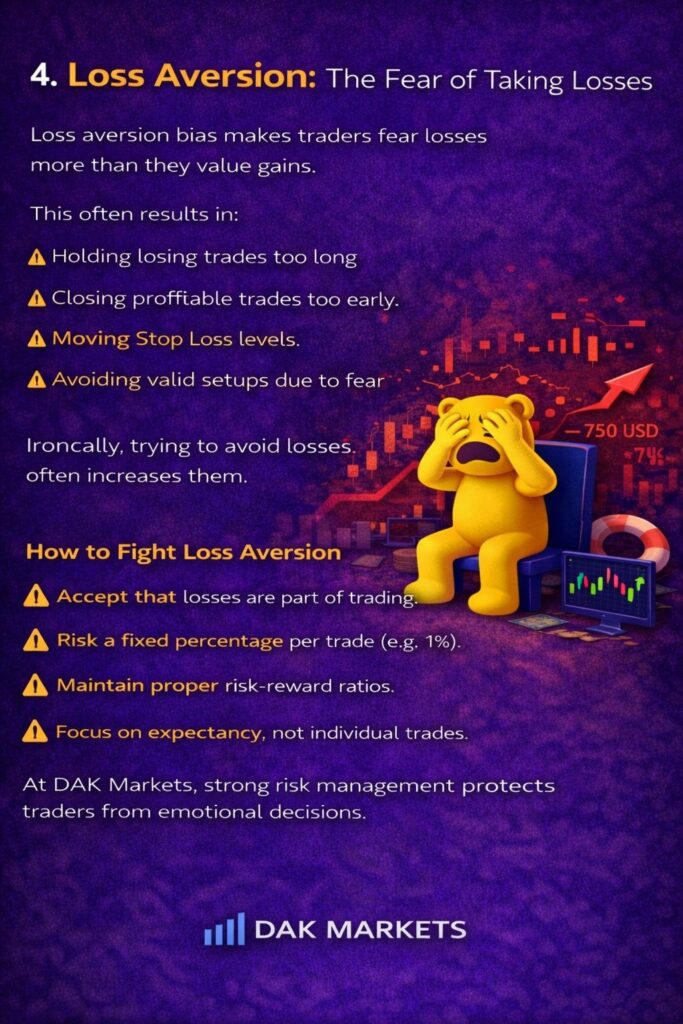
How to Fight Loss Aversion
- Accept that losses are part of trading.
- Risk a fixed percentage per trade (e.g., 1%).
- Maintain proper risk-reward ratios.
- Focus on expectancy, not individual trades.
At DAK Markets, strong risk management protects traders from emotional decisions.
5. Overconfidence Bias: The Silent Account Killer
Overconfidence bias causes traders to overestimate their skill and knowledge.
It often appears after a series of profitable trades.
Traders may:
- Increase position sizes excessively
- Ignore risk management rules
- Trade more frequently
- Abandon structured analysis
This usually leads to large drawdowns.
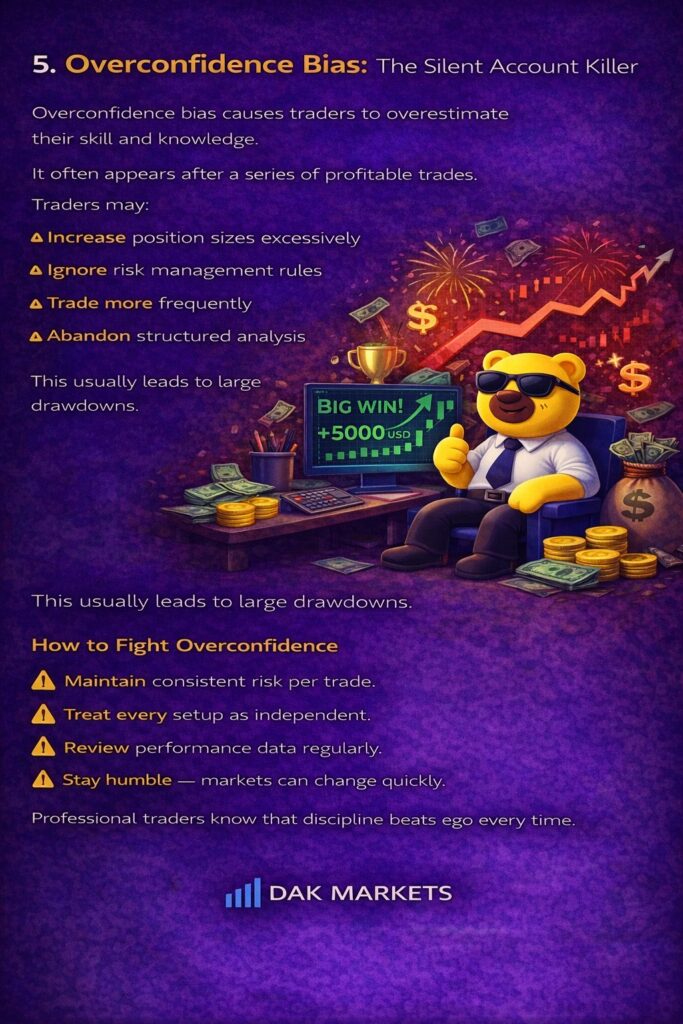
How to Fight Overconfidence
- Maintain consistent risk per trade.
- Treat every setup as independent.
- Review performance data regularly.
- Stay humble — markets can change quickly.
Professional traders know that discipline beats ego every time.
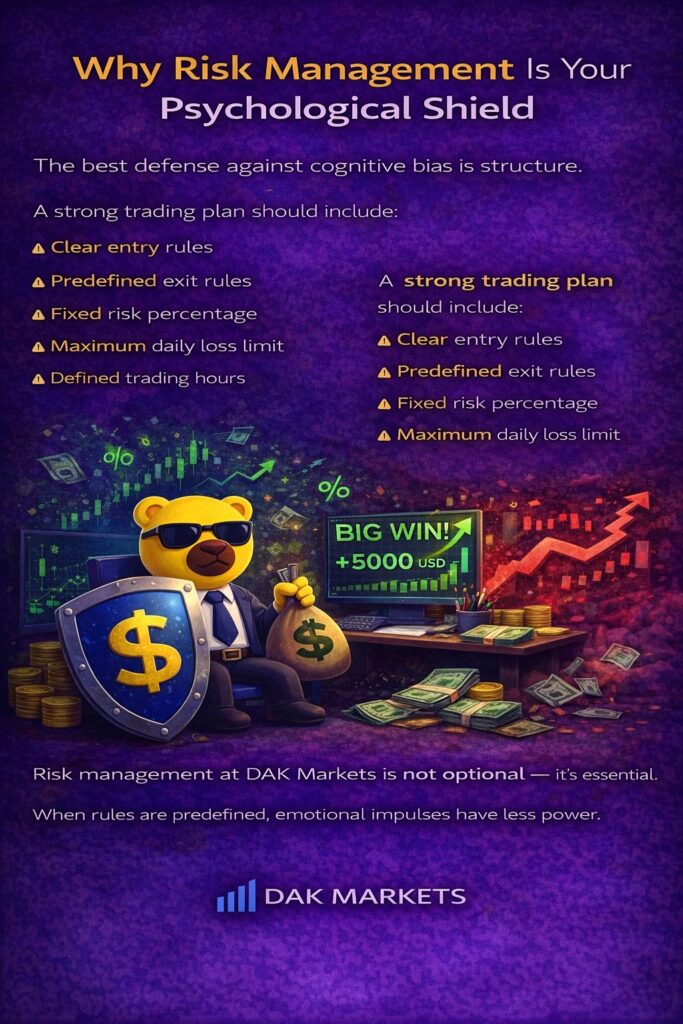
Why Risk Management Is Your Psychological Shield
The best defense against cognitive bias is structure.
A strong trading plan should include:
- Clear entry rules
- Predefined exit rules
- Fixed risk percentage
- Maximum daily loss limit
- Defined trading hours
Risk management at DAK Markets is not optional — it’s essential.
When rules are predefined, emotional impulses have less power.
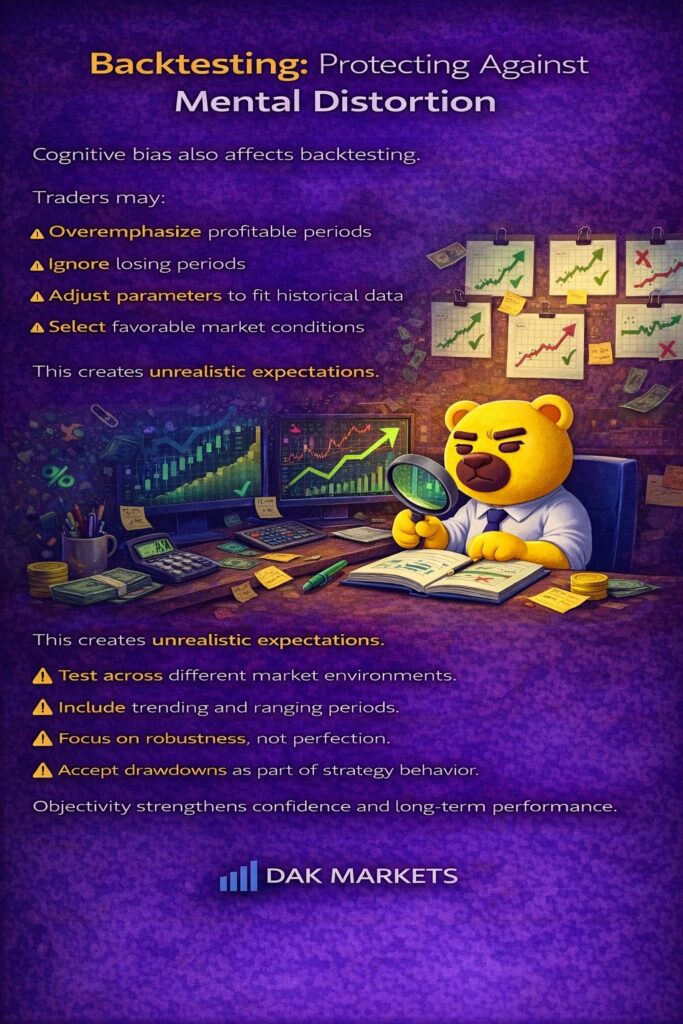
Backtesting: Protecting Against Mental Distortion
Cognitive bias also affects backtesting.
Traders may:
- Overemphasize profitable periods
- Ignore losing periods
- Adjust parameters to fit historical data
- Select favorable market conditions
This creates unrealistic expectations.
To avoid bias in backtesting:
- Test across different market environments.
- Include trending and ranging periods.
- Focus on robustness, not perfection.
- Accept drawdowns as part of strategy behavior.
Objectivity strengthens confidence and long-term performance.
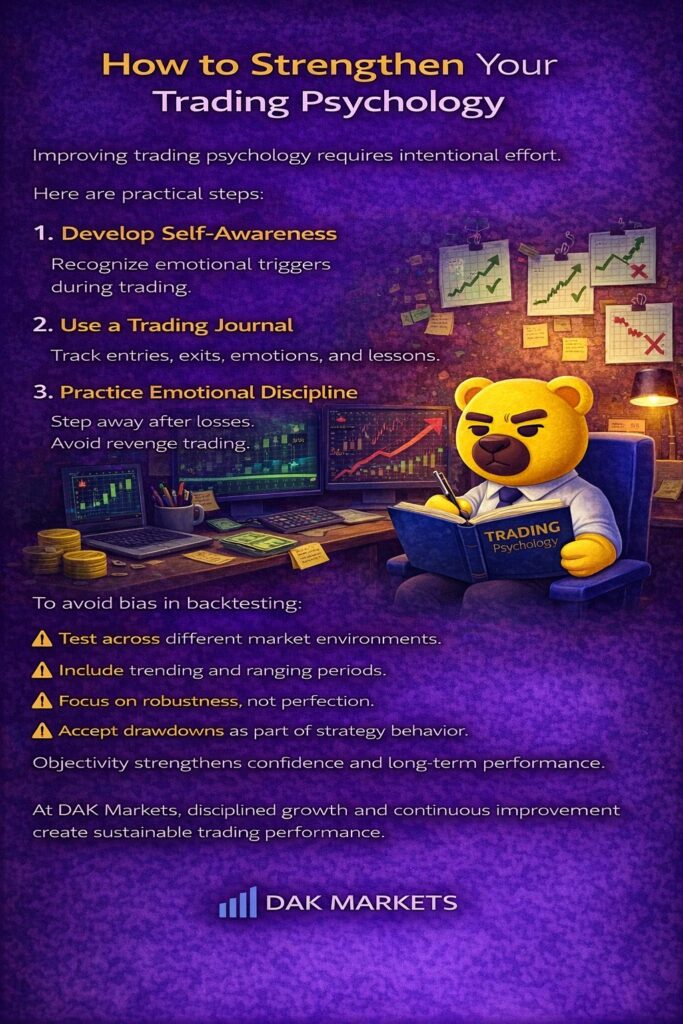
How to Strengthen Your Trading Psychology
Improving trading psychology requires intentional effort.
Here are practical steps:
1. Develop Self-Awareness
Recognize emotional triggers during trading.
2. Use a Trading Journal
Track entries, exits, emotions, and lessons.
3. Practice Emotional Discipline
Step away after losses. Avoid revenge trading.
4. Focus on Process, Not Outcome
Judge trades by rule-following — not profit.
5. Commit to Continuous Education
Market knowledge builds confidence and reduces impulsive decisions.
At DAK Markets, disciplined growth and continuous improvement create sustainable trading performance.
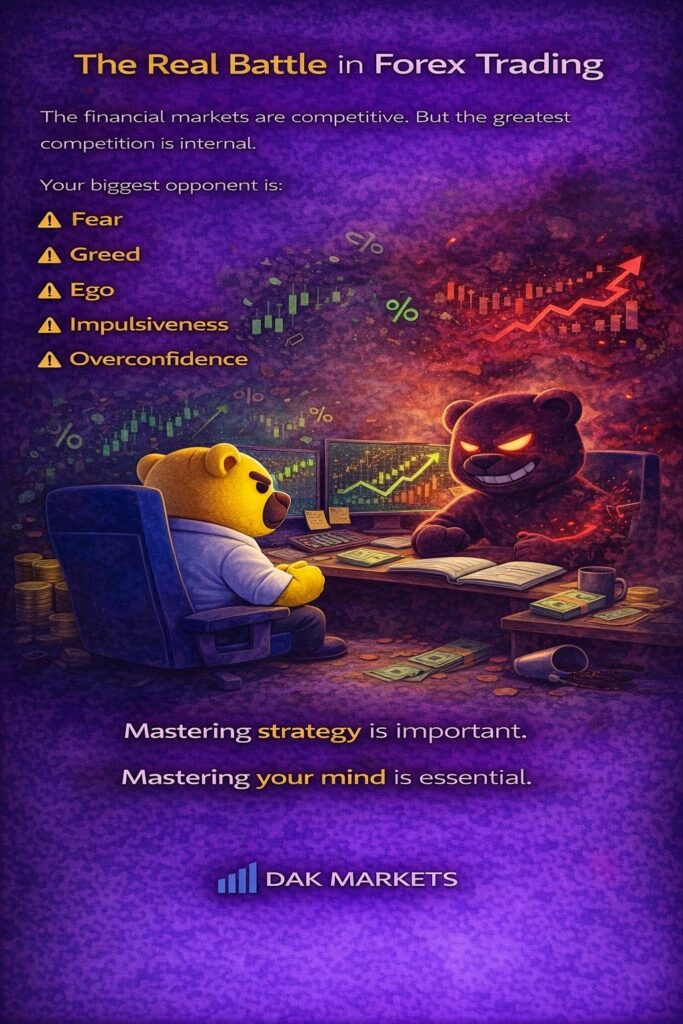
The Real Battle in Forex Trading
The financial markets are competitive. But the greatest competition is internal.
Your biggest opponent is:
- Fear
- Greed
- Ego
- Impulsiveness
- Overconfidence
Mastering strategy is important.
Mastering your mind is essential.
Final Thoughts: Control Your Mind, Improve Your Trading at DAK Markets
Trading success does not come from finding a perfect indicator.
It comes from:
- Understanding cognitive biases
- Following strict risk management
- Maintaining emotional discipline
- Staying objective under pressure
- Continuously refining your strategy
At DAK Markets, we provide traders with professional trading conditions and competitive execution. But sustainable profitability depends on your psychological strength.
Your head can be your greatest enemy —
or your strongest asset.
The choice depends on your discipline, awareness, and commitment to growth.
Trade smart.
Trade disciplined.
Trade with DAK Markets.