In the world of online trading, strategy and technical analysis often take center stage. Traders spend countless hours studying charts, indicators, and market structure. However, one of the most powerful yet underestimated tools for long-term success is self-awareness in trading.
At DAK Markets, we understand that trading psychology plays a crucial role in performance. Even the most robust trading strategy can fail if the trader lacks emotional discipline and awareness. In this article, we’ll explore what self-awareness means in trading, why it matters, and how you can use it to improve your trading consistency and results.

What Is Self-Awareness in Trading?
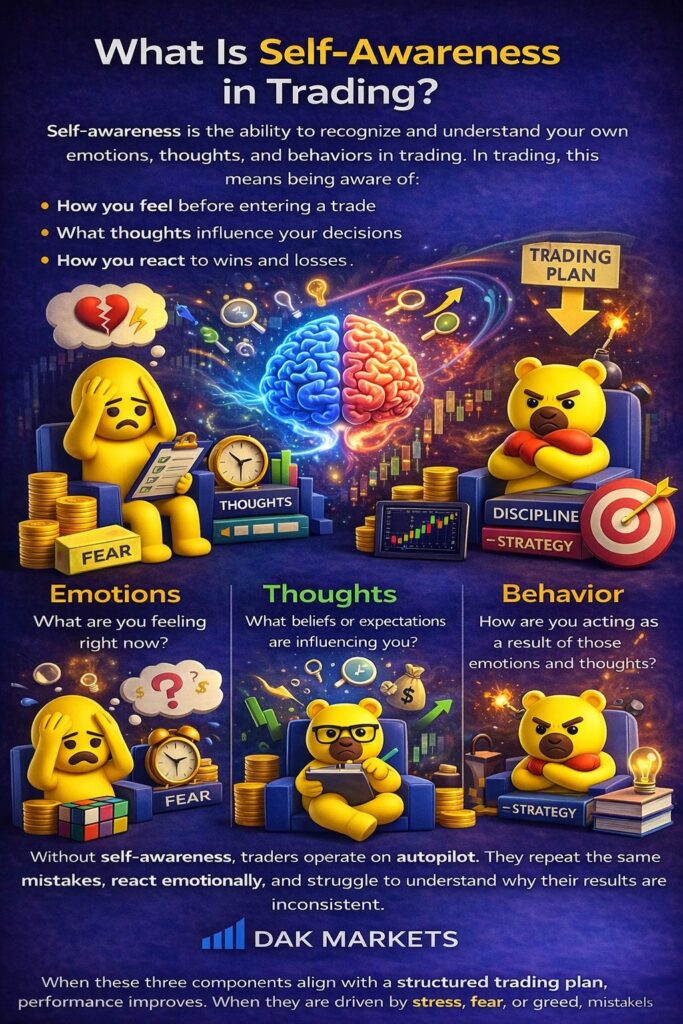
Self-awareness is the ability to recognize and understand your own emotions, thoughts, and behaviors in real time. In trading, this means being aware of:
- How you feel before entering a trade
- What thoughts influence your decisions
- How you react to wins and losses
- Whether you are following your trading plan
Without self-awareness, traders operate on autopilot. They repeat the same mistakes, react emotionally, and struggle to understand why their results are inconsistent.
Self-awareness consists of three key elements:
- Emotions – What are you feeling right now?
- Thoughts – What beliefs or expectations are influencing you?
- Behavior – How are you acting as a result of those emotions and thoughts?
When these three components align with a structured trading plan, performance improves. When they are driven by stress, fear, or greed, mistakes multiply.
Why Self-Awareness Is Critical for Trading Success
Financial markets are uncertain. Price movements are unpredictable in the short term. This uncertainty naturally triggers emotional responses.
Common emotional triggers in trading include:
- Fear of missing out (FOMO)
- Fear of losing money
- Overconfidence after a winning streak
- Frustration after consecutive losses
- Impatience during slow markets
Without awareness, traders may:
- Enter trades impulsively
- Increase position sizes irrationally
- Move Stop Loss levels
- Close trades too early
- Revenge trade
Self-awareness acts as a filter between emotion and execution. It gives traders a moment of clarity before acting.

Awareness and the Trading Environment
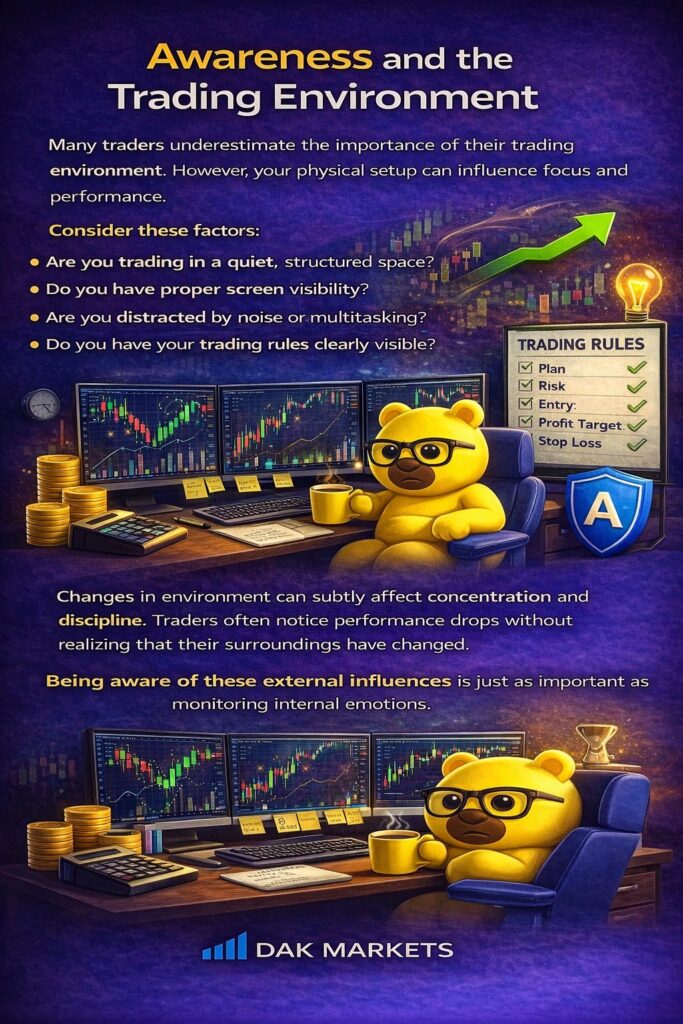
Many traders underestimate the importance of their trading environment. However, your physical setup can influence focus and performance.
Consider these factors:
- Are you trading in a quiet, structured space?
- Do you have proper screen visibility?
- Are you distracted by noise or multitasking?
- Do you have your trading rules clearly visible?
Changes in environment can subtly affect concentration and discipline. Traders often notice performance drops without realizing that their surroundings have changed.
Being aware of these external influences is just as important as monitoring internal emotions.
Observing Yourself Before You Trade
Professional traders do not just analyze the market; they analyze themselves.
Before opening a position, ask:
- Am I calm and focused?
- Am I tired or distracted?
- Is my mind clear?
- Am I following my trading plan or reacting emotionally?
If you are stressed, angry, or distracted, it may be better to step away from the market. Trading requires mental clarity.
At DAK Markets, we emphasize disciplined execution supported by structured risk management. Emotional awareness ensures that traders operate from logic rather than impulse.

Awareness During a Live Trade
The real psychological challenge begins after the trade is open.
As price moves, emotions shift:
- Price approaches Stop Loss → anxiety increases
- Price nears Take Profit → fear of reversal appears
- Trade fluctuates → doubt and second-guessing begin
These reactions are normal. The difference between professional and inconsistent traders is awareness.
Instead of reacting immediately, ask:
- What am I feeling right now?
- Is this feeling influencing my decision?
- Does my trading plan require action?
If your strategy does not signal an exit, emotional interference may harm performance.

Awareness After a Trade
Post-trade reflection is where growth happens.
After closing a position, evaluate:
- Did I follow my trading plan?
- Were my emotions controlled?
- Did I respect my risk management rules?
- What can I improve next time?
It is important to separate execution quality from trade outcome. A losing trade executed correctly is still a good trade. A profitable trade executed impulsively reinforces bad habits.
Self-awareness allows you to identify patterns in your behavior.

The Importance of a Trading Journal
One of the most effective tools for improving awareness is maintaining a detailed trading journal.
A proper trading journal should include:
- Entry and exit points
- Position size and risk percentage
- Market conditions
- Emotional state before and during the trade
- Post-trade reflections
The human brain cannot reliably remember emotional patterns over time. Writing down thoughts and feelings creates a permanent record.
By reviewing your journal weekly or monthly, you can identify:
- Recurring emotional triggers
- Impulsive behavior patterns
- Strengths in execution
- Situations where discipline weakens
Increased awareness leads to better decision-making.

How Self-Awareness Reduces Overtrading
Overtrading is a common problem among retail traders. It often stems from:
- Boredom
- Unrealistic profit expectations
- Fear of missing opportunities
- Emotional need for action
When traders become aware of these internal drivers, they can interrupt the cycle.
Instead of forcing trades, disciplined traders wait for high-probability setups that align with their strategy.
Sometimes, doing nothing is the most profitable decision.

Combining Awareness with Risk Management
Self-awareness alone is not enough. It must be combined with structured risk management.
Clear risk management rules include:
- Fixed percentage risk per trade
- Maximum daily loss limits
- Predefined Stop Loss levels
- Consistent position sizing
Risk management protects traders from emotional escalation. Awareness helps them follow those rules consistently.
At DAK Markets, our trading infrastructure supports disciplined execution with transparent order processing and stable performance conditions, allowing traders to focus on psychological consistency rather than technical concerns.

Practical Steps to Build Trading Awareness
Improving self-awareness is an ongoing process. Here are practical steps you can implement immediately:
- Pre-Trade Checklist – Create a written checklist to confirm emotional readiness before trading.
- Scheduled Breaks – Avoid trading when fatigued or emotionally charged.
- Post-Trade Reflection – Review every trade objectively.
- Daily Journaling – Document both technical and psychological aspects.
- Weekly Review Sessions – Identify recurring behavioral patterns.
Small, consistent improvements lead to significant long-term growth.

Awareness and Long-Term Trading Consistency
Many traders focus on improving technical indicators, strategies, or systems. While these are important, psychological discipline often determines success or failure.
Self-awareness helps traders:
- Stay aligned with their strategy
- Control emotional impulses
- Accept losses as part of the process
- Avoid overconfidence during winning streaks
- Learn from mistakes constructively
Consistency in trading comes from disciplined repetition. Discipline comes from awareness.

Final Thoughts
Self-awareness in trading is not optional—it is essential. Understanding your emotions, thoughts, and behaviors gives you control over your decisions in uncertain market conditions.
You cannot control market movements.
You cannot guarantee profits.
But you can control your preparation, your mindset, and your execution.
By developing awareness, maintaining a structured trading journal, and applying disciplined risk management, you build the foundation for long-term success.
At DAK Markets, we believe that professional trading combines strong infrastructure with strong psychology. Master both—and consistency becomes achievable.
Trade consciously.
Trade disciplined.
Trade with awareness.